


Tallow Tree (Stillingia Sebifera)
Description
This section is from "The American Cyclopaedia", by George Ripley And Charles A. Dana. Also available from Amazon: The New American Cyclopædia. 16 volumes complete..
Tallow Tree (Stillingia Sebifera)
Tallow Tree (Stillingia Sebifera), a Chinese tree, belonging to the spurge family (eu-pTiorbiacea?), growing from 20 to 40 ft., with long and flexible branches, and long-petioled leaves, much resembling those of the poplars, save that they are entire; the flowers are in dense terminal spikes, the upper part of which consists of sterile flowers, with a few fertile ones at the base; the fruit a small three-lobed capsule with one seed in each cell; the seeds are covered with a white tallow-like substance, which gives the tree its common name, and which the Chinese use for candles. This tree is abundantly naturalized in Georgia and South Carolina near the coast, and in Florida on the St. John's. The time and manner of its introduction do not seem to be known; Michaux in 1803 speaks of it as being in cultivation in Charleston and Savannah, and as also growing spontaneously at that time; and Elliott (1824) speaks of the abundance of the fruit, of which no use is made, though it contains much oil.
The seeds produce two oily substances: the tallow-like coating which envelops them, and an oil within the kernel itself. To obtain the first, the capsules are cracked without bruising the seeds, the shells separated, and the seeds treated with boiling water and the tallow skimmed off; after this, the seeds are crushed and pressed for their oil. The tallow when fresh is creamy white, but it becomes brown on long exposure; the Chinese convert it into candles, which receive a final dip in a mixture of the same substance with some insect wax, which gives them a hard surface and preserves their form in hot weather; the oil is used for lamps; the refuse of the process is used for fuel and for manure. The wood is hard, and is used by the Chinese to make blocks for printing. - Another species, S. sylvatica, popularly known as queen's delight, is an herb, 2 or 3 ft. high, with alternate, nearly sessile, oblong-lanceolate, serrate leaves, and a dense terminal yellowish spike of male flowers with a few fertile ones at the base; it is found in light dry soils from Virginia to Florida. The root in large doses is emetic and cathartic; in small doses it is regarded by some southern physicians as influencing the secretions, and it is useful in syphilis and skin diseases.
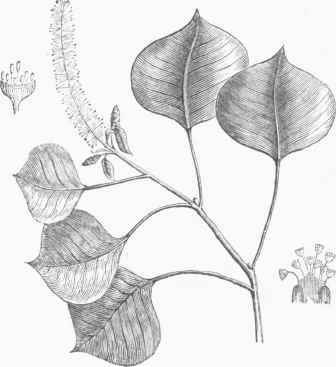
Tallow Tree (Stillingia scbifora).
Continue to:


My Books

