


Sundew
Description
This section is from "The American Cyclopaedia", by George Ripley And Charles A. Dana. Also available from Amazon: The New American Cyclopædia. 16 volumes complete..
Sundew
Sundew, the common name of plants of the genus drosera (Gr. δροσσεός, dewy), which gives its name to the droseraceoe, a small order of remarkable plants, one of which, the Venus's fly-trap, is described under DionAEa. There are about 100 species of drosera, distributed all over the world, except in some of the Pacific islands; they are perennials, and either stemless, with a rosette of leaves rising from the rhizome, or have steins with alternate leaves; with a few rare exceptions, the leaves bear numerous bristles or hairs, each of which exudes a drop of clear glutinous fluid; this exudation of the hairs, which glistens like dew drops, is recognized in the common and botanical names. Six species are found within the limits of the United States; they are all stemless, with the leaves circinate in the bud (i. e., rolled up from the apex downward), all in a tuft at the base, from the centre of which rises a naked scape bearing the flowers at the top in a one-sided raceme, the undeveloped apex of which droops, leaving the open flower apparently the highest.
The white or rose-colored flowers, which open only in sunshine, have in our species their parts mostly in fives, the calyx and corolla withering and remaining in fruit; the globular ovary has three or five styles, so deeply cleft as to appear like six or ten, and ripening into a one-celled, three-valved capsule containing numerous seeds, with a pitted surface. All are found in bogs or wet sands, some very rare and others widely distributed. The most common is the round-leaved sundew (D, rotundifolia), which extends from Canada to Florida; its leaves, 1 to 2 in. long, and spreading upon the ground, have an orbicular blade narrowing abruptly into a petiole; the scapes, 6 in. or more high, bear white flowers with their parts sometimes in sixes. The long-leaved (D.longifolia), less frequent, but with a similar range, often grows in the water, when its caudex is several inches long: the leaves, more or less erect, have an oblong blade which tapers gradually into the petiole, and are from 1½ to 4 in. long; scape and flowers similar to the preceding.
Both of these species are also natives of Europe, the first named extending from northern Spain to the arctic regions and throughout Russian Asia. The short-leaved (D. brevifolia) has wedge-shaped leaves only ½ in. long, and white flowers on a scape 3 in. or more high; this and D. capil laris, formerly regarded as a long-leaved variety of it, are found only from Florida to North Carolina. The slender sundew (D. linearis) is our most local species, being found along Lake Superior and in a few other localities further west; its narrowly linear leaves are 4 to 6 in. long, the blade barely 1/6 in. wide; the scape, at first shorter than the leaves, but at length longer, has white flowers. The thread-leaved sundew (D. filifolia) occurs in wet sand along the coast, from Plymouth, Mass., to Florida; it has a bulb-like base or corm, from which rise the singular threadlike leaves, from 6 to 12, and sometimes 18 in. long, in which there is no distinction between blade and petiole, having the upper surface somewhat convex; the scapes, which are a little longer than the leaves, bear handsome rose-purple flowers more than half an inch across. - It was long known in a general way that numerous small insects were caught by coming in contact with these viscid glands, and about 1860 it was discovered that this was not accidental, but that the leaves were especially adapted to the work, and that though their motions are much slower than those of the related dionoea, they are none the less effective, and the droseras now rank among the plants which catch and digest insects for their own nourishment.
Darwin, in his recent work on "Insectivorous Plants" (1875), gives in great detail the investigations of himself and others upon droseras and a few other genera, but two thirds of the work is devoted to drosera rotundifolia alone. The upper surface of the leaf is thickly studded with the glandular hairs already mentioned, to which Darwin gives the name of tentacles; the average number of these on 31 leaves was found to be 192; thoso on the central part of the leaf arc short and erect, with green pedicels; toward the margin they are larger, inclined outward, and have purple pedicels; those upon the extreme margin project on the same plane with the leaf, and are commonly reflexed, while a few which spring from the top of the petiole are the largest of all, some being ¼ in. long; each tentacle consists of a straight, hairlike pedicel or stalk, consisting of several rows of elongated cells filled with a purple fluid; the gland at the apex is mostly oval and complex, and secretes a colorless and extremely viscid matter, which may be drawn out into long threads.
If a small object, organic or inorganic, be placed on the centre of the leaf, the tentacles nearest it begin to bend toward it; this impulse is transmitted to those further off, until all, including the marginal ones, are closely inflected over the object, a process requiring from one to four or live hours. In case an insect alights upon or touches one of these glands, it is held by the secretion, and in its struggles comes in contact with other glands, which hold it until the tentacles can fold over it one by one and completely imprison it. The insects thus caught are actually digested, and the nutritive material absorbed to contribute to the growth of the plant; it is found that the secretion from these glands or tentacles has a digestive power closely resembling that of the gastric juice of animals, acting even upon cartilage and the fibrous substance of bone. Experiments with several other species of drosera show that, though the leaves vary greatly in shape and appearance from those of D. rotundifolia, they differ but little in their functions.
Some of the curious results obtained by Mrs. Treat with our thread-leaved sundew are given in the article Ixsec-tivoeous Plants.
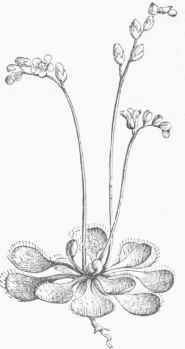
Round-leavcd Sundew (Drosera rotundifolia).
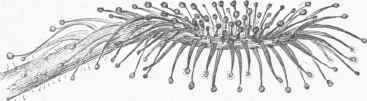
Leaf of Hound-leaved Sundew, viewed laterally. (Magnified four times).
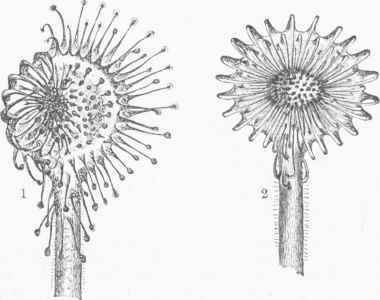
Hound-leaved Sundew, seen from above. 1. Tentacles partly inflected. 2. Tentacles entirely inflected.
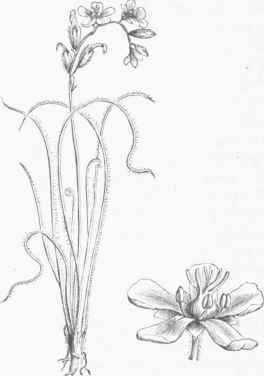
Thread-leaved Sundew (Drosera filiformis).
Continue to:


My Books

