


Solomon's Seal
Description
This section is from "The American Cyclopaedia", by George Ripley And Charles A. Dana. Also available from Amazon: The New American Cyclopædia. 16 volumes complete..
Solomon's Seal
Solomon's Seal, the common name for species of polygonatum (Gr .noxvg , many, and yovu, knee, the'stems having numerous joints), a genus of the lily family, closely related to asparagus, and having thick, knotted, horizontal rootstocks, which show upon their upper surface deep scars left by the falling away of the stems of previous years, a character which gave rise to the popular name. Each rootstock bears a single leafy stem; in front of it is a bud to continue the growth another year, and behind it are the scars of former stems; the stems, 1 to 4 ft. high, are gracefully curved, and clothed with nearly sessile or half clasping, strongly nerved leaves, from the axils of which appear the drooping greenish flowers; the perianth is cylindrical, six-lobed at the summit, with six stamens inserted near the middle of the tube; the three-celled ovary ripens to a globular black or blue berry with two to six seeds. The great Solomon's seal (P. giganteum) and the smaller (P. biflorum) are common species, while the remaining one, the broad-leaved (P. latifolium), is very local. Several species are found in Europe, which were formerly used medicinally, and ours have a reputed value as diuretics.
The young shoots are cooked and eaten in Turkey like asparagus, and the roots, which contain a considerable quantity of starch, have been used in Europe as food in times of scarcity. They are interesting but not showy garden plants. Species of the related genus smilacina are called falso Solomon's seal; they have their flowers in terminal racemes, and mostly red berries.
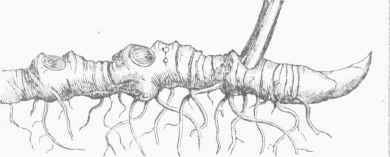
Solomon's Seal. Rhizome, showing stem, bud, and scars of former stems.
Continue to:


My Books

