


Sole
Description
This section is from "The American Cyclopaedia", by George Ripley And Charles A. Dana. Also available from Amazon: The New American Cyclopædia. 16 volumes complete..
Sole
Sole (solea, Cuv.), a genus of soft-rayed flat fishes of the family pleuronectidoe. (See Flounder.) The genus has the jaws concealed under the scaly skin, the upper rounded and longest; the eyes are both on the right side, small, the lower behind the upper and almost at the. angle of the mouth; the mouth is curved, and turned almost wholly to the left side, and the fine and villiform teeth are nearly all on this side; the snout is in advance of the mouth; the lateral line straight; branchial openings below the small pectorals; dorsal and anal very long, often confluent with the caudal; no air bladder, and no pancreatic caeca, and the intestine long and often doubled; the blind side is sometimes furnished with shred-like villi. The common sole (S. vulgaris, Cuv.) has the body more elongated than in most flat fishes, with a blunt and rounded muzzle; the length is from 10 to 20 in., and the color uniform dark brown above and white below, the pectorals tipped with black. It inhabits the sandy shores of Great Britain, keeping near the bottom, feeding on the spawn and fry of other fishes and on shell fish; it is found from the seas of Scandinavia to the Mediterranean. It is one of the best and most delicate fishes for the table, and is caught in immense numbers by trawl nets; the flesh is white and firm, and is in good condition all the year except in February and March, when they are spawning.
Some are found reversed, or with the eyes and colored surface on the left side, and a few .are dark and rough on both sides. In the genus achirus (Lac.) there are no pectorals; species are found in the Indian seas, with the upper parts marbled with brown and lighter. The New York sole (A. mollis, Mitch.) is 6 to 8 in. long, dark brown, marked transversely with irregular black bands, and has small scales; it is found from Nantucket to North Carolina.
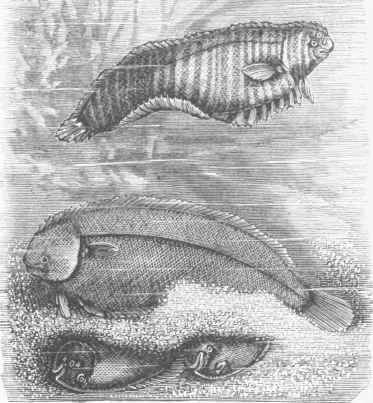
Common Sole (Solea vulgaris).
Continue to:


My Books

