


Shoe
Description
This section is from "The American Cyclopaedia", by George Ripley And Charles A. Dana. Also available from Amazon: The New American Cyclopædia. 16 volumes complete..
Shoe
Shoe, a covering for the foot, commonly made of leather. If furnished with a top for enclosing the lower part of the leg, it is called a boot. The oldest form is that of the sandal, a flat sole to be worn under the foot, and secured to it by thongs in various ways, as shown in the accompanying illustration. The ancient Egyptians made sandals of leather, and others for the priests of palm leaves and papyrus. Specimens from their tombs are preserved in the British museum, formed of strips of palm leaf nicely fitted together and furnished with bands of the stem of the papyrus. The Hebrews used similar protections for the feet, sometimes formed of linen and of wood, while those for soldiers were of brass or iron. Among the ancient Greeks and Romans the use of shoes was not general. Spartan youths were trained to go barefoot, and the heroes of Homer are usually described as without shoes when armed for battle. Greek women, however, wore shoes, and their use finally became universal. There was great diversity in their fashion, and the several sorts were named from the person who introduced them or from the place whence they came; as the "shoes of Al-cibiades," "Persian," "Cretan," "Athenian shoes," etc.
The Spartans wore red shoes, and the same were put on by the chief magistrates of Rome on ceremonial occasions. The calceus was like modern shoes in form, covering the whole foot, and tied with latchets or strings. Those of senators and patricians were high like buskins, ornamented with an ivory crescent, and called calcei lunati. Some were made with tops, and of all lengths, even to covering the whole leg; these were called calceamenta and cothurni. The tops were often of the skins of wild animals, lacing up in front, and ornamented at the upper extremity with the paws and heads arranged in a flap that turned over. The skin was dyed purple or some other bright color, and the shoes were variously ornamented with imitations of jewels, and sometimes with cameos. It was common to make them open at the toe, so that this part of the foot was left exposed. - Wooden shoes were in common use throughout Europe in the 9th and 10th centuries, and were worn even by the first princes; but sometimes highly ornamented leather sandals or shoes were worn. Great attention was directed in the middle ages to this portion of the dress, as well as to the covering for the head (see Hat), and equal extravagances were adopted in both articles.
The shoes were worn of different colors, and the stockings also were unlike each other, and of different colors from either of the shoes. In the reign of William Rufus a famous beau, Robert, surnamed the Horned, introduced shoes with long-pointed toes twisted like a ram's horn. Though strongly inveighed against, the style became fashionable, and in the reign of Richard II. the points had increased to such an extent that they reached the knee, to which they were secured by chains of silver or gold. The upper parts were cut to imitate the windows of a church, and the whole was made extravagantly conspicuous. For three centuries the clergy, popes, and public officers sought in vain by declamations, bulls, and orders to break up the fashion. By act of parliament in 1463 shoemakers were prohibited from making for the "unprivileged classes" any shoes with points more than 2 in. long; and afterward excommunication was denounced against any person wearing such. The extravagant taste was then directed to the width of the toe, till at last Queen Mary was impelled to restrict this by proclamation to 6 in. In the 16th century shoes were made of elegant buff-colored Spanish leather, with tops of enormous dimensions spreading over so widely as to obstruct the movement of the feet.
The Puritans wore such boot tops, and after the restoration of Charles II. the French custom was introduced of ornamenting the upper edge with lace. The present simple form of shoe was adopted in the early part of the 17th century, and in the latter portion of the same the shoe buckle began to be used. During the succeeding century this continued to be very conspicuous, and so many were dependent upon its manufacture in England that, when it began to be unfashionable in the commencement of the present century, the prince of Wales sought to keep up the custom for the sake of the buckle makers. Shoes worn by ladies in the last century were sometimes very elaborate and costly, made of bright-colored silk, ornamented with gold or silver stars and binding of different colored silks from the shoe itself. Of all the diversities of shoes worn by various nations, none are so strange and unnatural as the slippers of the Chinese ladies of rank. From childhood the growth of their feet is checked by bandages at the cost of extreme suffering. They are thus enabled to wear shoes only 3 or 4 in. long, which are most unquestionable evidences of their high rank. The shoes are of silk beautifully embroidered with designs in gold and silver thread and colored silks.
In European countries wooden shoes (Fr. sabots) are in very general use among the peasantry; they are cheap and durable, and, though clumsy, are said to be comfortable. In this country an attempt to manufacture wooden shoes was made on a large scale in 1863, but the market Was found to be limited, and very few are now made. - In the manufacture of shoes the highest perfection has been attained in the United States, due chiefly to the ingenuity and enterprise of the mechanics of Massachusetts. In Lynn the making of women's shoes had been a prominent industry almost from its first settlement. The business was conducted by the families of the manufacturers, and with no especial skill until the settlement there in 1750 of a Welsh shoemaker named John Adam Dagyr. By his superior workmanship he acquired great fame in the trade, and materially improved the style of the work in that region. During the revolutionary war Massachusetts supplied great quantities of shoes for the army; but soon after its close the business was seriously checked by large importations. In Lynn however it revived, so that in 1788 its exports of women's shoes were 100,000 pairs.
In 1795 200 master workmen were employed there, besides 600 journeymen and apprentices; and about 300,000 pairs of shoes were sent away, chiefly to southern markets. From the cities some were exported to Europe, and also direct from Lynn. The business continued steadily to increase, until it amounted in 1874 to a production estimated at about 11,000,000 pairs, of the total value of $14,000,000, and giving employment in the busy seasons to more than 10,000 operatives. The work is not continuous, there being about three months of the year when most of the operatives are idle or engaged in other pursuits. The shoes produced in Lynn are nearly all for women, misses, and children, the uppers of which are largely of lasting or serge, though a considerable quantity are of morocco, kid, and grain leather. Men's shoes are also made to some extent of calf and serge. Lynn work is distinctively known in the trade as embracing all the lighter grades to be found in the ordinary retail shoe stores, and it is made to sell at the lowest prices for which a light and cheap shoe can be produced. It is all "sewed" work, and for the greater part the bottoms are put on by the McKay machine, which sews through the outsole, insole, and upper.
All those not so bottomed are known as "turns," or shoes in the making of which the sole is attached with the shoe wrong side out, after which it is turned and lasted in finishing. A large portion of these shoes are made by hand, the work being done out of the shops in families in Lynn and vicinity; but there are two well known machines, the Goodyear and the McKay, for sewing bottoms on "turn" shoes. Next in importance to Lynn, among the shoe manufacturing towns of Massachusetts, is Haverhill, where a generally better quality of shoes is made, including both sewed and pegged work of every kind. Next come Marblehead, Worcester, Marlboro, Milford, the Abingtons, Spencer, the Bridgewaters, Brockton, the Wey-mouths, North and South Braintree, Brook-field, Beverly, Medway, Randolph, Stoughton, Danvers, Quincy, and several other places. In Maine and New Hampshire there is also an important shoe manufacturing industry, which is principally carried on at Portland, Auburn, and Lewiston, Me., and at Dover and Farmington, N. H. The business of buying the materials which enter into these goods and selling the productions is nearly all done in Boston, whose merchants are the principal owners of all the largest factories.
There are no returns by which the exact production can be definitely ascertained; but about three fourths of the goods made in the shoe towns of eastern Massachusetts, as well as some from Maine and New Hampshire, are shipped from Boston, and these shipments have been as follows for 10 years: 1865, 720,000 cases; 1866, 820,000; 1867, 920,000; 1868, 1,010,000; 1869, 1,340,000; 1870, 1,260,000; 1871, 1,310,-000; 1872, 1,450,000; 1873, 1,340,000; 1874, 1,375,000. A case of women's or children's shoes regularly contains 60 pairs, and of men's boots 12 pairs are packed to a case; it is therefore probably below rather than above the actual amount to estimate the total shipments from Boston to places outside of New England for the year 1874 at 55,000,000 pairs. There is a very wide difference in the prices, as the goods comprise everything from a carpet slipper to a farmer's brogan, from a gentleman's fine calfskin boot to a miner's iron-clad shoe. But on an average they sell for about $45 a case, making a total for the reported shipments for 1874 from Boston of $61,875,-000. By a careful estimate, the value of the boots and shoes made in Massachusetts and the shoe towns of Maine and New Hampshire is placed at $100,000,000 per annum.
While Boston is the leading wholesale shoe market of the United States, New York is entitled to the next place in importance as the distributing point for a great portion of the country, and for the manufacture of what are known as fine goods. Its work is the very best made in the country, and surpasses any factory-made boots and shoes in the world. In these goods only the best grades of French and German calf and kid skins, and the best morocco of domestic manufacture, with oak-tanned sole leather, are used. The work for ladies, misses, and children is nearly all machine-sewed, but of the best men's work a large proportion is made by hand. The production in the city of New York in 1874 amounted to about 3,000,-000 pairs, of an estimated value of $10,000,-000. Next to New York may be classed Philadelphia, after which come Baltimore, Chicago, Cincinnati, St. Louis, and many smaller places throughout the Union. The imports of boots and shoes into the United States are insignificant, those entered at New York for 1874 having an aggregate value of only $41,270. The exports for the same year from New York were $202,593, almost entirely to the West Indies and Central America. The total exports from the United States for 1874 were 302,218 pairs, valued at $448,138; for 1873, 215,308 pairs, valued at $351,318. - Excepting possibly England, no other country in the world is so generally supplied with factory-made shoes as the United States. Throughout Europe the cobbler and the journeyman shoemaker still do a large part of the business.
In England the factory system, with very much the same machinery and a similar division of labor as in the United States, supplies by far the greater part of the shoes called for by the British home trade, and its vast demand for export to all quarters of the globe. The manufacture of boots and shoes in England is principally carried on at Leeds and in its vicinity, in the northern part of the kingdom, and at Northampton, as well as in the city of London. - It would require a volume to give a full list of all the boot and shoe machinery made, with even brief mention of the uses of the different kinds. The pegging machine, one of the most important, is principally due to Alpheus C. Gallahue, to whom were granted six different patents, the first in 1851. Elmer Townsend and B. F. Sturtevant, of Boston, largely aided in perfecting the invention of Gallahue; but it was not until about 1858-'60 that it came to be generally introduced. There were 1,700 pegging machines in operation in the United States in 1873. A machine is capable of pegging two pairs of women's shoes in a minute, and will put in one, two, or three rows of pegs at once, as may be required.
The pegs are cut, by the working of the machine, from ribbon-like strips of white birch, which are supplied in rolls of from 75 to 150 ft. in length. About 1,000 cords of wood are required yearly for the manufacture of pegs in this country, but large quantities are regularly exported. Of equal importance with the pegging machine is the McKay sole-sewing machine, known in England and on the continent of Europe as the "Blake" machine. It was invented about 1858 by Lyman R. Blake, but was perfected and introduced into use by Gordon McKay. By this machine the soles can be sewed on nearly 100 pairs of women's shoes in an hour, and 800 pairs in a day of ten hours is fair work for an experienced operator. A royalty payable in stamps is required on all goods made on this machine, as follows: on slippers and misses' and youths' shoes, 1 ct. a pair; women's and boys' shoes, 2 cts.; men's boots, 3 cts. The income of the McKay machine association from the sale of stamps has been as follows: 1863, $38,746 51; 1864, $99,157 63; 1865, $150,-776 15; 1866, $181,404 97; 1867, $210,225 36; 1868, $286,011 93; 1869, $356,026 06; 1870, $400,011 08; 1871, $486,083 09; 1872, $564,-501 22; 1873, $529,973 81. This machine is in such general use that a statement of the number of machines employed in different localities will give a very fair general idea of the distribution of the manufacture.
In 1874 there were 1,200 of them in use in the United States, over 400 in England, and about 100 on the continent of Europe. Of those in the United States, 180 were employed in Lynn, 50 in Haverhill, 300 in the state of Massachusetts outside of these two places, 180 in the other New England states, 100 in New York, 90 in Philadelphia, 150 in the western states, and 130 in the southern. There are two other kinds of sole-sewing machines, viz.: the Goodyear welt machine, which makes a shoe in almost perfect imitation of hand work, and the Goodyear and McKay machines for making "turns".

Fig. 1. - Sandals. 1. Foot of Statue of Elpis, in the Vati-ican. 2. Female Foot with simple Sandal. 3. Foot of Apollo Belvedere.
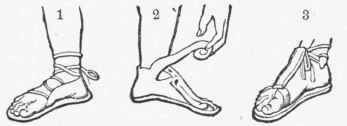
Fig. 2. - Shoes. 1. From an Antique Statue. 2. Foot of the Statue of Hermes in the Vatican. 3. From a Statue of Demosthenes in the Vatican.

Fig. 3. - Shoe and Boot. 1. Shoe, from an Antique Statue. 2. Hunting Boot, from a Statue of Diana.

Fig. 4. - Shoe of Charlemagne, Abbey of St. Denis.

Fig. 5. - 1. From a Portrait of the Emperor Frederick III. 2. Italian Shoe of the 14th Century.
For stitching the uppers of shoes several machines are in use, chief among which, both in this country and in Europe, are the Elias Howe and the Wheeler and Wilson. Next in importance to the pegging and sewing machines should be ranked cable-screw wire and wire-tacking machines, which have come into extensive use within a few years. After these come machines for setting and burnishing the edges of the soles, for making and trimming heels, for forming and beating out the sole, as well as for cutting it out, for rolling and splitting the leather, for sandpapering, eyelet making, etc. These machines, together with scores of less importance, are all of American invention, and most of them have been adopted in the shoe factories in other parts of the world. The attempt to introduce machinery on a large scale was first made in England, where in 1809 a patent was granted to David Mead Randolph for a method of riveting soles and heels to the uppers instead of sewing them together. He used a last sheathed on the bottom with an iron or steel plate. On this plate he laid the inner sole, and brought the edges of the upper leather around, and temporarily fastened them. The outer sole was then applied and secured by small nails driven through the three thicknesses and clinched against the plate.
The first large manufactory with machines for expediting the operation was established in Battersea, by Brunei, the famous engineer, and it was carried on by the invalid soldiers of Chelsea hospital for supplying shoes to the British army. The shoes were made with a welt riveted to the edge of the outer sole by small nails, and a row of longer nails outside of these secured the whole to the uppers and inner sole. The bottoms were studded with short nails of copper or iron to improve the wear. Several ingenious machines, worked mostly by treadles, or otherwise by a winch turned by hand, were devised by Brunei for the various processes, as cutting out the leather, hardening it by rolling, punching the holes for the nails, forming the nails from slips of metal and inserting them in the holes, both by one machine, and for the others connected with the securing of the parts together. The machines do not appear to have continued in use after 1815, when on the establishment of peace the demand for army shoes fell off, and manual labor being more abundant the machines were of less importance. It was not until English manufacturers had generally adopted the American factory system and American machinery, that any large portion of the total production was supplied by the use of machinery.
The wooden peg, now used for fastening boots and shoes, which has largely contributed to cheapening these articles, was invented about 1818 by Joseph Walker of Hopkinton, Mass. - In a modern shoe factory the division of labor on the various parts of a shoe is carried to its greatest extent. The uppers and linings are cut and stitched generally in one department, where the buttonholes are worked by hand or by a machine especially adapted to that purpose, and the buttons put on or eyelets punched, if for a laced shoe. The uppers being ready, the first process in bottoming is to wet the soles, which, after being partially dried, are passed under a heavy roller, which takes the place of the shoemaker's lapstone. They are then, if for machine sewing, after being properly cut out for the requisite sizes, run through a channelling machine, which takes out a thread of leather from the outside edge in the bottom of the sole, leaving a thin narrow flap all round, so that when the stitch is laid in the place of the leather thus removed the bottom may be hammered down so smoothly as hardly to indicate where its surface was raised to allow of the stitching. The upper is then drawn over the last and tacked on the insole, and the outsole is tacked on.
The last is now withdrawn, and the shoe passed to the sewing machine, where the stitch is made through the outsole and insole, and the edge of the upper coming between them, the flap raised for the channel being laid and cemented over the seam. The heel is now put on in the rough, and the edges of both heel and sole are trimmed and burnished. In making a "turn" shoe, the sole is shaped before tacking to the last, on which it is placed with the grain side of the leather, or that which is to form the bottom of the shoe, next the last; the upper, with the stiffening in, is then pulled over, wrong side out, then lasted and sewed, the last being taken out after sewing, and the surplus upper cut away. The shoe is then turned right side out, first at the seat, then the ball and toe, the last again put in, and the sole and stiffening hammered into proper form. A "team" of shoemakers consists of from four to nine men, comprising lasters, heelers, trimmers, burnishers, and finishers, who complete the shoe, after the uppers are made and the soles cut out. But the number of men in a team and the way in which the work is divided up are altogether dependent upon the kind of work.
What is called custom work, or making boots and shoes to measure for individuals, has of late years become comparatively obsolete. The styles of boots and shoes have not varied to any great extent for many years, the extremes of fashion having been from a long, narrow sole to a short and very broad one, with at times what is known as a "box" toe, and from a small, high heel, of from 1 1/2 to 2 in., to one of about an inch, more broad and comfortable.
Continue to:


My Books

