


Brunswick
Description
This section is from "The American Cyclopaedia", by George Ripley And Charles A. Dana. Also available from Amazon: The New American Cyclopædia. 16 volumes complete..
Brunswick
Brunswick (Ger. Braunschweig). I. A duchy of N. W. Germany, composed of three large portions, separated from each other chiefly by Prussian territory: 1, the principality of Wolfenbtittel, embracing the circles of Brunswick, Wolfenbtittel, and Helmstedt; 2, the district of the Hartz and the Weser, embracing the circles of Gandersheim and Holz-minden; 3, the principality of Blankenburg, on the lower Hartz. Besides these three large portions, there are five small isolated districts. Its area and population in 1871 were as follows:
CIRCLES. | Area, square miles. | Population. |
1.Brunswick........ | 210 | 90,845 |
2.Wolfenbuttel........ | 295 | 60.789 |
3. Helmstedt........................ | 308 | 53.705 |
4.andersheim......... | 212 | 42.822 |
5.Holzminden........... | 222 | 41.581 |
6.Blankenburg........... | 183 | 22,523 |
Total......................... | 1,425 | 311,715 |
Of the inhabitants 97.96 per cent, are Protestants, 1 .68 Catholics, and 0.36 Jews. The Protestants, with the exception of 1,700 Reformed, are Lutherans. The general character of the surface is hilly, and in the mountainous districts the climate is severe and the harvest late. About 33 per cent, of the land is arable; 27 per cent, consists of meadows, and 32 of woodland. The largest rivers are the Ocker, Leine, and Weser, the last of which drains the greater part of the duchy and has many affluents. Brunswick may be divided into the mining districts, which lie chiefly among the Hartz mountains, and the agricultural regions, which comprise nearly all the rest of the country. Grain, fruit, tobacco, flax, cattle, and horses are raised in the latter, while the former are rich in gold, silver, copper, lead, iron, sulphur, and coal. The mines, in some of which Hanover has a joint interest, are not now so productive as in former times, but are still of high value. Other minerals, such as marble, alabaster, limestone, gypsum, potter's clay, asbestus, as-phaltum, jasper, and agate, are found in various localities. Salt is obtained in abundance. The manufactures are inconsiderable.
Spinning is a favorite occupation, and there are several camlet manufactories, dye houses, paper, oil, and saw mills, breweries, iron works, and manufactories of lacquered wares and porcelain. The advantages of railway communication with Hanover, Magdeburg, and Neustadt have given to trade a magnitude scarcely to be expected from the geographical position of the country. The aggregate length of railways in 1871 was 131 m. The university of Helmstedt was suppressed in 1809, but there are 5 gymnasia, a polytechnic school, a theological seminary, 2 normal, 21 Latin, and 369 common schools, and a library at Wolfenbtittel, of considerable repute. - The form of government is a limited hereditary monarchy, the supreme power being vested in the duke and a legislative body of one chamber, consisting of 46 members, of whom 21 are chosen from the owners of large landed estates and the highest taxpayers, 10 from the towns, 12 from the rural districts, and 3 representatives of the church. They are elected for six years, one half going out of office every three years. They assemble triennially on convocation by the duke, but in certain cases may meet without his authority.
The duchy holds the 11th place among the states of the German empire, has two votes in the federal council, and elects one delegate to the Reichstag. To the army of the empire it contributes a regiment of infantry, a regiment of hussars, a battery of four pieces of ordnance, and two landwehr battalions. The public debt in 1871 was 23,765,768 thalers, including 19,670,700 thalers for railways; and the budget for the three years 1870-'72 presented an aggregate revenue of 7,196,400 thalers, and the same aggregate amount of expenditure. II. A city, capital of the above described duchy, situated on the Ocker, 32 m. E. S. E. of Hanover, and connected by railways with the other cities of Germany; pop. in 1871, 57,882. It is said to have been founded in the 9th century, by Bruno, second duke of Saxony, was enlarged by Henry the Lion, ranked in the 13th century among the first cities of the Hanseatic league, and, although much less important than in former times, continues to be one of the most active cities of N. W. Germany, The annual fairs held here are, after those of Leipsic and the two Frankforts, the most animated in Germany. The pork sausages of Brunswick (Brcmnschweiger Wurst), and its beer, have acquired great celebrity; the latter is known under the name of Braunschweiger Mumme, after Christian Mumme, who was the first to prepare it in 1492. The trade in this beer extended in former years to India. The book trade is of great importance.
Brunswick is the seat of a bank and of several banking establishments. The appearance of the town is antiquated, but there are several handsome streets and promenades. The new ducal palace is a magnificent building, with beautiful pleasure grounds. The most interesting monuments of the ancient cathedral of St. Blaise are the tombs of the ducal family. There are 10 churches and a synagogue. The Gewandhaus, in the old German style of architecture, and the council house, an elaborate Gothic structure, are among the most picturesque buildings. The museum in the arsenal contains a gallery of valuable paintings. The most prominent institution of learning, the Collegium Carolinum, which was founded in 1745, was in 1861 converted into a polytechnic school. The city has also a Lutheran gymnasium, a Realgymnasium, an institution for the blind, and one for the deaf and mute. Monuments have been erected to the two dukes of Brunswick who fell at Jena and at Quatre Bras; to the memory of Schill and his companions, 14 of whom were shot here; and to Lessing, who died here.
Reitschel's statue in honor of Lessing was erected in 1853. The most extensive of the many charitable and sanitary institutions is a great asylum which accommodates 250 orphans.

Gewandhaus.
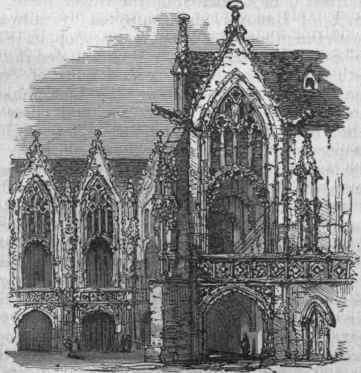
Council House.
Continue to:


My Books

