


Bison
Description
This section is from "The American Cyclopaedia", by George Ripley And Charles A. Dana. Also available from Amazon: The New American Cyclopædia. 16 volumes complete..
Bison
Bison, a name given to three species of the ox family. 1. The European or Eur-Asiatic species, bos urus, known as the bonassus, is supposed to be the ancient urus or aurochs. (See Aurochs.) 2. The Indian bison (B. gaunis) is but partially known and imperfectly described. It has the general characteristics of the bisons, the short horns, huge head, unshapely forehead, and the vast masses of shaggy wool covering those parts. It frequents the Ghauts and the wildest forest ranges of the Himalaya. 3. The bison, commonly and erroneously called buffalo, of North America (B. Americanus), is distinguished by its singular hump over the shoulders; this hump is of an oblong form, diminishing in height as it recedes, so as to give considerable obliquity to the line of the back. The eye is black and brilliant; the horns are black, and very thick near the head, whence they curve upward and outward, tapering rapidly toward the point. The outline of the face is convexly curved, and the upper lip on each side, being papillous within, dilates and extends downward, giving a very oblique appearance to the lateral gap of the mouth, in this particular resembling the ancient architectural bass reliefs representing the heads of oxen.
The physiogomyof the bison is menacing and ferocious; but this appearance is a mere outward show, since of all the species the bison is the most pacific. Even in his breeding season the bison will not attack man. In summer, from the shoulders backward, it is covered with a very short fine hair. The tail is short, and tufted at the end. The color of the hair is uniformly dun, but the long hair on the anterior parts of the body is to a certain extent tinged with yellowish or rust color. The shaggy masses of hair which cover the head, shoulders, end neck of the male, with his great beard, are of a darker shade of the same hue. The sexual saason of the bison commences in July, toward the latter end of the month, and lasts till the beginning of September; after which time the cows leave the company of the bulls and range in different herds. They calve in April, and the calves never leave the mother until they are a year old, while they often follow her until they are three years old. From July to the end of December the cows are very fat and in prime condition; the bulls are always poor, and their flesh is lean and hard; during the breeding season it is rank and disagreeable.
At this time of the year the roaring of the bulls on the prairies is like hoarse thunder, and they fight furious battles among themselves. When migrating, they travel in vast solid columns of thousands and tens of thousands, which it is almost impossible to turn or arrest in their progress, since the rearward masses drive the leaders on, whether they will or no. The flesh of the bison, the cow especially, is like coarsegrained beef, but is juicy, tender, and sapid in the highest degree. The favorite portion is the hump, which, when cooked in the Indian fashion, by sewing it up in the hide, singed and denuded of hair, and baking it in an earth oven, wherein a fire has been previously kindled, and over which a second fire is kept burning during the process, is considered the most exquisite of dainties; the tongue and the marrow bones are also greatly prized. Numerous tribes of Indians are almost entirely dependent on the bison for their food, clothing, dwellings, and even fuel; the dressed hides with the hair on form their robes - denuded of it, the covers of their tents; and the dried ordure - known on the prairies as bois de nache - on the vast, treeless plains of the west, furnishes 'the sole material for their fires.
The dressed hides are a considerable article of commerce, and for these as well as for other causes the slaughter of these animals is prodigious. Their original range appears to have been the whole of the North American continent, west of Lake Champlam and the Hudson river, with the exception of some intervals on the Atlantic Seaboard, and south of the Ottawa and Colombia rivers, northward of which its place is supplied by the musk ox, as is that of the elk and moose by the reindeer. For many years they have ceased to exist to the eastward of the Misissiipi,
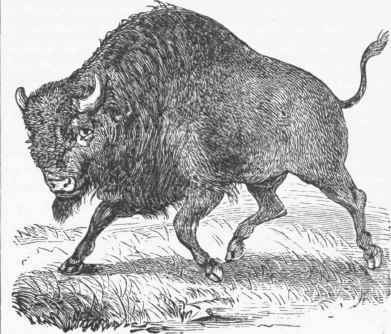
Bison Americanus.
Continue to:


My Books

