


Banana
Description
This section is from "The American Cyclopaedia", by George Ripley And Charles A. Dana. Also available from Amazon: The New American Cyclopædia. 16 volumes complete..
Banana
Banana (musa), the most important of tropical fruits, now common in the tropics of both hemispheres. When the cutting or shoot is planted (and it requires deep rich earth and much moisture to grow in perfection), it soon sends up two leaves, tightly rolled together until the green roll has grown two or three feet, when the blades unfold. These leaves are followed' by others, until the stems of the leaves have formed a smooth trunk some eight or ten inches thick, composed wholly of the concentric leaf stems or petioles. At the end of nine months a deep purple bud appears in the centre of the leaves; its constantly lengthening stem soon pushes it beyond the leaves, and it hangs down like a huge heart. As the purple envelopes of the bud fall off rows of buds are disclosed, extending two thirds around the stem. Each miniature fruit has a waxen yellow blossom with a large projecting stigma at the end. The female flowers come first on the stem, and nearer the end are the smaller male flowers; both are full of good honey.
Three or four months are required to ripen the fruit, and during the process the rows of male flowers have withered and dropped away, the ovaries of the female blossoms have swollen into bananas 6 to 14 inches long, and the huge bunch, containing several hundred fruits, hangs from the now withering plant, which soon dries up if left to itself. From its base spring up offshoots which may be transplanted, and if the stem is cut down as soon as the fruit is gathered, the round bulbous rootstock sends up new leaves, and a second plant matures much sooner than do the offshoots. Although most banana bunches hang down in maturity, a variety is found on the Society Islands whose very large bunches of deep orange-colored fruit stand up erect, forming ornamental rather than useful objects; for their taste even when cooked is acrid and disagreeable. The Brazilian banana is tall, rising to a height of 15 or even 20 feet, and the fruit is yellow and excellent, rather vinous in flavor. The Chinese banana seldom exceeds five feet in height, the leaves of a silver hue, and the fruit aromatic. The fei or Tahitian banana is similar to the Brazilian, but not so tall, and the fruit is angular, yellow, turning black when fully ripe, and the flesh is salmon-colored or buff, and slightly acid.
A variety with a red skin is brought from the West Indies, and a very small banana is found in Africa and the East Indies. The botanical distinction of species is probably not well founded, as at present two, M. sapientum and M. paradisiaca, are supposed to comprise all the edible varieties; and the popular names banana and plantain are often confounded, the latter being applied to the cooking varieties. Usually no seeds are found in the pulp, but at Akyab and along the coast of Arracan a kind is common full of seeds. These seeds are black, rough, as large as cotton seeds, and like these enveloped in a fibrous coat. The Spaniards, from the fancied resemblance of the transverse section to a cross, supposed the banana to have been the forbidden fruit, and that Adam saw in eating it the mystery of redemption by the cross. Bananas are eaten raw, either alone or cut in slices and with sugar and cream or wine and orange juice. Cooked when green or ripe, they are fried alone or in butter, baked with the skins on, or made into puddings or pies.
They may be cut into strips and dried, or pounded into a paste; in the latter form they are the staple food of many
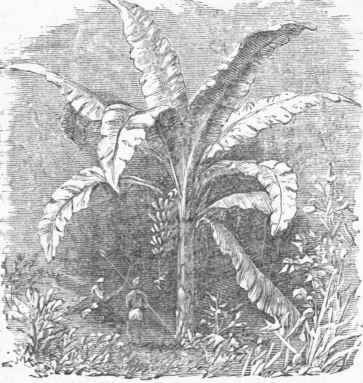
Banana.
Mexican tribes. The amount of nourishment is very great, and Humboldt states that the same land which produces 1,000 lbs. of potatoes will yield 44,000 lbs. of bananas; a surface bearing wheat enough to feed one man will, when planted with bananas, feed 25. The young shoots arc cooked as greens, but the old leaves (from 6 to 10 ft. long and 12 to 14 in. wide) and stem are full of a watery, acrid juice, which stains white cloth an indelible black or dark brown. The fibres of the leaves make a textile fabric of great beauty, known as a fine kind of grass cloth. The plants are set closely in cultivation, and the bunches are gathered before they are quite ripe and hungup in a cold place, or better still, buried in the earth. A plantation will yield all the year round by timing the planting, but the crop is much more abundant at one season. The bunches may weigh 80 or even 100 lbs. when ripe.
Continue to:


My Books

