


Some Suggestions On Developing The "Adventure Trail". 1. Preliminary Ideas For Preparing The Trail
Description
This section is from the book "Camping Manual For Troop Scouters", by Boy Scouts of America. Also available from Amazon: Camping Manual For Troop Scouters.
Some Suggestions On Developing The "Adventure Trail". 1. Preliminary Ideas For Preparing The Trail
(a) The "Adventure Trail" is a method of combining various Scouting activities into a type of hike, wherein the selection of unknown "obstacles" (based upon Scouting practice) is always placed before the Scout. This adds the elements of surprise, instruction and fun.
(b) Those "obstacles" are usually called "stations" and are of many kinds.
(c) The stations are usually numbered or the solving of one gives directions for finding the next. At times there is an observer or judge at the point where the activity is to take place. He may give the directions for finding the next point. If the number of Patrols is not too great the first one starts at the first station and continues from place to place, as indicated. Some 15 minutes later the second starts at station one and continues, with the others following at 15 minute intervals. It is always possible to start the various Patrols at different points along the trail, all at the same time. In this case each Patrol will have to have a different set of instructions. What is to be done is usually posted on a piece of cardboard at the station. A report or "log" should be kept by Patrols and "Observers."
(d) Since this is a contest some form of scoring is needed. For some of the events the scores are indicated. At others the observers give the ratings and they are added to those noted by the Patrols themselves.
(e) Usually a final summary is made by the observers at a gathering of all those who took part. Here the judges give their reaction to what was done and how it could have been done differently. The last part of this meeting will be the announcement of the winning Patrol.
2. Suggested Sample Stations For The Trail
(A) "A Clean Camp" (First Station - Posted At Beginning). Instructions
(1) Each Patrol has received an empty envelope.
(2) Scattered along the trail are 2,000 (depending on number of Patrols) pieces of blue paper.
(3) Each Patrol must find 100 squares of this paper, no more, no less, just one hundred.
(4) Keep these pieces in the empty envelope.
(5) Before turning in your Patrol log the Patrol Scribe should record your score in it as follows:
(6) For picking up paper - 100 points.
(7) For each piece less than 100 picked up deduct 1 point.
(8) For each piece over 100 picked up deduct 10 points.
(9) Go to tree at_for next instructions.
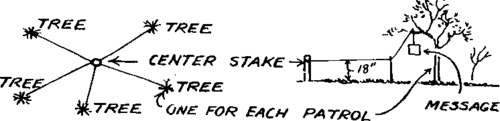
(B) "Fire Building" (Second Station). Instructions (Diagrams Show Set-Up)
(1) One of the papers suspended from the trees belongs to your Patrol.
(2) To get it you must build a fire under the string.
(3) Near the center stake you will find "Fire by Friction" and "Flint and Steel" sets and matches.
(4) Your score depends on what you use to light your fire.
(5) You are to state in your Patrol Log how you lit your fire, and score yourself as follows:
(6) If you light your fire by friction (or steel) 100 points
" " " " " with one match 25 points
" it " " " with two or more matches 10 points
" " fail to get a fire and must cut string 0
Put your fire out completely (Failure to do this deduct 25 points)
(C) "Solving A Code" (Third Obstacle). (The Message Is In Code.)
(1) JDP - GPLJ - RGWJEXOJRUGW - NIP - NW - CUFFUYW:
"QU - JU - JDP - YGUB - ZNIB - NGB - FUUS - CUI - ZDXI -RGWJIXOJRUGW - JDPIP. BUG'T - AUDJPI - JPD - CUUS."
(2) Write the solution of this message in your Patrol Log. You will find the correct message at the wood pile.
(3) Score yourself 100 points for deciphering the message, then deduct 5 points for each letter you have wrong.
(D) "Axemanship" - (Third Station - Fourth Obstacle.)
(Instructions found at wood-pile.)
(1) Each Patrol must chop one of these logs in half.
(2) Each man in turn must take TWO and only two "chops" or strokes with the axe.
(3) If after each man has had his two strokes the log is still not cut through, continue around again in the same order, each man taking two strokes again, until log is cut in two.
(4) Keep track of the number of strokes required.
(5) Add to 100 points the number of the men in your Patrol.
(6) From this deduct the number of strokes taken and the results will be your score.
(7) Record this score in your Patrol Log.
(At the place where the chopping is to be done there should be a number of pine (or other soft wood) logs about 6 inches through and a good axe.)
(Indicate in some way where to go next.)
(E) "Tree Identification" (Fifth Obstacle)
Instructions (Posted at beginning of the trail)
(1) From this point on along the trail you will find some trees marked in order with numbers from 1 to 25.
(2) Follow the trail and have your Patrol keep a record in your Patrol Log the number and name of each tree.
(3) At the.................shack or on Tree No. 25 you will find a correct list of these trees.
(4) Correct your list by this one and score yourself as follows:
(5) For each tree named correctly per requirements on cards - 100
(6) Add total points and divide this total by 25-
(On each tree there is tacked a white card saying just what is to be done - whether the family name or species is to be given. On the last tree there are instructions for going on to next obstacle.)
(F) "Scout Pace". Instructions
(1) Compute the distance from this point to the totem pole in _ ...............................camp (or some other designated spot) by Scouts pace.
(2) (Scouts pace is travelling at the rate of one mile in twelve minutes.)
(3) Hence, if you time yourself while going over an unknown distance you can figure out just how far you have gone. (Remember there are 5>280 feet in a mile.)
(4) Have your Patrol Scribe enter the number of feet in your Patrol Log.
(5) Then, and not before (a Scout's honor is to be trusted) turn up the card fastened to the ....................... _and read correct answer or number of feet in distance.
(6) From all deduct the difference between your figure and the one given on the card. This difference will be your score.
3. There are many additional events that can be worked out, but these will not be developed in detail. For instance:
(a) Finding trail markers.
(b) Meeting a Scout wearing his insignia incorrectly and later being asked what was wrong.
(c) Many different ways of using signalling.
(d) Swimming, boating, canoeing, etc. can be introduced.
(e) First Aid emergencies.
(f) Stalking
(g) Campers directions.
(h) Engineering
(Additional Materials for Topic No- 24) SAMPLES OF "WIDE GAMES"
(modified from "Wide Games" by Gilcraft)
Note: Read material in Handbook for Scoutmasters on "Wide Games", Pages 906 to 918- Gives explanations and additional samples.
Continue to:


My Books

