


IV. Swordfishing In The Pacific
Description
This section is from the book "Some Fish And Some Fishing", by Frank Gray Griswold. Also available from Amazon: Some Fish And Some Fishing.
IV. Swordfishing In The Pacific
I Roam The Seas To Fight The Whale, With Sword I Thrust, I Strike With Tail, But When I'm Hooked I Sound And Fight The Luckless Fisherman Half The Night.
THE swordfish (Xiphias gladius) of the Pacific is the same fish that is so well known in the Atlantic Ocean. Several thousand of these fish are captured every season during July and August along our coast from Block Island to Halifax, N. S.
The average weight of the swordfish shipped to the Boston market is about 360 pounds, and there is a legend among the fishermen that a fish was once brought in that weighed 750 pounds.
The U. S. Fisheries Commission have never been able to find out where these fish breed. No very small fish have ever been taken along our coast although the Commission did capture a 25 pounder on one occasion. It is known that the fish breed in the Mediterranean, but as they appear there at the same season of the year that they do here this would hardly apply to our fish.
These fish are found in midsummer swimming leisurely along on top of the water apparently sunning themselves. The boatmen steal upon them in power-boats. A fisherman is poised on the bowsprit or bow of the boat supported by a so-called pulpit of iron, and when just over the fish harpoons him. The steel end of the harpoon is driven well home and to it is attached a long strong rope which is coiled in a tub so that it will run free. To the end of the rope a five gallon keg painted white is fastened. This keg usually bears its owner's or the boat's name.
The harpooned fish always go to windward, and it used to be quite an undertaking to follow them in the days when sailpower had to be depended on, but the motor-boat has made it easy work.
The swordfish soon tires after sounding deep a few times, and when the tired fish comes to the surface he is lanced and hauled on board.
Great numbers of fish are taken in this manner every season. I heard of one boat that after a fourteen days' trip divided $5,000 among a crew of five fishermen. The swordfish bring fifteen cents a pound in the Boston market and are excellent eating.
Swordfishing is not carried on as a profession in the Pacific nor is the fish to be found in the market, but swordfishing with a rod and reel has become a sport, and an arduous one, for the members of the Tuna Club at Avalon.
The first fish was taken in 1913, since which time twenty fish have been brought in and weighed. The heaviest qualified fish weighed 465 pounds and the smallest 130 pounds.
Regulation Tuna Club tackle is used - a sixteen-ounce tip five feet or more long and 1,200 feet or more of 24-thread line. The leader is made of strong piano wire doubled.
Two six-foot wires are strung from the hook to a one-inch ring and two wires of the same length join this ring to another one onto which the line is bent. The rings are for the glove-handed boatman to hold on to when he gaffs the fish. Some fishermen use a chain on the hook and a swivel in place of the middle ring but they are not quite trustworthy.
Mr. Boschen, the strongest and most skillful fisherman in the Tuna Club, has fished for swordfish daily from June 1st to October for three years. He has fought some forty odd fish and has landed but eight. He has battled with them for five, eight, and even eleven hours and half through the night. He tells me they really do not wake up until it grows dark. He fought one fish for eleven hours. The fish sounded forty-eight times and had to be pumped up and led the launch twenty-nine miles before he was lost owing to the steel hook having cut through the brass chain attached to it.
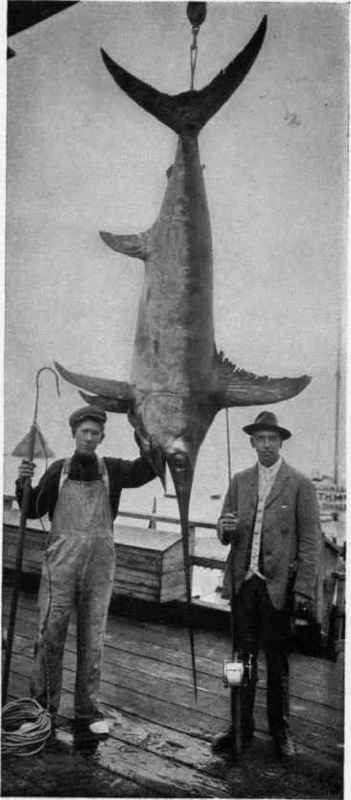
MR. JOHN V. ELIOT AND SWORDFISH. 5 hours and 7 minutes.
Mr. Boschen thinks they are the greatest fish that swim. They certainly are the most difficult to kill for they have a strength and vitality that are beyond belief. They fight as a heavyweight fighter boxes, for their every move is deliberate and well thought out. The marlin fights quickly and is all over the place; not so the swordfish. He moves as a rule slowly but with great strength and deliberation, yet he is known to be the fastest swimmer of the seas. Now and then, it is said, a crazy fish is hooked and acts quite differently.
The swordfish do not begin to fight until after the first or second hour when they seem to wake up, and a fish has been known to fight for an hour after he had the gaff in him and before he could be securely roped. Once you have a rope around the fish's tail he is safely captured but not until then.
There were seven swordfish brought in during the eighteen days that I was at Avalon and four of them had been foulhooked. A 404 pound fish was hooked in the anal fin, the hook having passed from his mouth through his gills in some mysterious manner and fastened in the anal fin. The wire had cut through the gills and after a five hours' fight the fish had bled to death and sank. He had to be handed up as the rod could not lift the weight. It took three men forty minutes to bring him to the surface tail first. His tail was then roped and he was towed twelve miles to Avalon.
Two fish were brought in wrapped up in the wire leader which had caught the hook and held the fish as in a vise. In both cases the bait was still on the hook.
The swordfish, when he sees the bait, sinks and the first thing he does is to hit the bait a hard blow with his sword. He seems to do this at times from pure viciousness, for he does not always take the bait after hitting it but moves off. He seems to be a poor batsman for he often becomes foul hooked by striking the wire instead of the bait; the wire enwraps his sword and in his struggles he becomes foul hooked.
One fish had been hooked in the anal fin and the wire had been across his mouth which was badly lacerated. If foul hooked in the body and not in the fins the hook usually pulls out as they are a tender-skinned fish.
Continue to:


My Books

