


Chapter IV. Hatching House
Description
This section is from the book "Fish Hatching, And Fish Catching", by R. Barnwell Roosevelt, Seth Green. Also available from Amazon: Fish Hatching, And Fish Catching.
Chapter IV. Hatching House
As a convenient illustration of a hatching house, we will present a view of the State establishment at Caledonia, as it was in the year 1875, the subsequent changes not being material to its efficiency, It is located on the stream where Mr. Seth Green had his original trout hatchery, and which is probably the finest site for the purpose in the United States. The source of Caledonia brook is only about one mile above, and consists of immense springs which in some instances sprout from the ground, and in others form large ponds, and by their current drive mills. The stream is almost a river from its very start and is filled with subsidiary springs its entire course. An estimated flow of six barrels per second comes fromsome of the initial springs, and the temperature at the hatching house varies only 25°, from 35° to 60°, winter or summer. A record of the thermometer has been kept for years during the hatching season and is found to be restricted to a variation from November to March from 35° to 45°, and stands ordinarily about 36°; the springs themselves remaining invariably at 50°.
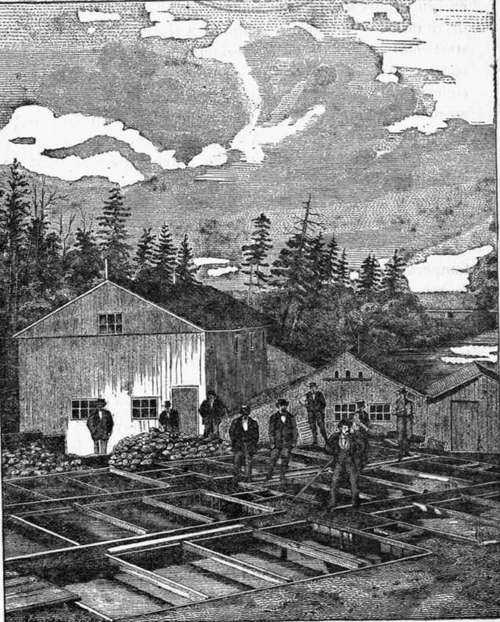
New York State Hatching House, At Caledonia, N. Y.
There is as little variation in the volume as in the temperature of the water, as the proximity to the source prevents the effcet of freshets or drouths. The stream is simply one huge spring, and was for years famous for the vast number and excellent flavor of the trout it contained. It abounds with the natural food of trout, with insects, shrimp and larvae of water flies, and in the spring and even in winter the surface is covered with the phryganidae and ephemeridae as they issue forth in perfect form. The ground around the house is well adapted for constructing ponds, as there is at this spot a fall of four feet or thereabouts. The house itself is cheaply constructed of hemlock boards, and is fifty feet long by twenty feet wide, and is one and a half stories high. There is no attempt at ornament or elegance, and it is probably the plainest while the most efficient hatching house in the world. In it have been hatched in one season two million and a half of whitefish, two million salmon trout, and one million and a half of brook trout together with several hundred thousand salmon, these figures not being taken by estimate but by actual count.
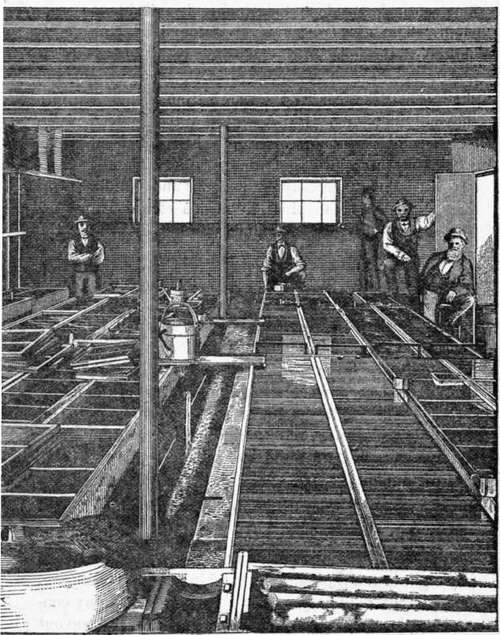
New York State Hatching House - Interior View.
The accompanying plate and ground plan will readily show its arrangement, AA are troughs, forty feet long by fourteen inches wide and six inches deep inside measurement. These troughs are raised about one foot and a half above the floor for the sake of convenience in attending to the eggs. The supply pipe, D, sixty feet long and six inches deep, carries the water from the stream into the building, where it is received into the feed pioes, CC, in which filters are inserted before the faucets which admit the water into the troughs, AA. These troughs are used now especially for salmon and salmon trout eggs. 00 are waste-pipes, by means of which any sec tion of a trough can be cleaned without disturbing the rest. BB are the Holton hatching boxes.
The eggs are placed on trays made of wire cloth stretched on wooden frames. Each tray is twenty-seven inches long by fourteen inches wide, and will hold in a layer, one deep, 6,272 salmon trout eggs. Instead of using only one layer of these trays, it has been the practice for the last four years to use four layers in the upper sections and five in the lower sections; making tor all the troughs a capacity of 534 trays, or, in round numbers, of three and one-half millions of salmon trout eggs.
With this illustration, we will proceed to give general direction for the construction and management of a hatching house.
Size And Make
If only a few eggs are to be hatched (say eight or ten thousand) no hatching house is necessary. The troughs may be placed in the open air, in any convenient place, and covered with a wire screen to keep out rats, mice and ducks. A light board cover must then be laid over them to shed the rain and snow and keep the eggs from exposure to the sunlight. A hatching house is much more comfortable to work in. A stove may be put in it and a fire started occasionally for warming one's fingers, but it is not needed for hatching purposes, as spring water in these latitudes is warm enough. The house may be constructed of rough boards,or as expensively as you choose, butcare should be taken to have a watertight roof, as drops of water leaking through and falling into the troughs will kill the eggs underneath. Its size must be regulated by the number and extent of the troughs.
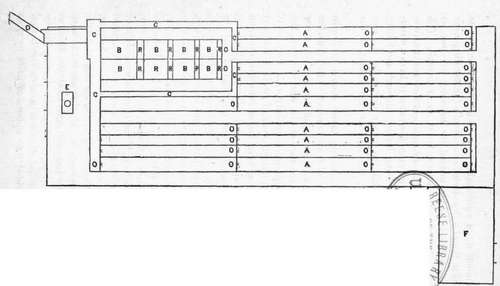
Ground Plan Of N. Y. State Hatching House
A - Hatching Troughs. B - Hatching Boxes. C - Feed Pipes. D - Supply Pipe.
E - Stove. F - Store House. R - Reservoir. O - Waste Piper.
The windows in a hatching house should be few in number and provided with curtains or shutters, as the sun shining upon the spawn will kill it. Not that a few minutes exposure to the rays of the sun will hurt the eggs, but a few hours exposure certainly will. Perhaps it would be well to have the windows, if possible, made on the north side of the hatching house, into which the sun will not shine in the winter season. Keep the hatching house clean. In fact cleanliness is one of the cardinal virtues to the trout raiser. He should have a clean house, should work with clean hands, and have all his pans, spoons and utensils of every sort free from grease and dirt.
Continue to:


My Books

