


Chapter III. Trout Ponds
Description
This section is from the book "Fish Hatching, And Fish Catching", by R. Barnwell Roosevelt, Seth Green. Also available from Amazon: Fish Hatching, And Fish Catching.
Chapter III. Trout Ponds
Location
It is very easy with good spring water to raise a few trout anywhere in temperate latitudes. But to raise a large number requires care in the selection of a location. Plenty of pure spring water is the first and most essential requisite. The spring, or one of the springs, if there are several, should have a fall of two or three feet, and a fall of five to ten feet of the whole volume of water is decidedly advantageous. If the supply of water is very large, it diminishes the necessity of a fall. The water from a spring remains (near its source) at nearly the same temperature during the whole year, and is the best for Trout raising. The water from a brook which does not rise higher than sixty five degrees in summer, may be used to supply ponds for adult Trout; but spring water is not absolutely necessary for hatching purposes. It is not a good plan to dam up a stream which varies in volume, and so make ponds. There should be enough level land by the side of such a stream to make ponds supplied by the stream; and it is best to have a stream much greater in volume than is necessary for the ponds, so that there will always be a good supply of water, and there will be no trouble with the surplus water after a freshet. A good knowledge of the whole system of Trout Culture is essential in choosing the very best location. It is desirable to have your ponds near your house, or have a man in charge living at the ponds. Of course your Trout may never be molested, but "an ounce of prevention is worth a pound of cure."
Laying Out Ponds
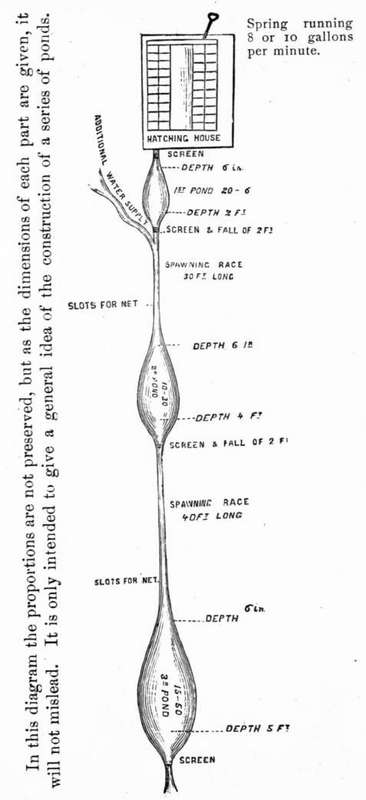
The diagram represents a series of ponds, in all of which the same water is used. This plan is generally considered the best, for several reasons. It economizes the water and space, and is most convenient for changing the fish from one pond to another. It is not necessary that the ponds should be in a straight line. Where the location demands it they may be turned so as to lie in a direction nearly or quite parallel with one another. This is easily done by bending the raceways, and lengthening them if necessary, only a curved raceway is sometimes not so convenient as if it were straight. The sides of the ponds may be walled up with stones, laid without mortar, unless the soil is very sandy. Wood may be better for the sides and bottoms, but we are inclined to think is not worth its expense. If the sides of the ponds are laid up with mortar, let it dry thoroughly before letting the water in; then let the water run through it two or three weeks, or long enough to purify the pond before putting any fish in it. It is as well to test it by putting in only a few fish at first; if the pond is not thoroughly purified the fish in it will turn blind. Ponds should not be built where much surface drainage will run into them; if they are so exposed the surface water should be carried off by a ditch around them. The Second and Third Ponds should receive an additional supply of water. The reason for this will be given further on. A general idea of the form and size of ponds can be gathered from the diagram without further explanation. If the supply of water is small, it is best to have as much fall between the ponds as the nature of the ground will allow. This fall aerates the water and makes it as good as new.
Shape Of Ponds
Where the supply of water is large it matters very little about the shape of the ponds. The best shape we believe to be the pear-shape, figured in the plate; such a shape combining an equable flow of water in all directions and the greatest amount of surface, with the least difference in the temperature of the water. If the nature of the ground demands other shapes, the ponds should be made long, narrow and deep, rather than broad and shallow. The depth of the pond is indicated in the plate, and will answer for any size of ponds. It is better for any one wishing to raise a large number of fish, to have several series of ponds, than to attempt raising a larger number by increasing the size of the ponds. Fish do not feed so well in large ponds, are not so easily taken care of, and eat each other more.
Raceways
The Second and Third ponds should have a long, narrow raceway where the water enters - about thirty or forty feet long, four feet wide and six inches deep. The sides of the raceway should be made of one and a half inch plank, one foot in width. This will answer for both natural and artificial impregnation. The raceway is required not only for the purpose of spawning, but as a resort for the fish at all seasons of the year.
Fish will go into this shallow graveled race, into the quick running water, to free themselves from the parasites which often trouble them; or they will go there if they are out of health and condition from any cause. This raceway must be filled with coarse gravel, and the bottom of the pond made to slope gently up to the raceway.
The head of the raceway is to be carefully looked after. If a series of ponds are made, then the screens between will keep the fish from running from one to the other; but if single ponds are used, each supplied with separate water from a stream, then much attention must be paid to the screens where the water enters. It would be well if the water was brought into the pond through a long box, as the water will very soon work around or under a short box, and allow the fish to escape. If the water enters with a fall, it may be allowed to pour over upon an apron, constructed of thin slats, one-half or one-quarter of an inch apart, and set edgeways. This will let the water through and keep the fish from running up. Trout will run up stream very freely, working their way through a small passage, but will not try much to run down stream.
Wild Raceway
If the ponds are connected with a stream in which there are trout, it is desirable if possible to make a raceway below the lowest dam and connect it with the stream, so that wild fish may use it. In this way a great many trout will be taken in a ripe condition that would otherwise spawn in some other part of the stream and be lost. The wild raceway has the advantage not merely of utilizing fish that have not cost any expense to keep, but of adding to the number of spawners for the following year by the addition of those that are thus captured.
Continue to:


My Books

