


Provisional Sketch Of A Religious Synthesis. Part 4
Description
This section is from the book "Human Personality And Its Survival Of Bodily Death", by Frederic W. H. Myers. Also available from Amazon: Human Personality And Its Survival Of Bodily Death.
Provisional Sketch Of A Religious Synthesis. Part 4
1014. Yet a durable religious synthesis should do more than satisfy man's immediate aspiration. It should be in itself progressive and evolutionary; it should bear a promise of ever deeper holiness, to answer to the long ages of heightening wisdom during which our race may be destined to inhabit the earth. This condition has never yet been met. No scheme, indeed, could meet it which was not based upon recurrent and developing facts. To such facts we now appeal. We look, not backward to fading tradition, but onward to dawning experience. We hope that the intercourse, now at last consciously begun - although as through the mouth of babes and sucklings, and in confused and stammering speech - between discarnate and incarnate souls, may through long effort clarify into a directer communion, so that they shall teach us all they will.
Science, then, need be no longer fettered by the limitations of this planetary standpoint; nor ethics by the narrow experience of a single life. Evolution will no longer appear as a truncated process, an ever-arrested movement upon an unknown goal. Rather we may gain a glimpse of an ultimate incandescence where science and religion fuse in one; a cosmic evolution of Energy into Life, and of Life into Love, which is Joy.
1 Enn. iv. 3, 27.
Love, which is Joy at once and Wisdom; - we can do no more than ring the changes on terms like these, whether we imagine the transfigurement and apotheosis of conquering souls, or the lower, but still sacred, destiny which may be some day possible for souls still tarrying here. We picture the perfected soul as the Buddha, the Saviour, the aurai simplicis ignem, dwelling on one or other aspect of that trinal conception of Wisdom, Love, and Joy. For souls not yet perfected but still held on earth I have foretold a growth in holiness. By this I mean no unreal opposition or forced divorcement of sacred and secular, of flesh and spirit. Rather I define holiness as the joy too high as yet for our enjoyment; the wisdom just beyond our learning; the rapture of love which we still strive to attain. Inevitably, as our link with other spirits strengthens, as the life of the organism pours more fully through the individual cell, we shall feel love more ardent, wider wisdom, higher joy; perceiving that this organic unity of Soul, which forms the inward aspect of the telepathic law, is in itself the Order of the Cosmos, the Summation of Things. And such devotion may find its flower in no vain self-martyrdom, no cloistered resignation, but rather in such pervading ecstasy as already the elect have known; the Vision which dissolves for a moment the corporeal prison-house; "the flight of the One to the One".
"So let the soul that is not unworthy of that Vision contemplate the Great Soul; freed from deceit and every witchery, and collected into calm. Calmed be the body for her in that hour, and the tumult of the flesh; ay, all that is about her, calm; calm be the earth, the sea, the air, and let Heaven itself be still. Then let her feel how into that silent heaven the Great Soul floweth in. . . And so may man's soul be sure of Vision, when suddenly she is filled with light; for this light is from Him and is He; and then surely shall one know His presence when, like a god of old time, He entered into the house of one that calleth Him, and maketh it full of light." "And how," concludes Plotinus, "may this thing be for us? Let all else go."1
1015. These heights, I confess, are above the stature of my spirit. Yet for each of us is a fit ingress into the Unseen; and for some lesser man the memory of one vanished soul may be beatific as of old for Plotinus the flooding immensity of Heaven. And albeit no historical religion can persist as a logical halting-place upon the endless mounting way - that way which leads unbroken from the first germ of love in the heart to an inconceivable union with the Divine - yet many a creed in turn may well be close inwrought and inwoven with our eternal hope. What wonder, if in the soul's long battle, some Captain of our Salvation shall sometimes seem to tower unrivalled and alone?

1 Enn. v. 2-3. The World-Soul is supra grammaticam; and Plotinus sometimes uses a personal, sometimes an impersonal, locution to express what is infinitely beyond the conception of personality, as it is infinitely beyond any human conception whatsoever.
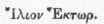
And yet in no single act or passion can that salvation stand; far hence, beyond Orion and Andromeda, the cosmic process works and shall work for ever through unbegotten souls. And even as it was not in truth the great ghost of Hector only, but the whole nascent race of Rome, which bore from the Trojan altar the hallowing fire, so is it not one Saviour only, but the whole nascent race of man - nay, all the immeasurable progeny and population of the heavens - which issues continually from behind the veil of Being, and forth from the Sanctuary of the Universe carries the ever-burning flame: Aeternumque adytis effert penetralibus ignem.
Continue to:


My Books

