


Phantasms Of The Dead. Part 7
Description
This section is from the book "Human Personality And Its Survival Of Bodily Death", by Frederic W. H. Myers. Also available from Amazon: Human Personality And Its Survival Of Bodily Death.
Phantasms Of The Dead. Part 7
708. This, as I conceive, is a sound method of proceeding from ground made secure in Phantasms of the Living - and retraversed in my own just previous chapter - to cases closely analogous, save for that little difference in time-relations, that occurrence in the hours which follow, instead of the hours which precede, bodily dissolution, which counts for so much in our insight into cosmic law.1
The hypothesis of latency which thus meets us in limine in this inquiry, will soon be found inadequate to cover the facts. Yet it will be well to dwell somewhat more fully upon its possible range.
It might conduce to a clearer view of the facts if we could draw a curve, showing the proportionate number of apparitions observed at various periods before and after death. It would then be seen that they increase very rapidly for the few hours which precede death, and decrease gradually during the hours and days which follow. In the present state of our evidence, however, and considering all the problems involved, there would perhaps be an affectation of more exactness than we can actually attain, were we to set forth such a curve, embodying the dates, in reference to death, of all the cases as yet received by us. It may be enough to say, generally, that if the length of the base-line represents a year, and the point with the highest ordinate the moment of death, the comparative frequency of veridical apparitions might be somewhat as follows:-
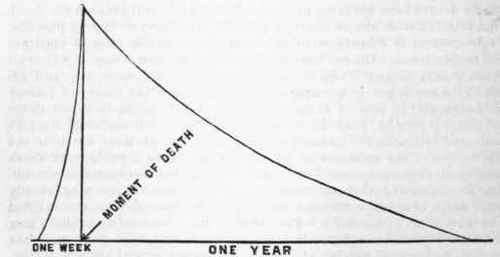
That is to say, the recognised apparitions decrease rapidly in the few days after death, then more slowly; and after about a year's time they become so sporadic that we can no longer include them in a steadily descending line.
1 Certain statistics as to these time-relations are given by Edmund Gurney as follows (Proceedings S.P.R., vol. v. p. 408): "The statistics drawn from the first-hand records in Phantasms of the Living as to the time-relation of appearances, etc, occurring in close proximity to deaths, are as follows:- In 134 cases the coincidence is represented as having been exact, or, when times are specifically stated, close to within an hour. In 104 cases it is not known whether the percipient's experience preceded or followed the death; such cases cannot be taken account of for our present purpose. There rarely be sure that the phantasm observed is more than a mere subjective hallucination. Thus we have several accounts of a rushing sound heard by the watcher of a dying man just after his apparent death, or of some kind of luminosity observed near his person; but this is just the moment when we may suppose some subjective hallucination likely to occur, and if one person's senses alone are affected we cannot allow much evidential weight to the occurrence.
I may add that one of our cases (which I quote below, in 747) is remarkable in that the auditory hallucination - a sound as of female voices gently singing - was heard by five persons - by four of them, as it seems, independently - and in two places, on different sides of the house. At the same time, one person - the Eton master whose mother had just died, and who was therefore presumably in a frame of mind more prone to hallucination than the physician, matron, friend, or servants who actually did hear the singing - himself heard nothing at all. In this case the physician felt no doubt that Mrs. L. was actually dead; and in fact it was during the laying out of the body that the sounds occurred. In including this case and similar collective ones in Phantasms of the Living, Gurney expressly stated (vol. ii. pp. 190-92) that he did so because in his view they involved at least an element of thought-transference between the living minds of the percipients, whatever other influence may or may not have proceeded from the deceased person.
But if we are finding reason to suppose that the deceased person's power of influencing other minds may persist after death, it seems reasonable to dwell on that aspect of such an incident as this.1
Yet one more point must be touched on, to avoid misconception of the phrase cited above, that "the moment of death is the centre of a cluster of abnormal experiences, of which some precede, while others follow the death." Gurney, of course, did not mean to assume that the act of death itself was the cause of all these experiences. Those which occur before death may be caused or conditioned, not by the death itself, but by the abnormal state, as of coma, delirium, etc, which preceded the death. This we say because we have many instances where veridical phantasms have coincided with moments of crisis - carriage -accidents and the like - occurring to distant agents, but not followed by death. Accordingly we find that in almost all cases where a phantasm, apparently veridical, has preceded the agent's death, that death was the result of disease and not of accident. To this rule there are very few exceptions. There is a case given in Phantasms of the Living (vol. ii. p. 52), where the phantasm seems on the evidence to have preceded by about half-an-hour (longitude allowed for) a sudden death by drowning.
In this case the percipient was in a Norfolk farmhouse, the drowning man - or agent - was in a storm off the island of Tristan d'Acunha; and we have suggested that an error of clocks or of observation may account for the discrepancy. In another case the death was in a sense a violent one, for it was a suicide; but the morbidly excited state of the girl a few hours before death - when her phantasm was seen - was in itself a state of crisis. But there are also a few recorded cases (none of which were cited in Phantasms of the Living) where a phantasm or double of some person has been observed some days previous to that person's accidental death. The evidence obtained in the Census of Hallucinations, however, tended to show that cases of this sort are too few to suggest even prima facie a causal connection between the death and the apparition (see Proceedings S.P.R., vol. x. p. 331).
Thus much it has seemed needful to say in order to explain the difficulty of representing by any one curved line the true time-relations involved in this complex matter. I now proceed briefly to review some of the cases where the interval between death and phantasm has been measurable by minutes or hours.
It is not easy to get definite cases where the interval has been measurable by minutes; for if the percipient is at a distance from the agent we can seldom be sure that the clocks at both places have been correct, and correctly observed; while if he is present with the agent we can remain 78 cases where it appears that there was an interval of more than an hour; and of these 38 preceded and 40 followed the death. Of the 38 cases where the percipient's experience preceded the death (all of which, of course, took place during a time when the 'agent' was seriously ill), 19 fell within twenty-four hours of the death. Of the 40 cases where the percipient's experience followed the death, all followed within an interval of twenty-four hours, and in only one (included by mistake) was the twelve hours' interval certainly exceeded, though there are one or two others where it is possible that it was slightly exceeded".
Continue to:


My Books

