


The "N" Hook. Expression Of "One". Continued
Description
This section is from the book "The Science And Art Of Phrase-Making", by David Wolfe Brown. Also available from Amazon: The science and art of phrase-making.
The "N" Hook. Expression Of "One". Continued
with your own knowledge
with your own name
with your own neighbors
with your own things
443. In many cases, own is conveniently joined by the n hook to with our, thus: with our own

Exercise
444. Write the following:
with our own with our own army with our own case with our own exertions with our own imports with our own lives with our own manufactures
with our own money with our own mouth with our own receipt with our own report with our own respect with our own responsibility with our own right
445. Own, expressed by the n hook, is often conveniently joined to in our, thus: in our own

Exercise
446. Write the following:
in our own
in our own case
in our own manufactures
in our own materials
in our own regiment
in our own report
in our own reply
in our own representations
in our own respect
in our own writing
447. The n hook affords often a very convenient means of adding own to their expressed by double-lengthing. Illustrations: for their own

was their own

may be their own

Exercise
448. Write the following:
although their own
are their own
ask only their own
between their own
ca (n) have their own
for their own
for their own case
for their own government
for their own information
for their own name
for their own necessities
for their own neighbors
for their own notions
for their own reasons
for their own sake
from their own admission
from their own information
from their own names from their own necessities from their own objections from their own showing from their own testimony have their own have their own notions have their own opinions have their own reasons have their own responsibilities have their own rights I have seen their own I take only their own 1 think their own I think their own information
The "N" Hook
I think their own knowledge.
I value their own (I. D.)
I wish their own (I. D.)
in their own
in their own cases
in their own report
in their own representation
in their own reputation
in their own right
it is only their own
it was their own
know their own
know their own case
know their own reasons
may their own
nor shall their own
over their own
over their own name
over their own town
receive only their own
say their own
seen their own
shall have their own
shall their own
should know their own
so their own
they may have their own
they mus(t) have their own
think their own though their own through their own through their own fault through their own objection through their own volition value their own was never their own was their own was their own choice was their own position was their own showing we have only their own we have seen their own we have their own we think their own when shall their own whenever their own wherever their own while their own will have their own why their own why their own information why their own judgment why their own notice why their own objection wish their own worthy their own you have only their own you have seen their own
449. Exception: Own, in the phrase my own, should be expressed by the stroke n, instead of the hook, to avoid possibility of conflict between mine and my own in such sentences as it is my own and it is mine.
Exercise
450. Write the following phrases, expressing own by the n stroke:
my own business
my own confessions (con expressed by "proximity")
my own conscience (con expressed by "proximity")
my own condition (con elided and dition joined)
my own convictions (con
expressed by "proximity")
my own course
my own decision
my own duty
my own information
my own judgment
my own objection
my own position
my own showing
451. It need hardly be said that the final hook for one and own must not be used in any case where its use would cause an awkward junction or endanger legibility. But, in general, no confusion is found to result from representing one and own by the same hook, as the context usually indicates clearly the word intended.
"N" hook foR "than."
452. Than may be added by means of the n hook to the words more, other and rather, and to any word ending with er, the sign of the comparative degree. Illustrations: better than

, lower than

, higher than

Exercise
453. Write the following:
any more than
any more than enough
any more than necessary
better than
better than a
better than mine better than my own better than the better than you better than you can
earlier than easier than farther than farther than a farther than asked farther than necessary farther than the farther than was greater than greater than the greater than you greater than you can harder than harder than a harder than ever harder than necessary harder than now harder than the harder than was higher than higher than now it is better than a it is better than mine it is better than the larger than longer than a longer than necessary longer than now longer than required longer than the more than
more than necessary more than a more than enough more than now more than the mors than would be
much more than
much more than necessary
no greater than will be
no longer than
no more than
no more than can be
no more than necessary
no more than would be
no more than would answer
other than
rather more than
rather than
rather than a
rather than ask
rather than make
rather than mention
rather than receive
rather than refuse
rather than remain
rather than say
rather than the
shorter than
shorter than they
smoother than
so many more than
sooner than
sooner than a
sooner than required
sooner than risk
sooner than the
stronger than
this is better than
you know better than (you inverted)
you know more than (you inverted)
454. In three exceptional cases, the n representing than is by some reporters attached to an s circle or an str loop
thus: less than

, faster than

vaster than

455. To the n hook representing than the circle s may be added when convenient, to represent is, his, has.
Exercise
456. Write the following:
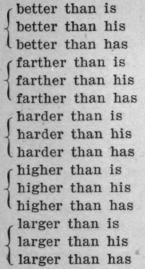
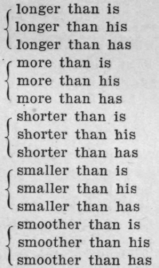
"n" hook for "beeN." 457. Been may be added by the n hook to had; have and
have there, thus: have been

had been

, have
there been

*Benn Pitman does not use the hook for this purpose; nor does •Graham, except on have.
The "N" Hook
458. Write the following:
Exercise
could have been could not have been have been have there been he had been* he may have been he may not have been he might not have been he might have been he must have been I cannot have been **I have been I have been received I had been (I. D.) I may not have been I might have been I mus(t) have been it mus(t) have been it should not have been it would have been many have been may not have been never have been
must have been nor have there been should not have been such as have been there have been there might have been there must have been they might not have been they must have been we have been acknowledged we have been ready when there have been which should not have been would have been would not have been you cannot have been you have been you have been ready you have been right you might have been you will have been you know more than enough (you inverted)
459. The use of the n hook in the expression of not will be explained in the next chapter, in connection with the half-length principle.
459 1/2. In a very few phrases, when in follows are, such as we are in, n hook is used by some writers to express in.
*He should be made downward in this particular case to guar d against confounding the very common phrases he had been and I had been. (See Paragraph 187 and note.) Or he had may be written with the half-length hay in the third position, as explained in a previous note.
**In this and the next phrase, I have is supposed to be written according to Benn Pitman.
Continue to:


My Books

