


Hooks Elided
Description
This section is from the book "The Science And Art Of Phrase-Making", by David Wolfe Brown. Also available from Amazon: The science and art of phrase-making.
Hooks Elided
160. In order to facilitate phrasing, hooks, initial or final, are sometimes elided. Under this principle, the w at the beginning of well, willing and week is frequently omitted.
Exercise
Write the following phrases, omitting the w:
as (w)ell as
as (w)ell as it should be
as (w)ell as you may
I am willing
it is (w)ell enough (well
downward) it is (w)ell known (well
downward)
it may as (w)ell
it might as (w)ell
las(t) (w)eek
next (ns) (w)eek
such as are (w)illing (are
downward) this (w)eek very (w)ell
"r" hook omitted and implied.
*See Paragraphs 255-263, **See Paragraphs 269-272.
161. To facilitate a junction, the r hook is frequently elided or imperfectly expressed, as in the phrases it is perhaps

in which consideration

162. Sometimes, in consequence of the elision of the r hook, the consonant to which it belongs assumes an imperfect and apparently ambiguous form. Thus mr in the midst of a phrase takes frequently the form of mp by reason of the omission of the r hook, as in much more

vr, with the hook omitted in the midst of a phrase, has the appearance of the consonant stroke w, as in the phrase there is very little

thr, with the hook omitted under similar circumstances, looks like the consonant stroke z, as in the phrases he is therefore

which is therefore
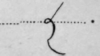
For the sake of brevity, these apparent anomalies are tolerated, because in practice no confusion or illegibility results.
Exercise
Write the following phrases, omitting the r hook as indicated :
he is the(r)efore he is ve(r)y likely it is thei(r) matter it is ve(r)y likely it is ve(r)y little
it is ve(r)y strange much mo(r)e much mo(r)e important so ve(r)y little which is the(r)eby
"n" hook elided.
163. The n nook is occasionally elided for the sake of securing a convenient junction.
Exercise
Write the following phrases, omitting the n hook as indicated:
all that has bee(n) said
America(n) people
dow(n) there
has bee(n) able
has bee(n) there
it has bee(n) suggested
Norther(n) Democracy
upo(n) their upo(n) them upo(n) themselves upo(n) those upo(n) those who woma(n)'s rights wome(n)'s rights
164. In the word can, the n may frequently be elided for the sake of phrasing.*
Exercise
Write the following phrases, omitting the n in con:
ca(n) be ca(n) only be ca(n) there be ca(n) they do ca(n) this be ca(n) you ca(n) you go ca(n) you receive ca(n) you remember
it ca(n) be
it ca(n) never be
there ca(n) be
this ca(n) only be
what ca(n) they do
what ca(n) they remember
which ca(n) be
you ca(n) generally
you ca(n) now
Continue to:


My Books

