


The Circles S And Z
Description
This section is from the book "Haven's Complete Manual Of Practical Phonography", by Curtis Haven.
The Circles S And Z
Rapidity in writing shorthand frequently necessitates, for the representation of the oft-recurring sounds of S and Z, a much shorter method than that found in our Visible Alphabet.
A small light circle is therefore often used to represent the hissing sound of S, and a shaded small circle to indicate Z under similar circumstances. These circles are joined to other consonants by writing them on the most convenient side of curved letters, and on the right or upper side of straight ones, though they may be placed at either end of any letter, as in following diagrams, the circle being read where written:
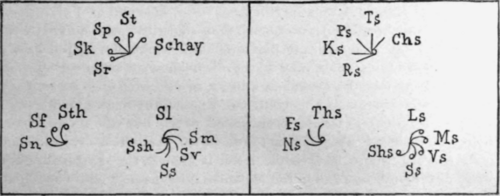
The superiority of these circles in point of speed, over the long signs for S or Z, is a fact which will be more or less appreciated and taken advantage of by the student. But, lest there be a disposition to do away entirely with the original signs representing these sounds in the Visible Alphabet, it is necessary to state that there are instances wherein the signs for S and Z, as written in the Visible Alphabet, must be employed. They are:
First. When either the sound of S or Z constitute the only consonant of a word, as in sign 21 of this Exercise.
Second. When either of the sounds of S or Z is the first consonant in a word, and is preceded by an invisible vowel, as in sign 22.
Third. When an invisible vowel sound terminates a word in which either S or Z happen to be the last consonant. Signs 26, 27, 33, 35 and 36.
Under the above three rules, the long S or Z of the Visible Alphabet must be used, and in the second and third rules, the student, when reading, has an infallible guide whereby to determine when an invisible vowel precedes or follows either S or Z in a consonant combination. In other words, when he sees the S or Z of the Visible Alphabet, beginning such a combination, he knows an invisible vowel must be read before and in conjunction with it, and that, when either of those long letters ends such a combination, there is an invisible vowel following it, as part of the word.
Under all circumstances not covered by above three rules, use the circle S or Z wherever possible. For instance, when either the sound of S or Z begin a combination, with no vowel before it, use the circle as in signs 23, 29, 30, 37, 38 and 40 in Exercise. When the sounds of S or Z end any combination, with no vowel sound after, use the circles, as in signs 24, 25, 28, 32, 34, 39 and 41 in Exercise.
Compare sign 22, indicating a preceding vowel, and sign 23, with no vowel before the S. Also compare sign 25, indicating no final vowel sound, with sign 26, indicating the final vowel E sound of Y.
Also compare sign 34, maz, spelled in shorthand with no final vowel sound, and sign 35, ma-zy, showing the final E sound of Y by full sized Z.
Just here the student may ask how it is known that the vowel sound is E following long-S in signs 26 and 27, or following Z in signs 33, 35 and 36. The answer to this is, that in English the final sound of such words ending in Y is always pronounced nearly like the vowel E, and therefore all that is necessary is to remember that when a vowel sound ends a word whose last visible letter is S or Z, the shorthander is to write the long S or Z, as in the instances - just named, and when he or she reads those letters, to pronounce after them the vowel sound of E, when the key to the outline will be at once evident.
The E in case, (sign 24), race (sign 25), sire (sign 30), maze (sign 34), etc., is of course silent and not considered in shorthand spelling.
A double-sized light circle, written alone or joined to other letters in accordance with the rule governing the small circles, represents the sounds ses, sez, size, zes, zez, etc.. See signs 42, 43 and 44 in Exercise.
This double-sized circle must not be mistaken for double-s (ss) in the English spelling of the word lass, etc. In phonography no letters are wasted and lass and kindred words terminating with double-s, are spelled quite as legibly, and much more economically, thus: 1-a-s, /ass.
These small and large circles are joined to the letters R and Arm in the same manner and upon the same sides as those circles are joined to K or Gay. See signs 24, 25 and 30. This is no more than proper, for R and Arm are written from left to right, as K and Gay are, and should, therefore, be treated similarly in this respect.
This rule the student will have frequent cause for recalling in future lessons and he or she should bear it well in mind and on all occasions where junctions are made with, or circles added to, the letters R and Arm, such junctures and additions must be made to R and Arm in precisely the same manner that they would be added to K or Gay.
When joining shaded circle-Z to letters, shade most convenient way.
Continue to:


My Books

