


Fifth Day. Malcom Jackson Vs. Daniel C. Kain
Description
This section is from the book "Haven's Complete Manual Of Practical Phonography", by Curtis Haven.
Fifth Day. Malcom Jackson Vs. Daniel C. Kain
Court Of Common Pleas. Before Judge D. D. Severns.
Case No. 6i. January Term, 1874. Pittsburg, Penn., April 2, 1874.
For the plaintiff appear Messrs. Kelly and Leach. For the defendant appears Mr. Bernard Baker.
Testimony For Plaintiff. Malcom Jackson, the plaintiff, sworn, testifies as follows:
Direct Examination
Mr. Kelly:
Q. What is your business, Mr. Jackson?
A. I am superintendent of a glass factory.
Q. Are you employed at present?
A. Yes, sir; with James Whalen & Company.
Q. Where were you employed in 1871?
A. I was employed from April, 71, to March, '73, by Mr. Daniel C. Kain, trading under the firm name of D. C. Kain & Company, Glass Manufacturers.
Q. What were your duties?
A. I was general superintendent of their pot-house.
Q. What were you to get for your services?
A. Fifteen hundred dollars per year. One hundred dollars per month, as regular salary. The other three hundred dollars per year were payable to me at the end of the year, providing my services were satisfactory.
Q. And in case they were not, how was that to be determined?
A. Mr. Kain was to decide that himself, and if such was his opinion, our contract was to be terminated at such date.
Q. How long was the contract made for?
A. For one year, subject to renewal, on same terms.
Q. Did you get your fifteen hundred dollars at the end of the first year, that is, your regular salary of one hundred dollars per month, and the three hundred bonus?
A. Yes, sir.
Q. Did you continue in service on the same terms the second year?
A. Yes, sir.
Q. Did you get your three hundred bonus, the second year, in addition to your one hundred dollars per month?
A. No, sir.
Q. Why not?
Objected to. Objection sustained.
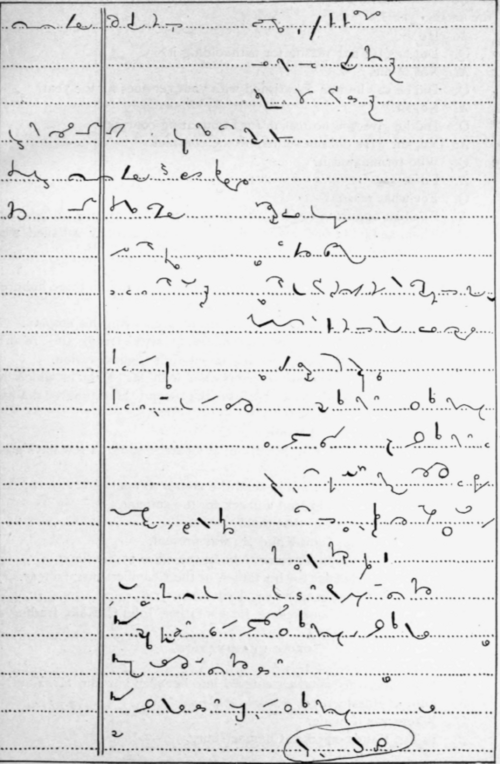
Q. Did Mr. Kain refuse to pay you the three hundred dollars bonus for the second year?
A. He did.
Q. Did he give any reason for withholding it?
A. Not to me.
Q. Did he say he was dissatisfied with your services for the year?
A. No, sir.
Q. Did he give you no reason for terminating contract?
A. No, sir. He did not terminate the contract.
Q. Who terminated it?
A. I did.
Q. For what reason?
A. I had an opportunity for getting better pay than my present position.
Q. Then, as far as you know, Mr. Kain was perfectly satisfied with your services for the last year you were with him?
A. Yes, sir.
Q. And you do not know why he refused to pay you the three hundred dollars bonus due you for the second year's salary?
A. Not unless he was angry on account of my leaving his employ.
Answer objected to, and motion made to strike from the record. Objection sustained. Motion taken under consideration.
Q. Did you ever have any conversation with Mr. Kain in which he Stated that he would send you a check for the second three hundred dollars?
A. I had such a conversation.
Q. When was that and where was it?
A. It was in the office of Mr. Kain, at Chambersburg, a few days after my second year.
Q. Did he say that he would send the money to you?
A. He stated he would send a check for the amount.
Q. Who was present at that time?
A. I think his son, John Kain, Jr., was present.
Q. Do you know how he came to be in the office at the time?
A. He was bookkeeper for his father, at the Chambersburg factory.
Q. Who is the bookkeeper now, John Kain, Jr.?
A. Yes, sir; he is bookkeeper for his father, John C. Kain, trading as John C. Kain & Co.
Cross Examination
Mr. Baker:
Q. When was this contract entered into between you and Mr. Kain?
A. Late in March, 1871.
Q. Where was it made?
A. In Mr. Kain's office, at Chambersburg.
Continue to:


My Books

