


The Driving Of A Nail
Description
This section is from the book "Handy Man's Workshop And Laboratory", by A. Russell Bond. Also available from Amazon: Handy Man's Workshop And Laboratory.
The Driving Of A Nail
The driving of a nail is deemed so simple a matter, that inability to do the job is often spoken of as though typifying entire lack of mechanical ability; yet it may be that some skilled mechanics have something to learn in regard to this elementary operation. It usually takes a woodworker's apprentice a year or more to learn that he doesn't know how.
A fledgling mechanic, who spoke sneeringly of a man whom he heard using several blows of the hammer to drive a single nail, was somewhat crestfallen when told that the nail would hold better when driven "home" by several light taps, than when driven by one heavy one.
"Why?" he asked, in surprise.
"Because," said the other, "when you drive a nail home with a heavy blow, it is apt to rebound a trifle, loosening the grip of the wood fibers on it. Drive it almost down, if you will, with as hard blows as you wish, but finish the job with several light blows."
One who thinks that the driving of a nail simply consists in getting the whole length of it out of sight, has little conception of the real nature of the operation. A nail driven by an expert will often hold several times as much as one ill driven; while, too, it is often made to draw the parts into place. If you have ever watched a mechanic driving nails, you have doubtless noted that he rarely drives one at right angles with the face of the work. There is a reason for this. Suppose that he is nailing the "sheeting" on the frame of a building, and desires to draw the board down tightly against the one below it; he points the nail downward, and a few well-considered blows at the last produce the desired effect. If the board is bent edgewise, so that much force is required, probably he will start the nail in the upper edge, pointing very sharply downward. Again, two nails driven in a board at different angles will hold it in place much more firmly than the same nails would if they were driven in at right angles with the face of the board.
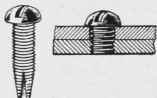
Fig. 94 - Improvised tap.
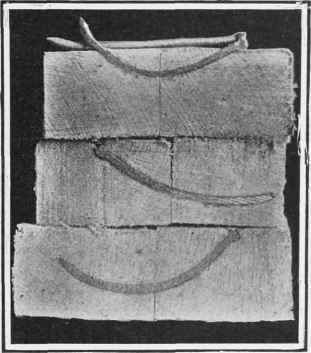
Fig. 95 - Nailing a butt joint.
Did you ever notice that, in driving a nail in very hard wood, one man will do it successfully, while another succeeds only in doubling the nail up before the point has fairly entered the wood? The difference lies in the fact that the expert strikes the nail fairly, and not too hard, "coaxing" it in: while the other strikes too hard and with indirection. It may be mentioned, right here, that in driving a nail into very hard wood, it is usually profitable to dip the end into oil or grease. This will not sensibly interfere with the holding qualities of the nail, while it will very materially facilitate its driving.
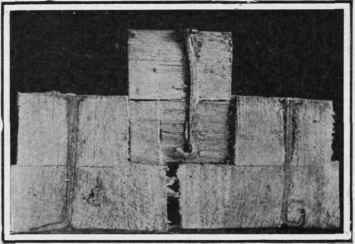
Fig. 96 - Methods of clinching a nail.
In order that a nail may hold its best, it is necessary that the pieces it penetrates should be in close contact. A few well-judged taps of the hammer at the finish will serve to bring about this contact; while a heavy, ill-judged blow often destroys it, on account of the rebound.
So, too. the direction in which a nail goes is governed, not merely by the direction in which it is started, but very largely by the shape of the point. You have doubtless noticed how a horseshoe nail, by having a chisel point, is made to swerve and to come out of the hoof but little above the shoe. By filing the point of a nail off on one side, it may readily be made to take a curved course in driving, or the same result may be attained by bending the point slightly with the claws of the hammer. The photograph. Fig. 95, shows how two boards may be secured, edge to edge, by nails bent in this way.
In driving a clinch nail, there is room for the exercise of some skill. In Fig. 96 the central figure is that of a clinch nail driven down onto a hard surface, thus being driven and clinched at the same operation. It will be noted that it is bent in the middle, "crippled," thus loosened in the wood and deprived of much of its holding capacity. At the left and right are nails which were first driven through the wood, and had the points bent over afterward, while a heavy hammer, or the like, was held against the bead. The one on the left was carelessly bent, leaving a clinch which will straighten easily; while the one at the right was first bent over a trifle at the extreme point, then hammered firmly down. By the latter method, it will be seen, the point is driven into the wood, and thus more securely held in place
Continue to:


My Books

