


Some Experiments With Carbon Disulphide
Description
This section is from the book "Handy Man's Workshop And Laboratory", by A. Russell Bond. Also available from Amazon: Handy Man's Workshop And Laboratory.
Some Experiments With Carbon Disulphide
Carbon disulphide vapor is nearly twice as heavy as carbon dioxide gas. Some experiments, still more curious than those which are usually made to manifest the density of carbon dioxide, can be performed with carbon disulphide.
To obtain carbon disulphide vapor there is no need of heating the liquid. It boils at 117 deg. F., but emits a considerable amount of vapor at temperatures far lower than 117 deg. To ascertain this fact, place in a dish a handful of cotton. Pour some carbon disulphide over it, and with bellows blow steadily over the whole. After a minute or two it will be found that the carbon disulphide has gone, and that a thick external layer of snow has taken its place. Condensation and congelation of atmospheric humidity were the result of the quick vaporization of the liquid.
The following experiment made with carbon disulphide always succeeds, although the writer has tried in vain to perform it with carbon dioxide. It offers no difficulty whatever, even when the thermometer stands as low as 66 deg. F., and it can probably be made at a lower temperature, although it is of course better to select a summer day, or, in winter, a heated room. Take a long and narrow strip of stiff paper. Fold it longitudinally so as to form a V-shaped trough. Support the trough on an incline, with the upper end resting on a book and the lower end in the mouth of an empty glass. In the bottom of a second glass press some cotton, and over this pour some disulphide. Have a third empty glass at hand. Everything is now ready for the experiment.
Go through the motions of pouring into the third glass the carbon disulphide contained in glass number two. Capillarity will keep the liquid in the cotton, and nothing will seem to flow out. Now take glass number three, which apparently contains nothing; handle it as if it contained something, and.pour slowly its invisible contents into the upper part of the paper gutter. Nothing is seen to leave the glass nor to run along the gutter nor to fill glass number one at the lower end of the gutter, but throw an ignited match into the latter glass and a blue flame will fill it for one or two seconds.

Fig. 183 - Making frost with carbon disulphide.
A little apparatus, called the four liquids vial, is generally shown to students during a course in elementary physics. Mercury, a solution of potassium carbonate, alcohol, and petroleum are seen to superpose themselves in one vessel according to their relative densities, the surface of separation being in each case horizontal. This is the way in which non-miscible liquids generally arrange themselves when thrown together in one vessel. Carbon disulphide permits of a somewhat different arrangement, which appears very odd because the conditions of its realization are so unusual. It happens that carbon disulphide and glycerin cannot be mixed, and have exactly the same density (1.26) up to the second decimal, the third decimal being variously influenced by the purity and temperature of both chemicals. If the two liquids be placed with some care side by side in one vessel, the adhesion of glycerin for glass will keep them in that queer position.
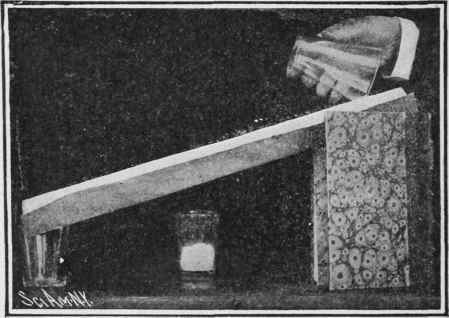
Fig. 184 - Pouring invisible vapor of carbon disulphide down a trough and into a glass.
Take an ordinary glass, and divide its capacity into two halves by means of a roughly-cut pasteboard partition laid vertically in the glass. Pour at the same time glycerin on one side of the partition and carbon disulphide on the other. If. while so doing, yon are careful not to allow too great a difference of level between both liquids, each will stay on its own side of the partition, even though the latter may imperfectly lit the glass. Now raise the partition. The surface of separation of the two liquids sometimes remains perfectly vertical for several minutes. More frequently.
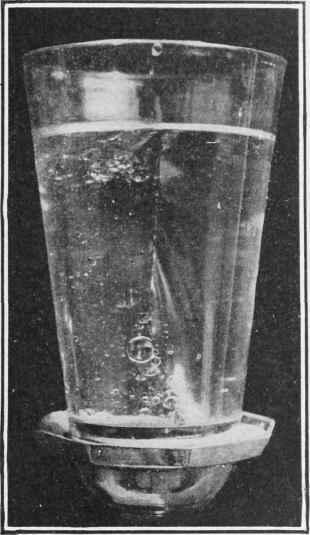
Fig. 185 - Carbon disulphide and glycerin side by side.
under the influence of the three factors which determine its shape, i. e., adhesion, cohesion, and a small difference in density, it bends itself and becomes more or less S shaped.
While handling carbon disulphide. one should always bear in mind that this liquid takes fire even more readily than gasoline, and that its vapor is poisonous. The latter inconvenience is the lesser, because the nature and intensity of the smell of the commercial product are such as to cause one to step back when the vapor reaches the nostrils.
Continue to:


My Books

