


A Home-Made Heat-Retaining Bottle
Description
This section is from the book "Handy Man's Workshop And Laboratory", by A. Russell Bond. Also available from Amazon: Handy Man's Workshop And Laboratory.
A Home-Made Heat-Retaining Bottle
Within the last few years there have appeared on the market several different makes of bottles designed to keep their contents hot or cold for a day or more, but their present high cost of from five to six dollars each in quart sizes still keeps them in the class of luxuries. By following out the instructions given below, however, anybody can make for a few cents a bottle that will be a fair substitute for the more costly manufactured article.
The essential principle involved is to surround a bottle with as poor a conductor of heat as possible, and thus prolong the time that it would ordinarily take for the contents to lose their initial heat or cold. The manufactured bottles are blown double, one within the other, and a vacuum is then formed in the space between them. Since a vacuum is the best possible non-conductor of heat, the contents of the inner bottle are well insulated from the outer air, except at the neck and top. In addition to this the inner bottle is also silver-plated on the outside so as to act as a heat reflector.
Nature has not provided us with any solid substance that even approaches a vacuum in its heat insulating qualities, but by using a sufficient thickness of loose sheep's wool, well dried, fair results can be obtained. Other substances, valuable in the order named, are woolen blankets, loose feathers, hair felt, and cotton wool.
In Fig. 275 is shown a section of a bottle intended to be portable, and therefore made as light and compact as possible. It consists of a cylinder A of bright tin and an outer tin box B having the space between them filled with the wool C, a part of which is sewed up into a mattress or cushion E. The bottle D must in all cases be provided with a tight rubber ring to prevent spilling the contents, and, what is equally important, to avoid moistening the wool. The bottle may be a quart milk bottle or a one or two quart fruit jar. Smaller sizes do not hold their heat long enough to be worth while. The thickness of the wool packing must be 1 1/8 inches thick at the very least, and when portability is not necessary it is desirable to have a thickness of from four to six inches. In the latter cases the outer box may be made square and of wood with a hinged cover.
Made as described, a bottle of this kind can be depended upon to keep its contents reasonably hot or cold for from six hours to an entire daw depending mostly on the thickness of the packing and its composition.
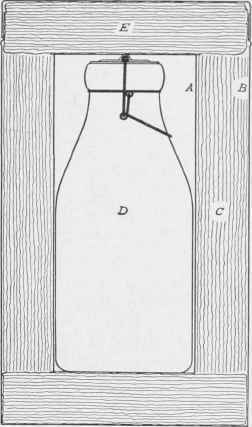
Fig. 275. - A heat retaining bottle.
Continue to:


My Books

