


The Parting Tool And Calipers
Description
This section is from the book "Art And Education In Wood-Turning", by William W. Klenke. Also available from Amazon: Art And Education In Wood-Turning.
The Parting Tool And Calipers
In order that the wood-turner may have some quick and efficient method for obtaining a desired diameter, he resorts to the use of a parting tool and a pair of calipers, Fig. 15. Where, however, a number of pieces with the same diameter are to be turned, he often uses a combination of these tools, known as a turner's sizer,Fig. 3,b. If he has a sufficiently large number of articles to turn, each with several different diameters, it would be folly for him to set three or four turner's sizers, as this would necessitate handling too many tools, and again there would be difficulty in keeping track of the diameter of each. Where such a problem confronts him, he works out accurate gages, Fig. 16, with the diameters placed in the order he intends using them.
Fig. 15 illustrates the correct method for using the calipers and parting tool. Both are worked at one time, the calipers being held at right angles to the axis and resting gently in the groove cut by the parting tool, which is held high on the work and gradually lowered toward the center as the cut is being made. When the diameter, at which the calipers are set, has been cut, the calipers will drop.
In order that the calipers may work freely, it is advisable to round the ends with a file, otherwise there is danger of them catching in the fiber of the wood, and being thrown some distance. To use the turner's sizer, it will first be necessary to have the work reasonably near the desired diameter, otherwise the tool cannot be used. The use of this tool is similar to that of a parting tool in its cutting stroke, only it will be necessary to pull slightly on the handle so as to keep the caliper end in perfect contact with the cylinder.

Fig. 15. Using the Perting Tool and Calipers at one Time.
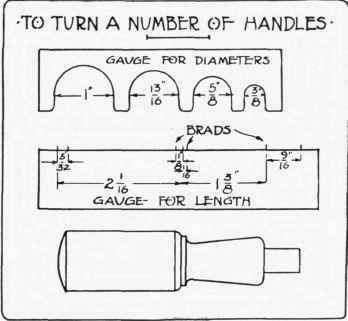
Fig. 16.
The use of the gage is almost the same as that of the calipers.
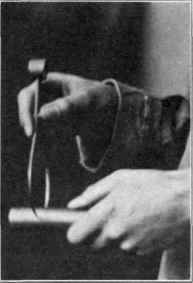
Fig. 17. Setting Calipers over a Mandrel.
To set the calipers quickly and accurately it is a good idea to use a cylinder of known diameter and set the calipers to fit that, as indicated in Fig. 17.
Continue to:


My Books

