


Shop Discipline
Description
This section is from the book "Art And Education In Wood-Turning", by William W. Klenke. Also available from Amazon: Art And Education In Wood-Turning.
Shop Discipline
With the exception of the machine shop, there is probably no shop in school where the discipline should be more carefully watched than in wood-turning. In the first place it is always more or less dangerous to work around machinery, and where we believe in Safety First, each student should be compelled to remain at his own lathe unless otherwise engaged. Permitting a reasonable amount of talking about the work in question is a good idea as one student gains knowledge from another, and it often saves the less apt student from accidents and mistakes by having suggestions made at the right time.
Secondly, if students are permitted to move about the room without a good reason, there is danger of one boy pushing another and ruining an otherwise good piece of work. When the order is given to shut off the lathes, it must be obeyed at once, and it is advisable to do this, should anything go wrong with the work or the machines. The work is not to be removed from the lathe more often than necessary, the instructor going to the lathe to inspect it rather than the student bringing the work to him.
Ample time is to be given at the end of each period for cleaning the lathes and putting all tools in their correct places. It is not enough to brush off the machines with a counter brush, but it is advisable to remove the grease, stains, dirt, etc., from all corners, and at the same time keep the lathes shining as they should. Kerosene and waste will be found to be the quickest and best method of accomplishing this. A metal receptacle is hung at each machine to contain the waste.
All tools should be numbered to correspond with a similar number on the lathe, and it is important that each boy put the correct tools at his lathe, thus making it easy to check up on missing or broken tools.
Each week one student is to be appointed, for a given length of time, to straighten out the general tool cabinet in the rear of the room, Fig. 1. This boy should see that all stain cans are closed, everything put in order, and the sandpaper box kept filled. A mark is to be given for this tool work and at least five minutes extra time for attending to everything. In the bench each boy has a locker to contain all unfinished work, also his jumper. Pieces of unfinished work too large for this are kept in a special locker, one of which is put aside for each class.
Ratings
Fig. 62 illustrates a rack for the individual cards of the students, arranged in alphabetical order. As indicated by Fig. 63 each card will contain all the necessary information needed about each boy. His name (the last name being written first), his home, room number, and a space for each problem. When a boy starts a job, he puts down the name of the problem and the date of starting. At the time his work has been passed upon and a rating given, he puts down the date of completion. In this way each boy knows where he stands and the instructor is better able to judge in the future how long it requires for the average student to do a certain problem. If at any time there is a question about a piece of work, the number on the card will indicate at what locker it may be found.
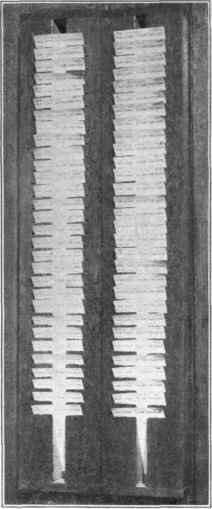
Fig. 62. Card Rack.
At the end of every month, a line is drawn under the last figure, indicating where the next month starts. The final rating of each month is kept in a separate book for this purpose.
As a part of the training and at the same time to keep up the condition of the tools, each boy is assigned, at the end of the term, the task of grinding and sharpening certain tools, for which work he is rated.

Fig. 63.
Continue to:


My Books

