


How To Cut In Whittling
Description
This section is from the book "Let's Whittle", by LeRoy Pynn, Jr.. Also available from Amazon: Let's Whittle.
How To Cut In Whittling
In whittling, you, as a beginner, must learn to hold the knife correctly and firmly and to turn the wood many times in your hand in order to obtain the best position for attack.
For the carving of some figures, especially those of animals with slender necks, it is advisable to draw a center line on the blank as a guide.
Rough cuts are used at the beginning of each project to clean away excess material. This is done by long cuts with the blade away from the body, never cutting more than the blade will take. The long sweep of the knife always is made with the grain. The knife is held firmly in the hand and the piece being cut is grasped back of the sweep of the knife. Never bury the blade into the wood, for a deep cut without direction will cause the wood to split. Figure 2.
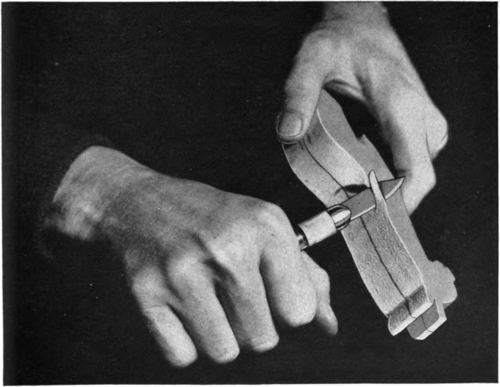
Figure 2
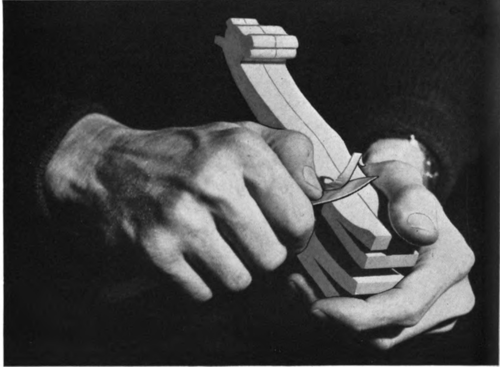
Figure 3

Figure 4
A draw cut, Figure 3, takes practice because the blade is held in an unconventional method. The blade edge faces the body and the holding hand is above the sweep of the knife as the cutting edge is drawn toward the body. Particular attention must be paid to the control of the knife in this cut.
V notching, Figure 4, is used to take away larger portions in a V shape, as between ears, wing edges, or where head and neck join in slendernecked animals. The piece being worked on is braced on a table, the holding hand grasping it close to the edge of the cut. The knife blade is forced into the wood at about a 30-degree angle, cutting to the depth needed, withdrawn, and reversed so that the next cut at the same angle forms a V notch.
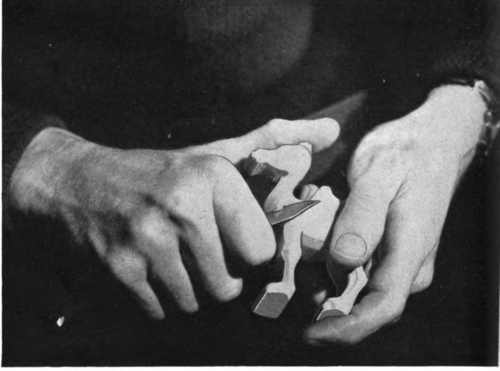
Figure 5
Seventy-five per cent of all carving is done with the thumb brace cut. Figure 5. In this, the blade of the knife again faces the body, while the thumb of the knife hand presses against the piece as in paring an apple. This cut is used for removing fine portions of wood where it is necessary to smooth and form contours.

Figure 6
Least used but important is the thumb push, Figure 6, in which the thumb of the holding hand presses against the thumb of the knife hand on the back of the blade and supplies the actual pressure for cutting the wood. This cut is used where it is necessary to maintain absolute control of the knife.
Continue to:


My Books

