


Metal Spinning
Description
This section is from the book "Handcraft In Wood And Metal", by John Hooper, Alfred J. Shirley. Also available from Amazon: Handcraft In Wood And Metal.
Metal Spinning
This process deals with the working up of thin sheet metal on a lathe, and only applies to what is known as hollow ware. It is a cheaper and quicker method of making such things as reflectors, tea and coffee pots, bowls, cups, bases for candlesticks and lamps, etc. It consists of turning a wood or metal chuck to the shape required, and then fixing between the chuck and back-centre of the lathe a flat circular piece of metal. The lathe is then put in motion, and with a steel burnisher, which is in a long handle and held in the hand and under the arm of the operator, the metal is burnished down on to the chuck. To prevent wrinkles being formed in the metal while it is being spun or burnished down on to the chuck, a flat piece of steel is held up against the back of the metal by the left hand of the worker. In spinning deep articles the metal has to be frequently annealed. Spinning requires a great deal of skill and knowledge of materials to avoid makingwasters,as they are called. Spun work is often further decorated by etching, that is, a design is drawn or stencilled on the spinning and the spaces are eaten away with acid; this is known as etched work. Stamping has to a certain extent supplanted spinning, but sometimes the work is partially stamped and then finished by spinning.
Niello is the name given to those articles of gold and silver which have the design engraved, and the engraved lines filled with a black composition composed of silver, copper, lead, and sulphur, which is made up separately and powdered very fine. This powder is applied to the metal with borax which acts as a flux; the article is then heated, the compound liquefies and runs into the hollows of the design. When cool the work is scraped over, polished or burnished, leaving the design in black upon the metal. This method is said to be the origin of engraving (printing), as when testing the work for accuracy, etc., the lines were filled with a black substance and a piece of paper was pressed on to the surface which caused the reversed design to be transferred to the paper and any faults could be easily seen. Tommaso Finiguerra was the inventor, and he lived in Florence about the middle of the fifteenth century. He was skilled in niello work.
Piercing
This is accomplished in many ways according to the material and its thickness. Thin material can be punched or pierced by means of cutting dies, or pierced by cutting out the design with a hand fret saw, or a power fret-cutting machine. Another method is to use various shaped chisels and afterwards trim up with a file.
The examples shown in Ch. viii, Fig. 6, would be best cut out with a fret saw; if a number were required a pattern could be made in mahogany and castings made from it.
Solder Decoration
Another method of decorating metal surfaces is to stencil out a pattern on the object, fill the spaces with a black varnish, or some composition that is not affected by the flux and heat, scrape clean the pattern that is left by the stencil, and apply the flux and ordinary soft solder with a soldering iron, then wash the varnish off and the design in solder will be left in relief.
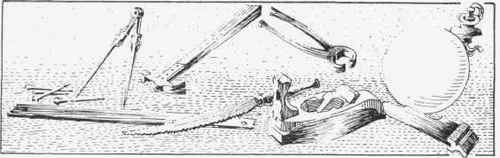
Tools of the early sixteenth century from the picture " Melancholia " by A. Durer.
Continue to:


My Books

