


Chapter XIII. Decorative Processes. In Wood And Metal Work. Continued
Description
This section is from the book "Handcraft In Wood And Metal", by John Hooper, Alfred J. Shirley. Also available from Amazon: Handcraft In Wood And Metal.
Chapter XIII. Decorative Processes. In Wood And Metal Work. Continued
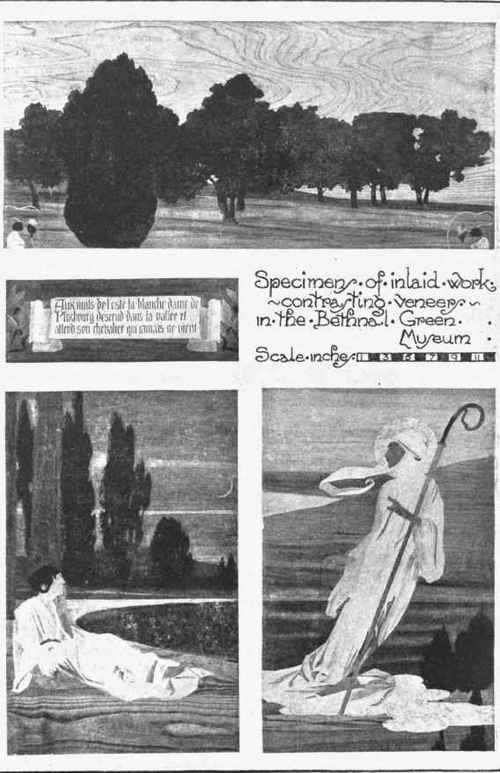
Fig. 4.-Various specimens of pictorial overlaying from Bethnal Green Museum.
Various London museums and the Louvre display specimens of inlaying of ancient Assyrian and Egyptian origin, remarkable both for ingenuity of design and perfection of execution. Metal, ebony, and ivory were the chief media used. Processes connected with handcraft lessons, either constructional or decorative, must necessarily be simple and within the range of a boy's ability. Whilst, however, strict limitations to the practical side are imposed by a pupil's capacity and physical strength, the educational or culture value is practically unlimited. Lessons on the history or development of inlaying can be devised, and the importance attached to this art in ancient times can be discussed through the medium of classic literature. The style of inlaying best suited to the needs of handcraft centres is that in which a definite unit is taken and arranged into a design. Thus in Fig. 6 a leaf is made by the simple action of two gouge cuts. The boys should be 1imitcd to the use of a certain number of units and instructed to arrange them into a simple design. Reference to Fig. 6 will show two simple treatments. When the design is completed and drawn in outline, it should be pasted down to the work in hand. The same gouge is used to cut the units in the groundwork, and when it is placed in position it should be struck smartly with the hand. The inside can then be easily removed with a small chisel, leaving cavities for the reception of the leaf units. Further applications of this process embodying various degrees of manipulative skill are illustrated in the woodwork models.
Another simple method of decorating the edges of handcraft models is that illustrated in frontispiece. This is a traditional type of decoration, introduced during the period of Queen Anne. It is easy to manipulate and refined in appearance. It is capable of many variations and is proceeded with as follows: Two pieces of wood of contrasting colours and 3/16 in. thick are gauged and planed up to thickness; the end of each piece is then planed across and strips gauged and cut from each piece, the edges being smoothed with a finely set plane. They are then glued down alternately to a piece of knife-cut veneer, and when dry the edge is planed, and strips gauged off as indicated by the dotted lines in diagram Fig. 7. In each of these designs it is necessary to work a small rebate, into which the "mosaic"inlay is glued and levelled off. This process is further illustrated on p. 50. A few good specimens of mosaic stringings, which can be purchased at most veneer stores, are illustrated on p. 53. These are inlaid as shown on p. 54, and the method by which this is effected is as follows: A scratch stock (see Fig. 8) is first prepared. A represents the stock, B is the stock or butt piece, and is connected to the stock by a bolt passed through A and B. The butterfly nut C is loosened, and B can then be pushed along the required distance from the edge of cutter E. The sectional view shows the stock with convex edge fitting into the concave edge of the butt piece or stop. The cutter E is made from 1/16 in. steel, the edge sharpened like a chisel, and then a burr is produced as with an ordinary scraper. The scratch stock is operated by pressing the end of B against the edge of the material, drawing the instrument to and fro to form a channel into which are glued the stringings, and when dry they are levelled with the groundwork. Various other applications of this process involving slight variations of practice are dealt with as they occur in connexion with the models. The following are given as examples of combinations of colour in natural woods for purposes of inlaying:-
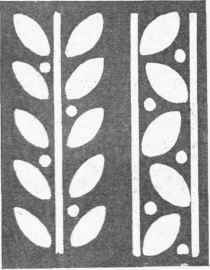
Fig. 6.-Gouge patterns.
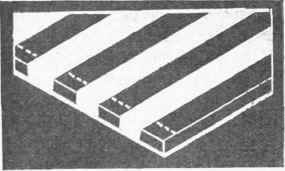
Fig. 7.-Building mosaic edging.
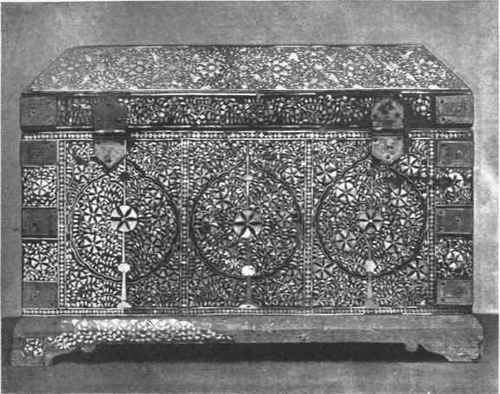
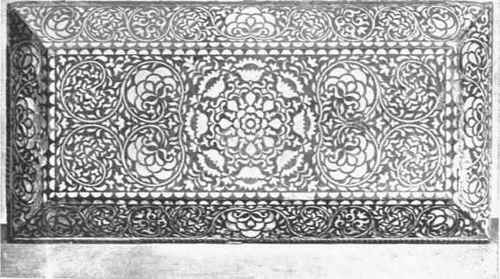
Fig. 5.-Fine examples of Eastern inlaying. Mother of pearl and mastic.
For oak groundworks the following woods give pleasing effects:-
Green and brown ebony. Various varieties of rosewoods, holly, chestnut, Italian and American walnut, and cocos wood, a species of ebony.
For Italian or American walnut groundworks:-
Brown oak, the various varieties of ebony and rosewoods, holly, pear, box, and purple wood.
For rosewood groundworks:-
Brown oak, ebony, purple, ivory, and holly. Other materials used for inlaying include mother of pearl, blue and Japanese pearl, ivory, and various metals, all of which can be judiciously combined with the majority of the preceding woods. All these demand certain processes not previously dealt with. Pearl is a very brittle substance and extremely hard, hence one thickness only can be cut at a time, and the best plan is to trace the desired shapes on to the pearl and then to fix it in the jaws of a parallel vice (see diagram Ch. xvi, f. 15). A small fret saw frame (see Ch. xvi, f. 8 (1)) should be used to cut the pearl, held with the blade horizontal. A little soap rubbed on the blade facilitates working, and if necessary the pieces should be regulated with a fine cut file. Before they are glued in, the pieces should be roughened with the end of a file in order to assist the adhesion of the glue. Ivory is treated in a similar manner, and is also cut, one or more thicknesses, as described above. Metal for inlaying should be about 1/32 in. thick, and is also cut with fret saws as described, the underside being picked with a sharp point to assist adhesion. A small quantity of Venice turpentine or garlic added to glue acts chemically upon metallic surfaces, removing all traces of grease, and effects a much stronger joint. Mother of pearl is best when treated in masses for decoration, thus obtaining the full effect of its charming colours and varying shades. Ivory is best for spotted or mosaic decoration, and the use of metal is practically restricted to small escutcheons and enrichments.
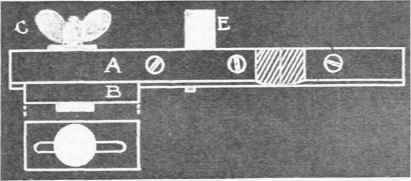
Fig. S.-Diagrams illustrating a scratch stock.
Continue to:


My Books

