


The Use Of A Steel Scraper
Description
This section is from the book "Shop Projects Based On Community Problems", by Myron G. Burton. Also available from Amazon: Shop Projects Based on Community Problems.
The Use Of A Steel Scraper
Paragraph 16. The purpose of the steel scraper is to finish and to produce a fine surface on the board by removing all tool marks and other blemishes. It is practically impossible to finish the surface of a board with a plane without leaving plane marks; for this reason a very sharp scraper must be used as the final cutting tool. The steel scraper should be used as shown in Figure 33. Notice that the scraper is held between the thumb and finger in such a way as to throw it in a small curve. This has a tendency to raise the corners and prevent their marring the work. Sometimes a scraper is so made as to fit into an iron frame which is equipped with handles; this sort of cabinet scraper enables one to work much faster than with a small hand scraper, shown in the illustration. In the shop where considerable resurfacing is to be done, such a scraper should be provided.
The scraper should be kept very sharp. The cutting edge should be as nearly straight as possible, with the exception of the corners being slightly rounded to prevent scratching. The scraper may be sharpened with a file; the angle at which it is to be sharpened varies and is not of vital importance. After filing the scraper some men use the tang of the file or some other smooth piece of steel and rub it along the sharp edge of the scraper to turn the edge out slightly; this makes it cut more readily. You will have to experiment with this tool in order to sharpen it so it will do good work. The scraper should always be used in the direction of the grain, never across the grain, and it should be used to finish all surfaces of cabinet or other fine work.
Note: As a rule beginning students are inclined to neglect the use of the scraper, thinking that they can produce a satisfactory surface with a plane and sandpaper. In order to avoid this mistake you should learn to use the scraper early in your work, and practice it until you appreciate what an important tool it is when you are expecting to do fine work. Of course its value depends largely upon its being kept properly sharpened.
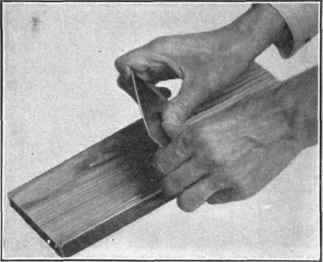
Figure 33.
Continue to:


My Books

