


Hatchet And Hammer Handles
Description
This section is from the book "Shop Projects Based On Community Problems", by Myron G. Burton. Also available from Amazon: Shop Projects Based on Community Problems.
Hatchet And Hammer Handles
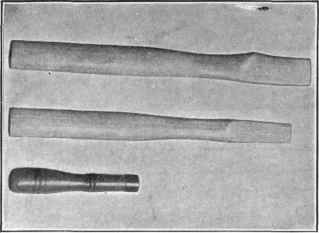
Materials
Hickory (Chap. III., Par.
39).
1 pc. 1 1/8" x 1 3/4" x 14 l/2" rough (split).
Introductory Statement
Everybody is more or less familiar with the use of a hammer, for there is possibly no one tool which is so generally employed in all kinds of work. The handle is usually the first part of the hammer to wear out or break, and while a new handle can be purchased at a very reasonable price, yet it is quite convenient for a boy to be able to make a hammer handle. Most hammer handles are broken by carelessness or abuse; this is not likely to occur if one has had the experience of making a few handles.
Hammer handles should be made of clear, straight-grained hickory, and if the material is properly selected a hand-shaved handle is usually far superior to the machine-made handles which are on the market.
References:
U. S. Farmer's Bulletin No. 347, The Repair of Farm Equipment. The Lathe and Its Uses, Stories of Industries. G. P. Putnam's Sons. The Repair of Farm Equipment, Scientific Am., June 5, 1909. Farm Conveniences. Orange-Judd Co., New York.
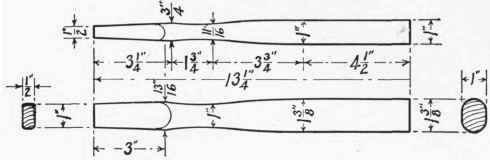
Hammer Handle
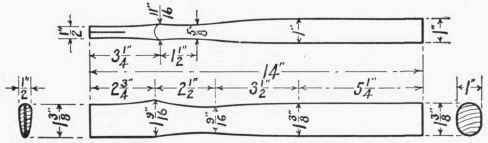
Hatchet Handle
Suggestions For Original Design
Sole Leather
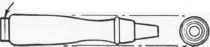
No.1
Chisel Handle

No. 2 File Handle
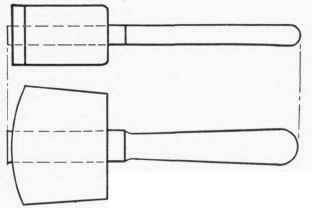
No. 3 Mallet
Hatchet And Hammer Handle Specifications
The material for your hammer, or hatchet handle, is rough on all sides, because it is split out of the log. The purpose in furnishing split material is that you may get your handle perfectly straight grained. The hammer handle cannot be laid out with a marking gauge and try-square in the same way that you lay out most pieces of work, because the completed handle does not have straight and parallel edges. If you have a drawing knife in the shop, it will be found the most convenient tool with which to do most of the cutting.
It would be well to square this stock to the largest size shown in the drawing (Chapter II., Paragraphs 1, 2, 3, 4). In any kind of shaved work you must be very careful not to cut against the grain, or the wood will tear and be very rough. This is particularly true in making a handle. After you get the stock squared, so it is thick enough for the thickest dimension of the drawing, and wide enough for the widest place, you should then block it out with the drawing knife or plane, or pocket knife, by cutting away the corners and making it approach the shape of the handle. You must be very careful not to cut it too small at any point, or to allow any of the shavings to cut in too deeply by following the grain.
Making the final shape of the handle is largely a matter of judgment, and you will show your skill by shaving out the handle to the desired shape, and bringing it to the dimensions at all of the points shown in the drawing.
Continue to:


My Books

