


Mathematical Rules, Etc., For The Convenience Of Mechanics
Description
This section is from the book "Modern Carpentry And Building", by W. A. Sylvester. Also available from Amazon: Modern Carpentry And Building.
Mathematical Rules, Etc., For The Convenience Of Mechanics
Indicative Characters or Signs.
The sign + (plus) between two numbers indicates that they are to be added together.
The sign - (minus) indicates that the number placed after it is to be subtracted from the number placed before it.
The sign x (times) indicates that one number is to be multiplied by another.
The sign (divided by) indicates that the number on the left hand is to be divided by the number on the right hand.
The sign = (equal to) indicates that the result of the figures before it amounts to the number placed after it.
The sign is called the radical sign; and, if it has a figure 2 placed over it, it signifies that the square root of the number before which it is placed is required. If it has the figure 3 placed over it, then it is the cube root which is required.
In figuring drawings, feet are usually indicated by a single index, and inches are indicated by two indices, thus: 12' 8 3/4" is 12 feet 8 3/4 inches.
Prime Numbers.
A prime number is a number that cannot be divided by any other number without leaving a remainder.


Table of Prime Numbers from 1 to 1,000. | |||||||||
1 | 59 | 139 | 233 | 337 | 439 | 557 | 653 | 769 | 883 |
2 | 6l | 149 | 239 | 347 | 443 | 563 | 659 | 773 | 887 |
3 | 67 | 151 | 241 | 349 | 449 | 569 | 661 | 787 | 907 |
5 | 71 | 157 | 251 | 353 | 457 | 571 | 673 | 797 | 911 |
7 | 73 | 163 | 257 | 359 | 461 | 577 | 677 | 809 | 919 |
11 | 79 | 167 | 263 | 367 | 463 | 587 | 683 | 811 | 929 |
13 | 83 | 173 | 269 | 373 | 467 | 593 | 691 | 821 | 937 |
17 | 89 | 179 | 271 | 379 | 479 | 599 | 701 | 823 | 941 |
19 | 97 | 181 | 277 | 383 | 487 | 601 | 709 | 827 | 947 |
23 | 101 | 191 | 281 | 389 | 491 | 607 | 719 | 829 | 953 |
29 | 103 | 193 | 283 | 397 | 499 | 613 | 727 | 839 | 967 |
31 | 107 | 197 | 293 | 401 | 503 | 617 | 733 | 853 | 971 |
37 | 109 | 199 | 307 | 409 | 509 | 619 | 739 | 857 | 977 |
41 | 113 | 211 | 311 | 419 | 521 | 631 | 743 | 859 | 983 |
43 | 127 | 223 | 313 | 421 | 523 | 641 | 751 | 863 | 991 |
47 | 131 | 227 | 317 | 431 | 541 | 643 | 757 | 877 | 997 |
53 | 137 | 229 | 331 | 433 | 547 | 647 | 761 | 881 | |
Long-Measure Table.
12 | inches make ....................... | 1 | foot |
3 | feet make.................... | 1 | yard |
5 1/2 | yards, or 16 1/2 feet, make................. | 1 | rod or pole |
40 | rods make.................. | 1 | furlong |
8 | furlongs make...................... | 1 | mile |
One mile contains 5,280 feet, or 1,760 yards, or 320 rods; 3 miles make 1 league; 6 feet=l fathom.
Surface, or Square 31easure.
144 | square inches make......................... | 1 | square foot |
9 | square feet make...................................... | 1 | square yard |
30 1/4 | square yards make............................ | 1 | square rod |
160 | square rods make.............................. | 1 | acre |
640 | acres....................... | 1 | square mile |
Lathing and plastering are usually reckoned by the square yard. Of flooring, slating, etc., a square is 100 square feet.
Cubic, or Solid Measure.
1728 | cubic inches make...... | 1 | cubic foot |
27 | cubic feet make........................ | 1 | cubic yard |
10 | cubic feet make.................. | 1 | cord foot |
8 | cord feet, or 128 cubic feet, make . | 1 | cord of wood |
A pile of wood 8 feet long, 4 feet broad, and 4 feet high contains a cord.
A cord foot is 1 foot in length of the above pile.
A perch of masonry is 16 1/2 feet long, 1 foot high, and 18 inches thick; or 24 3/4 cubic feet.
To reduce Several Fractions to their Least Common Denominator.
The numerator of a fraction is the number above the line; the denominator is the number below the line.
Rule. - 1. Find the least common multiple of the denominators for a new denominator.
2. Divide the least common denominator by each given denominator, and multiply the quotient by the corresponding numerator, for the new numerators.
Example. - Reduce 1/2, 3/4, 1/3, 5/6, and 1/8 to the least common denominator.
2 | 2 | - | 4 | - | 3 | - | 6 | - | 8 |
2 | 2 | - | 3 | - | 3 | - | 4 | ||
3 | 3 | - | 3 | - | 2 | ||||
2 | 2 |
2 x 2 x 3 x 2 = 24, the least common denominator.
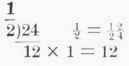
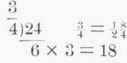
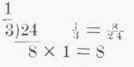
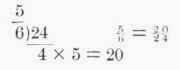
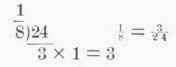
Explanation. - We first find the least common multiple of the denominators, 2, 4, 3, 6, and 8, by dividing them by a number which is contained in one or 4moie of them; and this quotient we divide again in the same manner, and so on until the division is complete; then multiply together the divisors, and the result is the least common multiple of these denominators, which we use for the new denominator. Then divide this new denominator by each of the others, and multiply this quotient by the given numerators.
To reduce a Fraction to a Given Denominator.
It sometimes happens in figuring out work that the fractions come different from any marking: of the rule. For in-stance, it may come in ninths, or in fourteenths; the workman wants to know how many eighths and sixteenths a certain number of ninths or fourteenths may be. Suppose we have \\ of an inch, we want to know how many sixteenths that represents.
Rule. - Multiply the required denominator by the numerator, and divide the product by the denominator of the given fraction: the result will be the required numerator.
Thus 10, the required denominator, multiplied by 11, the numerator, gives 176; which, divided by 14, the denominator of the given fraction, gives 12 8/14, the new numerator: so that
11 _ 12 8/14 =3
- = - - strong
14 16 4
To reduce Fractions to Decimals.
Rule. - 1. Annex ciphers to the numerator, and divide by the denominator.
2. Point off in the quotient as many, decimal places as there* have been ciphers annexed.
Example. - Reduce i to a decimal.
Ans. .125 (125 thousandths). 8)1.000
.125
Simple Proportion, or Rule of Three.
Simple Proportion is an equality between two simple ratios.
Ratio is the relation, in respect to magnitude or value, which one quantity or number has to another of the same kind; or the quotient arising from the division of one number by another: thus, the ratio of 8 to 4 is 2, since 8 is 2 times 4; the ratio of 4 to 8 is 1/2, since 4 is 1/2 of 8.
Rule. - Make that number the third term which is.of the same kind as the answer; and if, from the nature of the question, the third term must be greater than the fourth term, or answer, make the greater of the two remaining terms the first term, and the smaller, the second; but, if the third term must be less than the fourth, make the less of the two remaining terms the first, and the greater, the second; then multiply the second and third terms together, and divide their product by the first term: the quotient will be the fourth term, or answer.
Continue to:


My Books

