


269. Ash (Fraxinus)
Description
This section is from the book "Bench Work In Wood", by W. F. M. Goss. Also available from Amazon: Bench Work In Wood.
269. Ash (Fraxinus)
Ash (Fraxinus). This wood occupies a place in commerce next in importance to that of oak. In fact, ash and oak resemble each other in that there are bands of porous spring wood in both, though the medullary rays of ash are thinner and are often hardly discernible. Ash is coarser and less attractive, but easier to work than oak. There are, in the United States, about fifteen species of this genus. Lumbermen, however, separate them into white and black ash.
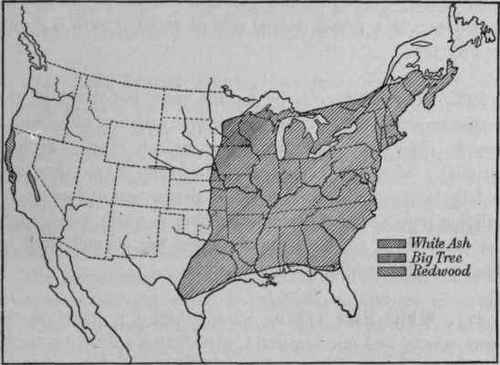
270. White Ash (Fraxinus Americana Linn.) grows in the region between Nova Scotia and Florida, and westward intermittently to Minnesota and Texas. The tree rises to a height of from forty-five to ninety feet and is three or four feet in diameter. It usually has gray or dark brown, furrowed bark, and smooth leaves, which are white on the under side. The heart-wood is a mottled, reddish brown, and the sapwood either white or very light.
The wood is straight-grained, heavy, hard, strong, stiff, and tough, but becomes brittle with age; it is not durable in contact with the soil, shrinks moderately, seasons with little injury, takes a good polish, and is easily worked. In carpentry it is used for finishing lumber, for stairways, and for panels. Barrels, baskets, cars, tool handles, and hoops are made from it, as well as wagons, carriages, farm implements, machinery, and all kinds of furniture. This wood grows in abundance and is one of the most useful of the broad-leaved varieties. The weight of the seasoned wood is thirty-nine pounds per cubic foot. The general characteristics of the other varieties of this genus are very similar to those of white ash. The distribution of this wood is shown by Fig. 313.
Fig. 313
271. Needle-Leaved Woods are more uniform in their general characteristics than the broad-leaved varieties. These characteristics are lightness, regularity of structure, obscurity of the medullary rays, presence of resins, absence of pores in sections, and the ease with which the wood is worked. Trees of this class may commonly be identified by the cones, by the needle-like leaves, and by the fact that they are evergreen, although there are a few exceptions to this characterization. In common speech, needle-leaved tree, soft wood, conifer, and evergreen are used as synonymous terms. These trees afford large, straight pieces of timber and, consequently, are suitable for carpentry and the frames of buildings, and in the United States they furnish the bulk of lumber for purposes of construction. The principal varieties are cedar, cypress, fir, hemlock, tamarack, pine, redwood, spruce, and yew. The general appearance of a needle-leaved tree of forest growth is shown by Fig. 310.
272. Pine (Pinus) is by far the most important of the needle-leaved family. There are several varieties, all of which may be classed as either hard pine or soft pine. The four varieties - white pine, long-leaved pine, short-leaved pine, and loblolly pine - are important in the production of lumber for building purposes. Of these, white pine is a soft wood, while the other three are hard woods. Pines are characterized by long, smooth, straight, and solid trunks.
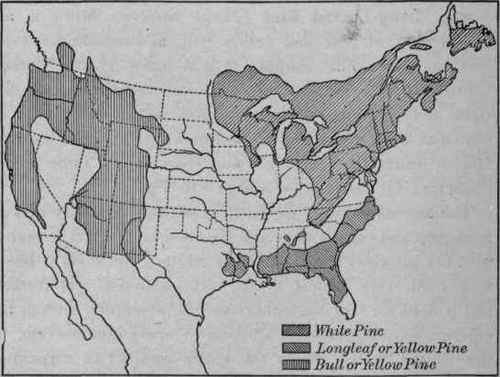
273. White Pine (Finns Strobus Linn.) is found in the north-central and northeastern United States, advancing northward into Canada, southward into Illinois, and along the Alle-ghenies into Georgia. This species, though commonly called white pine, is known in different localities as Weymouth pine, soft pine, northern pine, spruce pine, and pumpkin pine. It is distinctively a northern tree, though it is found in some portions of the South. It grows to be from seventy-five to one hundred and fifty feet in height, and from three to six feet in diameter, and even larger. The wood is very soft, light, not strong, very close, straight-grained, exceedingly easy to work, and susceptible of a beautiful polish. The resin passages are small and not numerous or conspicuous; the annual rings are obscure, and the medullary rays thin and numerous. Its color is a very light brown, often tinged with red, and the sapwood is nearly white. It seasons well, shrinks less than other pines when drying, and is fairly durable. It is used in the manufacture of matches, wooden ware, and shingles, in cabinetmaking, for interior finish, and in carpentry, and is the most valuable building material of the northern states. It has existed in extensive forests, but the supply is now rapidly diminishing and the yellow pines are to some extent taking its place. The weight of the seasoned white pine is twenty-four pounds per cubic foot. Its distribution is shown by Fig. 314.
274. Long-Leaved Pine (Pinus palustris Mill.) is also known as hard pine and yellow pine, and in different localities has many other names. It is a native of the southern United States, growing freely in the south-Atlantic and Gulf states and intermittently from Virginia to Alabama, and is the principal lumber tree of the Southeast. It grows to be from fifty to ninety feet in height and from one to three feet in diameter. Its distribution is shown by Fig. 314.
The annual rings are easily detected, the medullary rays are numerous and conspicuous, and the color is light red or orange, with the sapwood thin and nearly white. The wood is heavy, very hard, very strong, tough, coarse-grained, and durable, and is used for fencing, railway ties, shipbuilding, interior and exterior finishing, and for all sorts of heavy construction. In the United States almost the entire product of turpentine, pitch, tar, and resin comes from this species. Commercially it is considered the most valuable of the southern pines. The weight of the seasoned wood is thirty-eight pounds per cubic foot.
275. Short-Leaved Pine (Finns echinata Mill.) is called yellow pine and hard pine, and has many other local names.
It is found in the region from Connecticut westward to Kansas and Texas. The tree grows from fifty to sixty feet in height and from two to four feet in diameter, and is erect and of fine appearance. Its general characteristics are much like those of the long-leaved pine, except that it is lighter and not so strong, and its uses, also, are practically the same. The weight of the seasoned wood is thirty-two pounds per cubic foot.
276. Loblolly Pine (Pinus Taeda Linn.). - This tree grows in nearly the same region as the long-leaved pine and appears naturally on land which has been abandoned, preferably that which has been occupied by a forest. This trait gives it the name of old-field pine. The tree grows to be from fifty to one hundred feet in height and from two to four feet in diameter. In color, grain, structural qualities of wood, and representative uses it is very similar to the long-leaved pine, though it is not so durable in the natural state. At present one of its uses is in making bridge timbers and railroad cross-ties. In such service, by the application of some preservative, it is often made to take the place of the more durable long-leaved pine. The weight of the seasoned wood is thirty-three pounds per cubic foot.
Fig. 314
Continue to:


My Books

