


Toy Boats
Description
This section is from the book "Woodworking For Beginners: A Manual for Amateurs", by Charles G. Wheeler. Also available from Amazon: Woodworking For Beginners.
Toy Boats
A few suggestions about the woodwork of the hulls of toy boats may be useful to the beginner. The details of rigging and discussion of the merits of the various types and designs are matters which do not come within the scope of this book, and you can easily find information upon these points.
Making your boats yourself is half the fun, of course, and capital practice with tools as well as a valuable introduction to the building of model yachts, which you may undertake later, and to the general subject of boat-building and sailing. Making different types and sailing them is both interesting and instructive.
You will quite often see little boats fitted up as exact copies in miniature of real vessels, with all the complexity of fittings, rigging, and minor details found in the larger boats. These models are often interesting specimens of skill, - as pieces of handiwork, - but the time can usually be spent to better advantage in some other way. If you wish actually to sail your boats, leave out everything which is not essential to successful sailing.
Very little skill, and no instruction, is required to make the simpler forms of toy boats familiar to the small boy who lives near the water. Almost any scrap of shingle or piece of wood upon which a little mast can be raised will sail, as the small boy well knows. The difficulties begin when something more like a boat is attempted, and the first and greatest of all difficulties is that of the design, as you will discover later if you attempt scientific model yacht-building. But advanced model yacht-work requires much skill - more than can be expected of a beginner. At first, in beginning to make toy boats, copy any successful boat as nearly as you can. After you get beyond making boats of shingles and scraps of board, you may very likely make something like Fig. 351,which is too simple to require special description ; but when you begin to build regular boats you will find enough to tax your wood-working skill to t h e utmost. You had best begin with simple forms and not make your first attempts too large.
One way of making the hull (as of course you know) is to cut it from a solid block of wood of the required size. Another way is to build it up of layers of board laid on one another horizontally (Fig. 352).'

Fig. 351.
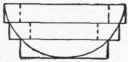
Fig. 352.
1 Still another way sometimes used for model yachts is to build the hull much in the same way that a real vessel is built - making a framework or skeleton and covering it with little planks, but this method (though a good one in some respects) requires more skill than can be expected of the average amateur, and this mode of construction should not be attempted until you become a skilful workman and accomplished in the building of regular model yachts.
If your boat is quite small it will probably be easier and better in most cases to cut the hull from a solid block ; but if much more than two feet in length it is usually better to build it in layers.
Either of these methods can be used in any case, but for a small boat the building in layers is more difficult, while for a large one it is hard to find a block that will be sufficiently free from defects.
The greatest care must be taken in the selection of the wood. It should be free from knots, checks, and bad grain, and above all things must be thoroughly seasoned. Nothing is better than the best quality of clear white pine. Mahogany is excellent, but is more costly and harder to work.
Take a simple model of the fin-keel type (Fig. 353). First you must have the design or drawing giving the different plans or views. If the drawing is smaller than the actual size you wish to make the boat, it must, of course, be enlarged and a full-sized working drawing made.1
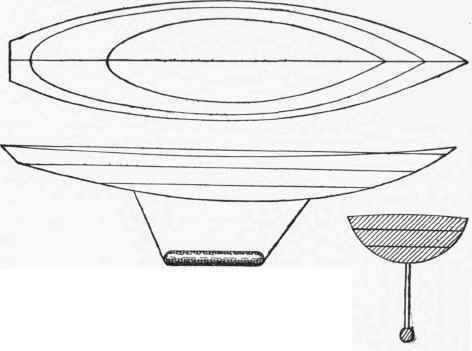
Fig- 353
1 In making the plans for a boat, three views are usually drawn, known as the sheer plan, the body plan, and the half-breadth plan. These correspond to the "front or side elevation," "end elevation," and "plan" in ordinary drawings, and give side, end, and top views of the boat, - or of one-half of it, which is all that is needed, as the sides are of course alike. Several equidistant
Before beginning work read carefully Marking, Rule, Square, Saw, Plane, Chisel, Gouge, Spokeshave, Paring, etc., and look up any other references.
To cut the hull from a solid block, first prepare the block of the right dimensions, and plane it, making sure that the sides are true and square with one another. The sheer plan must now be transferred to the sides of the block, either by copying it on the wood by the use of transfer paper placed between the drawing and the wood, by cutting out a pattern, or by fastening the drawing itself on one side of the wood and a reversed duplicate on the other side. In the same way transfer the half-breadth plan twice to the top of the block, on each side of a line drawn along the centre, reversing the pattern for one side, of course. Also continue the centre line down each end and along the bottom.
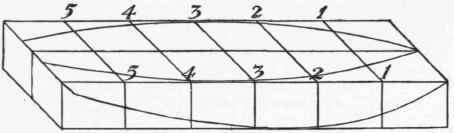
Fig. 354.
If the top and side outlines can be sawed to the lines marked with a band-saw or jig-saw, the expense will be but slight and considerable labour will be saved. Saw down on the lines 1 - 1, 2 - 2, 3 - 3, etc. (Fig. 354), nearly to the sheer line shown in Fig. horizontal lines are drawn across the plans. One of these represents the line of the water when the boat has its proper load. It is called the load water-line. The other lines being parallel to it represent other imaginary levels, at equal distances apart - like the lines which would be made by the water if the boat sunk deeper or floated higher. Other lines are also added to show vertical and horizontal, longitudinal and cross-sections, at regular intervals, and also other longitudinal sections, but these details you will find fully described in works on yacht- (and model yacht-) building.
Continue to:


My Books

