


Boat-Houses
Description
This section is from the book "Woodworking For Beginners: A Manual for Amateurs", by Charles G. Wheeler. Also available from Amazon: Woodworking For Beginners.
Boat-Houses
By using the same simple system of framework shown in Fig. 389 you can make an inexpensive boat-house (Fig. 405).
Before beginning work read carefully Marking, Rule, Square,
Saw, Plane, Nailing, Screws, Hinges, Painting, in Part V., and look up any other references.
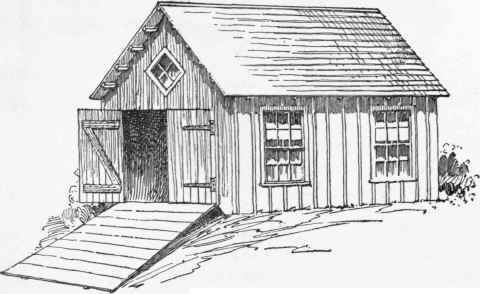
Fig. 405.
The inclined slip or platform upon which you haul the boats up from the water requires simply two or three timbers for stringers, running down towards the water, with 2" planks nailed across, as shown. The simplest way to square the ends of these planks is to nail them in place, allowing a little extra length, and then saw the ends all off at once by a line.

Fig. 406.
A house of this kind can be built to extend over the water (for boats which are to be kept in the water) by arranging a foundation of stone or piles in the water, or by digging a little dock into the shore under the house.
In these cases there must, of course, be an additional door of the ordinary kind for entrance on the shore end of the house, and it will be convenient, if the house is long enough, to floor over this end. A narrow floor or platform can also be extended along one or both sides to facilitate handling the boats and getting in or out of them.
The sill at the water end will have to be omitted, of course, a piece of studding being fitted in at each side of the door-space, but these details you will have no difficulty in arranging if you have studied the preceding examples.
A larger and more elaborate boat-house, or clubhouse (Fig. 406), having a loft for storage as well as a balcony, can be constructed on the same general principles already explained.
Before beginning work read carefully Marking, Rale, Square, Saw, Plane, Nailing, Screws, Hinges, Painting, in Part V., and look up any other references.
The end-plate for the end shown in the illustration cannot run across from side to side, because of the doorway opening on the balcony, but can be made in two parts to extend from the sides to upright studs at each side of the doorway. A simple way of arranging the frame at the floor of the second story is shown in Fig. 407.
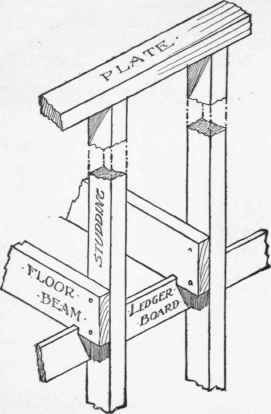
Fig. 407.
Unless this building is very small (in which case it can only be used for the storage of oars, rigging, etc.), the sills should be of 4" x 6" (on edge) or 6" x 6" stock, and the floor-beams of 2" x 6" stock. 4" x 4" or 4" x 6" will do for the corner-posts, and 2" x 4" for the studding and rafters for such a small structure as is advisable for the beginner to attempt.
If you should, however, build anything large, the posts, the lower floor-beams, if unsupported in the middle, the plates, and the rafters should be heavier. If your house is to be used by many people and heavy boats are to be hauled in and out, it is much better to err on the side of having these timbers too heavy rather than too light. But these designs are only intended for comparatively small structures.
The outer floor-timbers for the balcony had best be mortised into the posts (see Mortising). The top rail around the balcony can be of 2" x 4" studding, laid flatways, and with the upper angles bevelled (see Bevelling). The balusters can be simply square pieces nailed into place. The rail and balusters can, however, be obtained in a great variety of forms at a wood-working mill, if you prefer to buy them. The braces under the balcony can be of 2" x 4" stock. All these outside parts should be planed by machine.
The remaining details do not differ from those of the houses already described.
Continue to:


My Books

