


Bevel
Description
This section is from the book "Woodworking For Beginners: A Manual for Amateurs", by Charles G. Wheeler. Also available from Amazon: Woodworking For Beginners.
Bevel
This is similar to the square, but with a movable blade which can be set at any angle. When permanently fixed at an angle of 450, it is called a mitre-square. The bevel is useful, not merely to mark any desired angle, but to repeat some angle already formed, to which you apply it, moving the blade until it fits the angle, when the tool can be applied to another piece and the angle repeated. The directions about holding the head of the square close to the edge apply also to the use of the bevel (see Square).
To obtain an angle of 450 with the bevel, place it against the inside edge of the large steel square (Fig. 475), setting the blade at such an angle that it will intercept equal distances on both arms of the square.
On this same principle, for other angles, observe the figures intercepted by the blade, as shown in Fig. 476. Note that for this angle the figures are 2 and 4, and you can get the angle again at any time by setting the bevel at those figures. You can also set the bevel by laying off the required angle with compasses on a straight-edged board, to which the bevel can be applied. The angle should be so laid out on the board that it will not be necessary to try to set the point of the compasses exactly at the edge, which is of course impossible. See Bevelling.
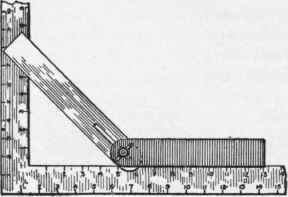
Fig. 475.
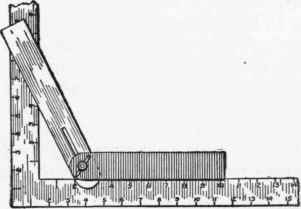
Fig. 476.
Continue to:


My Books

