


Arms
Description
This section is from the book "A History Of Furniture", by Albert Jacquemart. Also available from Amazon: A History Of Furniture.
This section is from the "" book, by .
Arms
MAN had no sooner appeared upon the earth than he felt that his first need was to provide himself with arms to resist his various enemies. Of these the most formidable were his fellow-men, and he was compelled to seek in weapons offensive and defensive, a whole system of expedients to insure his security. The history of man could then be written in his arms, if they had been preserved in an unbroken series, and in all their infinite varieties. But the research into this history requires studies special, curious, and involved. Without attempting a work so exhaustive that it would evidently far exceed the limits of this book, we will just cast a rapid glance over those objects which can find place among the furniture of collectors, and the characteristics which commend each speciality to their notice.
Arms are essentially ornamental, and can be used to decorate not only sumptuous interiors but the most simple apartment. What more imposing in an entrance hall than complete suits of armour set up all along the walls, and separated by groups of partisans, halberds, and swords crossed beneath shields or helmets ? What more elegant, in a cabinet, than panoplies of Eastern arms with their coats of mail with gilded rings, their damascened bucklers, and their swords or daggers, with Damascus blades, glittering with gold and settings of precious stones as if in irony of death?
But, as we have said more than once, this book written to assist collectors does not aim at becoming a manual of archaeological science. If we invite to the careful study of all which can interest the man of taste, we address ourselves most especially to subjects which show perfection in whole or in details - in a word, to objects of art. We must keep in view the fact that, in retracing the history of the past, it is ever to objects of luxury and of elegance that renown is attached: would the name of Theophilus have ever descended to us, had he not chased in iron the magnificent helmet of Alexander the Great? Again, it is a precious helmet found at Olympia which has preserved for us the signature of Coios; and if Hermes the armourer, Pistras of Athens and Sosinus of Gortyna had made only helmets and shields of the commoner sort and not splendid armour, we should have remained to-day ignorant of their existence.
The first complete defensive armour, the coat of mail, dates from the battle of Bouvines (1214), and was in use during the whole reign of Saint Louis. The complete armour of mail, which the knights alone were entitled to wear, was called "grand haubert" or "blanc haubert." The haubergeon, (called at a later period "a jack," was more scanty than the coat; it was specially reserved for esquires, archers and the sergeants-at-arms. The knights often wore beneath the hauberk a body-garment of leather or of cloth, quilted, this was the gamboison or gambeson. Entirely clad in mail, they covered their heads, in action, with a great cylindrical helmet. This fashion was in use until the thirteenth century, and then underwent successive modifications: from 1270 to the beginning of the fourteenth century, the coat of mail became shorter; but, long before that time in order to resist the augmented weight of offensive arms, an iron breast-plate had been worn underneath the mailed shirt: the new defence was gradually developed, and we see plates of cuir bouilli or steel upon the legs, over the joints of the knees, and on the anterior portion of the limbs; these were attached to the mail by means of leather straps. By degrees this system extended, and steps were made towards the full suit of armour, of steel plates, termed plate-armour. In 1413, the chain-mail disappears, the breastplate is arched, and of a single piece, the roundels or gussets of plate which protected the armpits are replaced by two square pieces, the braconniere, a species of jupon of jointed scales, protects the abdomen and upper part of the thighs, the vambraces and the cuisses are complete, the gauntlets have fingers and flexible joints, and the long-toed sollerets are jointed also. It was the period in which armour attained its most perfect form.
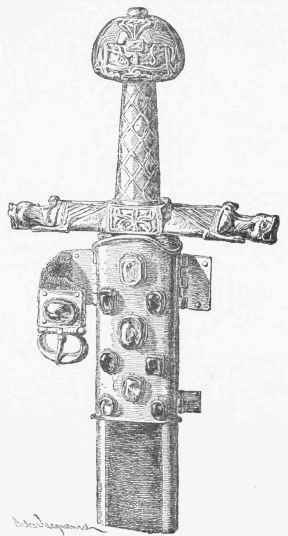
Sword of Charlemagnc, the hilt, chape, and buckle of gold, set with uncut stones. (Museum of the Louvre.).
From 1436 to the close of the fifteenth century, the men-at-arms dismounted and fought on foot, especially in pitched battles; armour was then symmetrical. But after the formation of artillery companies, in 1445, the man-at-arms remounted on horseback, in order to charge, he couched his lance in the firm iron rest of the breast-plate, and kept his left side advanced; that side required protection more than the other; the garde-bras, or cubitiere assumed vast dimensions; the right epauliere or pauldron, was reduced in size to allow of the couching of the lance, and the other enlarged until it became the great pass-guard, or garde-collet. These suits, in their several varieties, now with the pansiere and tassets added, are highly characteristic. But how much more graceful in their severe and simple elegance, are the defensive armours of the sixteenth century, commencing with the Maximilian armour, with its convex breastplate and hand-shield (rondelle a -poing), which its numerous flutings, either plain or finely engraved, relieve so agreeably.
From this time luxury took possession of the military dress: triumphs, tournays, all the grand ceremonials aroused the emulation of the great to rivalry in extravagance art must enhance the prestige of a valiant man's harness, its richness must express his power. It was then that that phalanx of marvellous artists whose names have often outlived their mighty works was formed. Milan was distinguished in the first rank, there were Antonio Biancardini, armourer to the Farnese; Bernardo Civo, Felippo Negrolo, who worked for Francis I. and Charles V.; Antonio Romero, the Piccinini, Antonio, Federico, his grandson, and Luccio, the great artists of the Renaissance, Garbugnani of Brescia, who was still living and working in 1688, Antoine Jacquart, a poitevin armourer, who lived at Bordeaux in the end of the sixteenth century and the beginning of the seventeenth. In Germany there were Kollmann of Augsburg, Leigeber, Frangois Garbag-nauer, who made the armour of Louis XIV., and Gottfried Leigeber of Nuremberg, who died, at Berlin, in 1683.
Continue to:


My Books

