


Appendix. Clocks And Timepieces. Part 2
Description
This section is from the book "A History Of Furniture", by Albert Jacquemart. Also available from Amazon: A History Of Furniture.
This section is from the "" book, by .
Appendix. Clocks And Timepieces. Part 2
In the seventeenth century the clock-manufacture underwent a two-fold change; in the first place that necessitated by the new forms in furniture, and secondly that resulting from the discovery in physics which modified even the names of the great horary constructions. Galileo had observed the laws of gravity, and had demonstrated them by means of the pendulum. In 1602 he had made use of this new instrument in those experiments which led Huygens to adopt it for his clocks. In the reign of Louis XIII., however, as we have already said, the old system was still in vogue, and Germany attached to some remarkable works the names of Conrad Kreiser, Michel Snoeberger, Altenstetter, Hans Buschmann, and Wilhelm Peffenhauser.
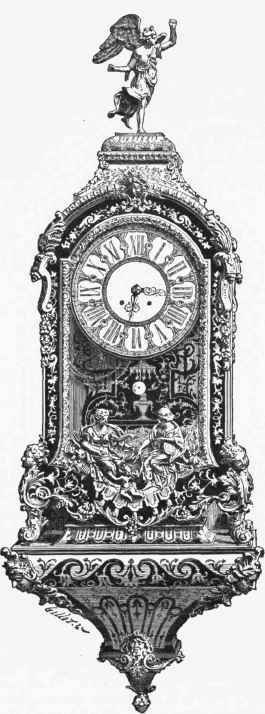
Pendule religieusc, with incrustations in boule and chased metal. End of the period of I.ouis XIV.
(Collection of M. Chocquel).
Horloge or Pendule, from the moment when the instrument for marking time became an article of furniture, it had to assume certain dimensions, whether intended to figure upon a mantelpiece, surmount a bureau, or be suspended from the centre of a panel; first placed on a bracket, afterwards isolated and having very generally a companion in a barometer with a dial face, a fashion which we meet with from the reign of Louis XIV. to the end of that of Louis XVI.
One of the earliest styles which we notice is the terminal clock (a gaine) of which the long and narrow case is equally well adapted to conceal the cords and weights of the old system, or to allow the balance or pendulum to swing with freedom. Another, called, we know not wherefore, the religieuse, is simply a modification or rather a development of the rectangular clock of the Renaissance; the top is more elaborate, the outlines more marked, and bas-reliefs and groups of figures take the place of simple engravings. It is especially in the period of Louis XIV., and under the impulse given by Boule, that this style attains its greatest development; the case is covered with tortoiseshell, incrusted with brass, the dial is surrounded by allegorical subjects in bas-relief, and the brackets, terminating in a floriated pendant, have frequently their angles embellished with magnificent acanthus leaves.
So great was the success of this style of clock in France, that it remained in favour notwithstanding all other changes of fashion : here for instance, is one on which we readily identify the bronzes of Caffieri, that is the middle of the reign of Louis XV. At this period the incrustations of Boule had been already exaggerated, the tortoiseshell was coloured red, blue, and green, and painting had been joined to the bronze, so as to increase the effect.
Of this style we cannot give a better example, than the charming bracket clock (cartel) in the collection of M. H. Barbet de Jouy. The bronzes ingeniously chased, stand boldly out from the background of green tortoise-shell, and the elegant outline of the whole composition, as well as the taste evinced in the acanthus leaves, have a highly distinctive air which enables us with certainty to attribute it to the epoch of the Regency.
It must be conceded that Italy was among the first to follow the initiative of France; and, at the Exhibition for the benefit of Alsace-Lorraine, there was shown a "pendule religieuse" belonging to the Baroness Rothschild embellished with that difficult work in hard stones known as Florentine mosaic: the elegant style of this clock, and even the judgment shown in its ornamentation would appear to fix its date about the end of the sixteenth rather than the seventeenth century; the ground of lapis lazuli, relieved by sober ornaments of various stones, is entirely free from that overloading so often a sign of decay. Another clock, the property of Baron Gustave de Rothschild, and which we have already described when treating of furniture incrusted with precious stones, excites general admiration notwithstanding its excessive richness. Among the rare objects belonging to the same amateur, we must mention a time-piece, entirely of bronze, and standing upon an open-work bracket of beautiful rocaille interlacings, in a style denoting the early part of the reign of Louis XV. This clock may be regarded as the connecting link - the transition between the "religieuses" and the cartels or hanging clocks of the latter part of the same reign, so fanciful, and sometimes so elegant in design. We find some of these clocks, supported by Cupids, and surmounted by vases adorned with wreaths of flowers, in the same style as mantel-piece clocks (pendules) which we are about to consider.

Cartel in bronze chased and gilt upon a ground of green tortoiseshell. Period of the Regency. (Collection of M. H. Barbet de Jouy.).
How far back can we trace the origin of these clocks with subjects? It would be difficult to say. We see in the collection of the Comte de Vogue a composition by Boule, wherein the oblong base is surmounted by a dial against which repose reductions in bronze of the two well-known figures from the tomb of the Medici at Florence. It is at a later date, however, and especially under Louis XV., that the subject-clock acquires real interest; for regarded in one aspect it assumes an historical character, and in another pourtrays for us some curious touches of the manners and habits of the time.
Formerly, manufactures for purposes of commerce scarcely existed; little work was done for the public, and each person in giving an order had it executed in accordance with his own tastes, or specially adapted to its intended destination. Frequently armorial shields, or ciphers surmounted with a coronet, serve to show for whom the work had been made, occasionally the clock preserved the memory of a marriage: thus on a memorial of this sort whereon Venus and Cupid predominate, we see military trophies mingled with the attributes of beauty: and again, from a bas-relief representing marriage under its antique aspect issue the shields conjoined of the wedded pair, with their ciphers, on medallions, surmounted by coronets.
Continue to:


My Books

