


Chapter XIV. The Colonial Style
Description
This section is from the book "Interior Decoration: Its Principles And Practice", by Frank Alvah Parsons. Also available from Amazon: Interior Decoration: Its Principles and Practice.
Chapter XIV. The Colonial Style
THIS style takes its name from the original Colonies as settled in North America during the seventeenth century and is the natural offspring of the parent stems - the European countries of Britain, the Netherlands and France.
In the early sixteen hundreds, about the time of the death of Elizabeth, religious, political and social conditions in England had reached the state of fomentation which resulted in the exodus of large numbers of Separatists to the Netherlands, where a larger freedom and a more democratic tendency was the accepted order of the time.
These Separatists, colonizing the western cities of the Netherland country, became somewhat mixed with the Dutch, at least they accepted Dutch forms as a partial expression of their life while in their adopted land. This was particularly true in the domestic field. Most of the Separatists were among the middle and upper classes, and they found economic necessity and religious teaching both naturally trending toward a simple, conservative and rather barren expression of the home ideal.
By 1625, when the Jacobean period in England was well under way, Massachusetts, Connecticut and Rhode Island were colonized mostly by Puritans who had left Holland and found a home in the new land. Virginia, Georgia and the Carolinas were colonized mainly by people directly from Great Britain without the influence of the adopted Dutch traditions. New York, or New Amsterdam, received its settlers from Holland direct. Pennsylvania, Maryland and Delaware were somewhat mixed with certain settlements of English, while others were of the Dutch middle classes. These settlements were, some of them, a little later than those of New England and the South.
These three rather distinct types of colonization received, off and on, considerable modifications from French influence. It is well to consider each of these as quite distinct from the others to appreciate the meaning of the term "Colonial."
The people of New England as we know them - Puritan in origin, conscientious, financially poor, sturdy, determined, conservative and hardy - developed a Colonial type quite in keeping with their general characteristics. These characteristics were crystallized and modified by the climatic conditions, while their art expressions were modified to suit the materials which were natural to the locality and by the ideals which had brought them to the new land.
Their product was a house not too pretentious in size, severely plain, generally all brick or wood, with the architectural and decorative modifications which their limited means and the rigour of the climate naturally dictated. The Anglo-classic mania of England was in their blood, though they could hardly expect to build their modest houses with solid marble columns, pilasters and cornices, or to erect their classic ideals in scale to correspond with the Jones and Wren ideas of Great Britain.
They did, however, admire the forms and seemed naturally to evolve sometimes a stone, more often a wooden pillar and capital, which, when combined with the brick or the wooden house, gave an altogether charming, though restrained, effect, known as the Northern Colonial type. To those interested in studying the peculiar charm of this type of classic manifestation the towns of Salem, Plymouth and Deerfield, Massachusetts, and those of Litchfield, Gilford and Hartford, Connecticut, present still some of the most delightful examples of the best development of the Colonial type.
Not alone in the domestic field was this Colonial style manifest. There was crystallized a religious manifestation known as the "New England meeting house," which by its nature expressed the whole story of the Separatists' idea. Gothic expression was an undisputed expression of the mediaeval Roman church. The Anglican church modified it to express as nearly as possible the Anglican idea, but the Separatist could not see his new religious ideal manifest in terms of either the Roman or Anglican architecture; nor could he think of representing this new faith, particularly in the interior, in any forms or combinations which tend to create a sensuous delight through the aesthetic combination of its significant forms and colours. To those who have seen the New England meeting house this suggestion will create a sufficient mental picture to give the desired criteria for judging the Northern Colonial its religious aspect.
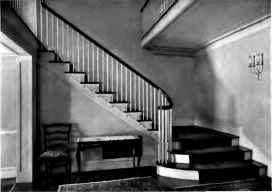
A COLONIAL HALL EXPRESSING THE QUALITIES OF SIMPLICITY, SINCERITY AND RESTRA1NT BO CHARACTERISTIC OF ALL COLONIAL TYPES.
The interior of the house at first expressed architecturally the influence of Wren, the Adam brothers and their followers, in a restrained and sometimes primitive way with flat, bare walls, white ceilings and wooden floors in strips. Among the more affluent, classic motifs are found in the cornices, and the wood trim betrays a decided Anglo-classic influence. Some of these doors, windows and chimney pieces are beautiful in proportion, chaste and simple in effect, and altogether charming. Among the poorer people the classic elements were almost unknown. Walls were, like the ceilings, bare and white or sometimes coloured with a tinted whitewash. A little later they were covered with wall papers as these became the vogue in England and, gradually, the floors received the traditional rag carpet, either braided or woven, as the fashion of the day dictated.
The first furniture was, of course, a direct importation from England and it was of the Jacobean type - mainly Queen Anne and Chippendale, with Queen Anne in the ascendancy. By 1700 the Colonies were sufficiently developed to receive a good deal of furniture, and newcomers brought with them the Queen Anne idea. By the early seventeen hundreds these pieces of furniture were copied in Hartford, Connecticut, Boston and Massachusetts, an American made Queen Anne style resulting.
Continue to:


My Books

