


Sofas
Description
This section is from the book "The Art Of Decoration", by H. R. Haweis. Also available from Amazon: The Art Of Decoration.
Sofas
Sofas ought to be as a rule simply enlarged chairs, they ought not to represent beds. There have been many very ingenious forms invented in modern days, but almost all have been spoilt by the inveterate habit of over-stuffing and pulling in with buttons. The S-shaped settee, in which two people sit on opposite sides and face one another, might be made a very pretty piece of furniture. The S might be more elegantly curved, and the upper rail might be well wadded with a smaller amount of material. The seats should be low, and deep enough to admit of a good plunge into them; and given a proper contrast of materials, wood and silk, or metal and velvet, or cane and satin, or whatever the choice be, there would be nothing to urge against its picturesque-ness as a sofa. It is at present, however, for the most part a shapeless-looking red machine which only forms one item of the ugly 'drawing-room suite.'
A very simple, almost severe, form which may be seen at Knole House is much to be commended. In spite of its straight lines, it is a most luxurious resort, and its broad surfaces admit of patterns in silk or velvet far finer than what we are accustomed to see in drawing-rooms. The fringes (almost all fringes are beautiful) are clearly seen, not smothered by jutting lumps and creases, and all the lines are good and satisfactory to the eye.
Empire sofas, like Empire chairs, are not usually comfortable, even when the horsehair is replaced by something softer. I have already said that the mood of that time was adverse to pleasure, and those Chippendale admirers who are so run away with by this 'Empire' hobby as to assert that these high heavy seats are pleasing, deny the very spirit which brought them forth. They were meant to be good artistically and mechanically - they were meant to be Greek; they are for the most part neither Greek nor good, neither convenient nor comfortable. But, compared with the horrible 'shaped ' monstrosities seen in the shops, they are quiet, severe, at any rate a change, and their angularity and plain dark colour and castorless legs win indulgence on account of the careful and temperate ornament and slender strength which characterise the best examples of this time.
For the most part, simple forms, adapted to various bodily attitudes by loose cushions, are preferable, this is because they are more manageable and more restful to the eye. Fitness to its purpose is one of the tests of beauty, and a chair or sofa should be judged like a dress or a house, by the laws of appropriateness and pleasure.
But when I say simple forms, I do not mean without ornament, for extraneous ornament is only objectionable when it misses or confuses the original intention of the thing decorated, and is only dangerous in ignorant hands.

Fig 57. - Old French sofa, in the possession of Luke Ionides, Esq.
The fine old French sofa (temp. Louis Ouinze) belonging to Mr. Luke Ionides, may be cited as an example. The primary idea, that of a low oblong couch, is not lost by the additional decorations, which are all in the direction of defining, not disguising it. This sofa is at once a beautiful ornament and a luxurious refuge. It belongs to the date when Madame de Pompadour's taste became classic, and there is no detail in its elaborate yet never obtrusive ornament but deserves study. Its refined form, its height, proportions, and workmanship are perfect. The quaint swans and the wreath of oak-leaves are conventionalised, but not unnatural; the floral ornament on the lower part is delicate and charming, though its combination with the conventional Greek 'honeysuckle,' etc, is indulgent enough.
The mahogany sofas, or rather double chairs, peculiar to late Georgian taste, are far from easy, but they boast occasionally good hand-carving. The lyre-back is remotely referable to the classics. I have seen some which, protected by loose cushions, and made in well-seasoned, hand-polished wood, are real ornaments in their quiet, rather solemn, fashion.
It is remarkable how like our own are some of the ancient Greek sofas or couches, or rather how Greek influence is traceable in some of our worst productions. Fig. 58, made in two contrasting woods, or wood and metal, would be a beautiful and comfortable seat. We know what machinery and obtuseness made of this form, how it spoiled all the curves, and how different is a poor wood structure upheld on ill-turned legs from one of similar form beautifully carven out of a fine material.
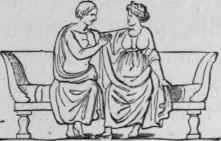
Fig. 58. - Greek sofa.
As we can refer so much in the Renascence costume to classic precedent, so we can refer to it many forms in furniture not immediately pretending to be classic, just as we can in Empire time. The 'long settles' - plain flat couches six or seven feet long by three wide, stuffed with hair - which came in vogue in the seventeenth century, with the high square-backed chair, were precisely similar to the couches used in Ancient Egypt, save that in lieu of being supported on twisted legs the box which supported them was painted with devices, more like the Gothic hutch or settle. The Greek couch had a rail at the end, like one of the Empire forms, wherein a rail of ball pattern ran equally along three sides - rather pretty. The limbs of beasts adapted to legs of furniture, a pattern so common in Rome, ought to be modelled with extreme ability to be unobjectionable, and when the modelled limb is debased into the mere curved support, without meaning or grace (as it was in classic times, not ours only), the effect is always that of nerveless insecurity, i.e. bad taste.
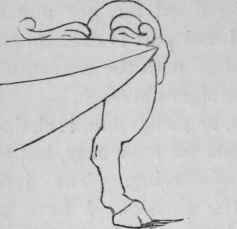
Fig. 59. Roman forms.

Fig. 60.
Continue to:


My Books

