


Bookcases
Description
This section is from the book "The Art Of Decoration", by H. R. Haweis. Also available from Amazon: The Art Of Decoration.
Bookcases
Books may be considered an ornament by their association with learning and intellectual pleasure; but unless very handsomely bound, modern books are not particularly ornamental in themselves. They may, however, always inhabit a pretty bookshelf, and I have sketched a case which has the merit of novelty in that it breaks up the dull uniform brown tint which a mass of books usually presents by niches for pots and other ornaments, and cupboards whose panels ask for ornament.
The colour of a bookshelf is not necessarily dark; the wood may be inlaid, incrusted with pieces of metal or stone, or painted. In pale blue, white, or green, varnished and thoroughly dried before the books are put in, bookshelves may be made a real addition in beauty. The colour should depend on that of the walls and ceiling. A pale blue and white 'Morris' paper adjoins pleasantly pale blue shelves; the niches may be lined with Japanese gilt papers, and the doors painted with flowers, insects, shells, crests or more ambitious subjects.' The pots may be Delft, Nankedn, Gres de Flandres, or yellow Crackle; with such a room the ceiling may be scarlet, and the doors black and blue and White.
With a room papered with a reddish paper, the shelves may be white or sea-green. The niches may correspond with the wall, or they may have a purple tinge lighted up with silver points. The pots may be Cinquecento Italian ware, or Oriental. The ceiling should carry out the colour of the pottery or of the niches.
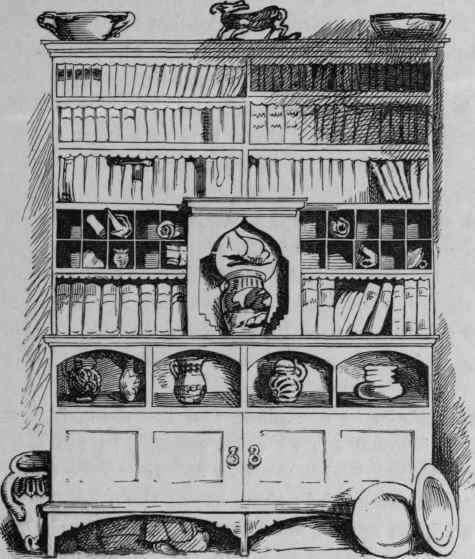
Fig. 62. - Design for a bookcase.
Inlaid shelves - in a kind of soft-coloured mar-queterie - go with almost any colour in furniture or wall. A plain murrey-coloured wall with amber velvet hangings would have a very elegant effect.
I prefer the furniture of a study or library a little gay in colour, because a mass of books, even gilt-backed, unrelieved, always tells dark and heavy; still the walls should not be so obtrusively gay that the colour distracts attention from the books. I once knew a bookworm who, feeling the want of colour, painted his wall blood-red, his doors arsenic-green; and the ideas of butchery and poisoning which these two foul hues aroused in some minds sensitive to colour-influences, were really distressing.
A soft light-red and a kindly moss-green such as a wood grows in midsummer, would have had a different effect; but most colours are painful in too large amass, and should be relieved by variations in the mouldings, or by pictures in parcel-gilt frames - filagree are best - and a little china, or cloisonne, or German glass, sturdy and quaint.
The books in one place and the china in another, each in its own glazed case, appears to me a joyless arrangement. Marry the gay colours of the one to the sober coats and bright thoughts of the other; mix pots and books in such a manner as that neither shall interfere with the other; and you get an artistically good effect. Moreover the depth of the niches is sufficient to prevent accidents, and a cloth hooked up during the sweeping out of the sanctum (which must be done, in spite of the prejudices of bookworms) preserves all together.
A pretty curtain, by the way, is a permanent protection from daily dust; and does not offer the same obstacles to reaching a book hastily as glass, or that worse device against theft, wire-netting. It should be in a thin material such as cretonne, or coloured Corah silk, and should slip to and fro on smooth and silent rings.
Continue to:


My Books

