


The Operation Of Vacuum And Safety Valves
Description
This section is from the book "Plumbing Problems", by The Sanitary Engineer. Also available from Amazon: Plumbing Problems, or Questions, Answers and Descriptions Relating to House Drainage and Plumbing.
The Operation Of Vacuum And Safety Valves
Q. What is the principle on which the "safety and vacuum valve" on top of a boiler acts, and how should it be set?
A. A vacuum-valve on a kitchen-boiler is intended to prevent the collapse of the boiler by the pressure of the atmosphere on its outside, should it become empty or partly empty through the shutting off of the water - supply; at the same time, should there be a heavy fire in the range, steam may be generated within the boiler, in which case a safety-valve is intended to let the overpressure escape. It also provides for the expansion of the water should a fire be started with a full boiler and pipes, with the street-cock accidentally shut. The annexed cut shows how a combined "vacuum and safety valve" may be set.
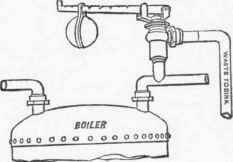
Figure 111.
For hot-water boilers in houses we much prefer to have an open-end relief-pipe, to prevent vacuum and explosions, to trusting to vacuum or safety valves, because, unlike the valves on steam-boilers, they are not often tested, and when wanted they do not always work.
Continue to:


My Books

