


Syphoning Water Through A Bath-Supply
Description
This section is from the book "Plumbing Problems", by The Sanitary Engineer. Also available from Amazon: Plumbing Problems, or Questions, Answers and Descriptions Relating to House Drainage and Plumbing.
Syphoning Water Through A Bath-Supply
Q. The writer, while repairing the connections to one of the many styles of bath-tubs which admit the water at or near the bottom, noticed that when the tub was filled, and the water shut off at the stop and waste in the cellar, upon opening the cocks in the tub the water syphoned back through the stop and waste. This is, in his opinion, a fault with tubs of that kind, or rather in connections of that kind, and one which, in the judgment of the writer, might be easily remedied. Let the manufacturers see to this, and further improve a good thing.
A. It is not clear how manufacturers can guard against such a contingency. As a practical question, we imagine such an occurrence as that cited must be uncommonly rare, though we recently heard of a case where a small service-pipe conveyed water under a light pressure to a bath, and below it to a pantry-cock and sink. On one occasion, when the bath-cock was open and a person was bathing, the pantry-cock below was also opened and speedily began to discharge dirty water, because there was not sufficient pressure to deliver at both points, the water being drawn from the bath and discharged below.
If baths are to be supplied in this way, the inlet should be above the usual water-line, though in such cases the special object of the end-supply is lost, since it is used to avoid the steam from the hot water running in. If the bath-supply were taken from a tank, there would be no risk of such an occurrence, but if, as in the case cited, the bath-cock is supplied from the same pipe that supplies several cocks below it, the opening of one or more of these lower cocks would draw the water back from the bath, providing its cock were open. We should, therefore, when the bottom supply is used, either rely on tank-supply, or be sure, if it is from street-pressure, to have the supply-pipe of sufficient size to permit water to flow at the bath, even if all the taps below it were open. In any case, it is another instance where the judgment of the plumber must be exercised.
Mr. Stephen H. Terry, of London, relates his experience as follows with regard to the foregoing:
"I will state my own experience, which goes to prove that water may be so sucked into the service-pipe, and delivered (mixed with water from the cistern) at taps below, the only requirements necessary to fulfill these conditions being that the tap or taps at the lowest level shall be open and capable of discharging (cognizance being taken of the difference in head) slightly more than the orifice of the service-pipe at its junction with the supply-tank.
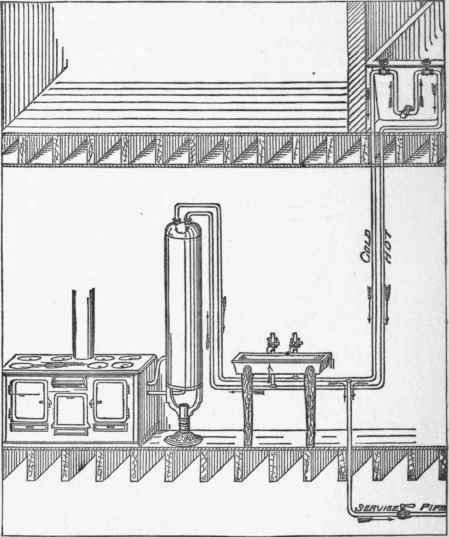
Figure 53.
"I have a cistern at the top of my house which holds about 500 gallons; this is on the third floor. On the second floor is a bath-room, closet and draw-taps. On the first floor is a lavatory and closet, on the ground-floor is a closet, and in the scullery a 3/4-inch screw-down draw-off cock. About five weeks since, wishing to clean out my lead cistern, I commenced by running off the water, for this purpose opening the scullery and lavatory draw-off cocks, and fixing the pedal of the basement-closet open. Water was plentifully discharged from all of these. I then proceeded to open the draw-off taps in the bath-room on the second floor, about ten feet lower than the water-level in the tank (the tap from which the water was running being about thirty-six feet below the water-level). To my surprise, instead of water coming out, air was sucked in, with much gurgling sound. On going up to the tank overhead, I found there was still two feet deep of water in it, while air and water were being discharged below with considerable noise.
"I may mention that the service-pipe is a small one, one inch in diameter, and this is slightly - very slightly - throttled at the place where it is soldered into the bottom of the tank.
"From the above description it is evident that all that is necessary for the suction of bath-water, or other even more objectionable liquid, into the service-pipe, is that the supply to bath or sink, or, for that matter, closet, should discharge below the level of the water in such bath, sink, or closet, and such conditions, unfortunately, are not difficult to fulfill. A bath may be left full of dirty water at a time when the cistern above is nearly empty, the supply-cock may be open, the taps in the basement may be opened, and in that case the whole of the bathwater might be syphoned out through the supply-cock, as soon as water comes on from the main to start the syphon. Sinks and closets may become choked with tea-leaves or thick paper, and other material which should not be thrown in.
"The lesson to be learned from this is that the regulations of the Metropolis Water Act, 1871, framed partly to prevent waste of water and partly for purposes of promoting public health, should be attended to. I quote Regulation 26:
"'in every bath hereafter fitted or fixed the outlet shall be distinct from and unconnected with the inlet or inlets; and the inlet or inlets must be placed so that the orifice or orifices shall be above the highest water-level of the bath. The outlet of every such bath shall be provided with a perfectly water-tight plug-valve or cock."
We are glad to record this further instance of the risks incurred in a supply to a bath entering below the water-line, especially as our attention has been called to another case, in which, as in the one cited above and in those which we have before cited, the mishap seems to have been due to insufficient size of main supply-pipe to the various fixtures. The risks of direct supply to a valve on a water-closet without the intervention of a cistern are also above forcibly illustrated.
Continue to:


My Books

