


Plumbing Fixtures. Part 7
Description
This section is from the book "A Working Manual Of American Plumbing Practice", by William Beall Gray, Charles B. Ball. Also available from Amazon: Plumbing.
Plumbing Fixtures. Part 7
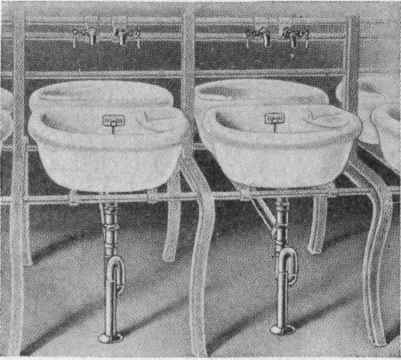
Fig. 29. Individual Factory Lavatories Courtesy of The Trenton Potteries Company.
Open strainers are most frequently fitted to sinks, in which case the sink cannot be then used for washing dishes, but merely serves as a, support for dishpans and other vessels and as a catch-all for drippings from the drainer. Hence the open-strainer sink must be large enough to accommodate suitable Washpans, etc., while one fitted with a plug-strainer should be relatively small if it is designed to use the sink proper as a washpan. A new form of sink waste connection is now a feature of the better class of enameled sinks, in which the connection is made by means of a spud and coupling something like the ordinary lavatory coupling. In it the strainer is held down in a way less likely to cause injury to the sink lining at the waste hole.

Fig. 30. Roll Rim Enameled-Iron Kitchen Sink Supported on Brackets. Splash-Back Omitted behind Drainboard.
The use of wooden sinks in large installations, such as hotel kitchens and restaurants, is not unusual, the theory of their use being that less breakage of crockery occurs, by reason of the softness of the material. However, because of the objection to any porous material which retains moisture and is subject to decomposition, wood is never suitable for this use, though with copper-lining.it is permissible.
Rubber mats are essential for both sinks and drainboards having enameled or glazed surfaces, in order to avoid accidental injury to both the fixture and the articles cleansed. As a matter of fact, the average dwelling has but one sink, which serves both kitchen and pantry purposes. Dual service is not always satisfactory, however, as no sink can be well adapted to both uses for a large family.
Porcelain and iron sinks have generally been supplied with loose backs; but sinks of one piece - that is, with sink and back integral - are now obtainable. Sinks with integral apron or skirting all around, placed free of the wall, are suitable where the wall is waterproof.
Sinks are built from slabs of natural stone as desired, and may be with or without drainboard or skirting. They are generally provided with a high splash-back. These sinks are not limited to the patterns of a moulding room, and easily keep pace with the desires of the purchasers. Selection is confined to a choice of material.
In the use of any natural stone, such as slate or soapstone, for plumbing fixtures, and especially for sinks, it should not be forgotten that angles and rectangular corners are with difficulty maintained entirely free from deposit. Although the flat surface can be readily scoured, it is always difficult to clean the sharp angles and corners satisfactorily. The difficulty is increased by the fact that some plastic jointing material, such as putty or cement, must be used in putting together the fixture; small fragments of this material project into the angles and render the corners rough.
Air-chambers may be cast in iron sink-backs, or independent cast or pipe chambers fitted in the cavity. The ordinary sink-back is not well suited to the convenience of the plumber where supplies to any fixtures pass up behind the sink. The faucet-holes cannot be changed, and slots for pipe are not provided at the top edge. Sawing these gaps after the goods are enameled, leaves the fixture with an unfinished appearance. The proportion of shank to the handle of faucets of the Fuller pattern used on sink-backs, must be such that the handles will turn straight back.
A popular fixture of comparatively late design, adapted for small dwellings and now made in the cheaper materials, is the kitchen sink in combination with a single laundry tray, Fig. 31. In this, the drainboard serves as a cover for the tray when the sink is in use. Sinks have also been supplied in combinations with lavatories, one sink being placed in the center or at the end of a battery of lavatories.
A pantry sink (Fig. 32) should always be provided with a drain-board. It is a smaller fixture than the kitchen sink, and is nearly always of the plug-strainer and overflow type. Its faucets are generally of the high-nozzle barber-shop type, but of smaller capacity and better adapted to rinsing than are kitchen-sink faucets. Indeed, the pantry sink proper need not necessarily differ at all, unless in size from sinks used for other purposes. Every feature of its trimmings and setting is intended to best serve the butler's needs.
The waste matter from the butler's sink is not like that from the kitchen sink; hence the waste pipe is not necessarily so large, nor is a grease-trap so badly needed. Grease in considerable quantities finds its way into kitchen-sink waste pipes. It floats on the stream of waste water as it travels through the pipe, and, being always next the interior surface, either adheres thereto on contact, or by a reduction in temperature is chilled and congealed arid thus clings to the pipe walls. Successive layers of grease are in this way accumulated, and the bore of the pipe is finally reduced so much that solid matter easily completes the stoppage. Forcing out, and then filling the pipe with boiling lye water, and again flushing with hot water, will usually remove most of the obstruction. Sometimes the lye loosens the grease in chunks, which clog the pipe seriously at the first favoring point, and the pipe must then be cleaned manually.
When once choked with grease, the pipe must ultimately be opened and cleaned by hand, often at material expense when long lines are deep underground. To avoid this trouble, various traps (of which two examples are shown in Fig. 33) have been designed to separate and collect the grease, either by flotation alone or by chilling and flotation combined - generally by the former. The former were previously improvised by the plumber, being placed in the drainpipe just outside the building. This location left too much pipe subject to choking between the grease-trap and the sink; and the trap itself often became a generator of bad odors in warm weather. The grease-traps now commonly furnished are placed in the kitchen under the sink, and frequently serve as the regular trap for the fixture. The grease is easily removed by lifting out the container or by skimming from the top. Hinged bolts with thumb-nuts secure the covers so that they can be easily and quickly opened and securely closed.
Continue to:


My Books

