


Trouble With A Kitchen And Laundry Boiler System
Description
This section is from the book "American Plumbing Practice", by The Engineering Record. Also available from Amazon: Plumbing: A working manual of American plumbing practice.
Trouble With A Kitchen And Laundry Boiler System
David S. Cowan, Bath-on-the-Hudson, N. Y., writes:
"About a year ago I fitted up a house in Albany with water throughout the house. There was a 40-gallon boiler placed in the kitchen connected to range. About a month ago I placed a boiler range in the laundry, which was on the floor below. The idea was to use the laundry range during the summer. Connections were made to the ends of supplies over laundry tubs for laundrv boiler, and a stop-cock was Placed on the hot-water supply from laundry tubs, because when the laundry range was not in use and kitchen range was, cold water came through the laundry boiler and chilled the hot water over tubs unless this stop-cock was closed.
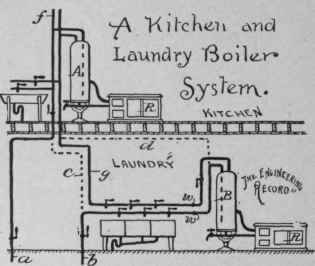
"The trouble now is that when laundry range is in use they draw hot water from the cold-water cock over the kitchen sink. I find that the hot water circulates through the hot-water pipe into kitchen boiler, and thence through the boiler tube into cold-water pipe and over sink. What I propose to do is to place a check valve on the cold-water pipe over the kitchen boiler to keep the hot water from entering the cold-water pipe. I would like to know if that would remedy the trouble, and also if this is the proper way to connect the laundry boiler. If not, please let me know what is."
[In the accompanying sketch a represents the cold supply to upper boiler A; b, the cold supply to tubs and lower boiler B; R, range for upper, and R1 range for lower boiler; /, supply to bathroom; g, hot water supply to tubs in laundry; and w w are the points where connections were made to the ends of supply pipes over the laundry tubs for the laundry boiler.
If the apparatus was arranged with a circulating pipe, we should object to the use of the check valve at once, as it will undoubtedly offer resistance enough to spoil the circulation. The diagram shows no circulating pipe, and therefore we assume there is none, and think the check valve the readiest means of curing the trouble described in the letter. The cause of the trouble is undoubtedly that there is a better and stronger flow of cold water to the boiler in the laundry than there is to the boiler in the kitchen, and that when it is attempted to draw cold water at kitchen sink a large part of it is obtained by the way of the cold supply to the lower boiler; thence through hot-water pipe to upper boiler; thence through cold-water pipe to the sink. A partial stoppage in the cold-water supply to the upper sink and upper boiler will account for it, or a contracted or small supply pipe. There are. in our judgment, two methods of remedying the difficulty without the use of a check valve - namely, the removal of the supply pipe a and the joining of the supply pipe b, as shown by the arrow and dotted line c. The second method is to remove the supply pipe b, and the connection of the pipe a with the lower boiler, as shown by the dotted line d. We favor the second method proposed, however, as we are of the opinion the supply b is more ample and vigorous than the supply a, notwithstanding that they probably come from the same source.]
Continue to:


My Books

