


Part IV.- Drip Boxes And Running Traps On House Drains
Description
This section is from the book "American Plumbing Practice", by The Engineering Record. Also available from Amazon: Plumbing: A working manual of American plumbing practice.
Part IV.- Drip Boxes And Running Traps On House Drains
All of the floor drains shown in the ground plan, Fig. 1, and those in the cellar have square cast-iron drip boxes, as shown in Fig. 8, which are also used as cleanout boxes. Some of them are large enough to allow of the assembling in them of several drains, which are then carried to the main drainage system through a larger size pipe, having a full-size running trap. Each of these traps had a cleanout G set in a manhole with cast-iron cover to allow of ready inspection. On long lines of drain pipes and at some of their intersecting points these cast-iron junction boxes are used in order that they may be readily cleaned or inspected. On these cases a flat cast-iron cover takes the place of the brass perforated top A. So far as possible two or more of these floor drains were connected with each run of the drainage pipes, and at the highest ends of each of them were set automatic flushing tanks supplied by the waste from the cold-water drinking-fountains. The cooling coils for these fountains are made a part of the general refrigerating and icemaking plant, and a current must consequently be continuously maintained to prevent freezing. Floor-drain bell traps, which are liable to become clogged when subjected to the severe service to be expected in a job of this magnitude, are thus avoided, and a cleanout arrangement is provided. All of the brass covers A are arranged for ready removal. The inlets B and the outlet D' in the cast-iron box C are cast flush with the inside bottom, which is pitched to form canals through which the water may flow unimpeded.
The cast-iron running traps A, Fig, 9, on the main house drains were set sufficiently beyond the inside lines of the area walls to give a vertical fall to any dirt, water, etc. which gained entrance to the fresh-air inlet B on the house side of the traps in order to guard against a common cause of failure of fresh-air inlets to operate. All matter or water so falling passes directly into the trap and is readily washed away. The cast-iron round bottomed bowls C were made especially for this job. They were set in the brickwork of the sidewalk arches, the wide flanges D allowing of a water-tight cement joint. The stone walk above the bowls was pierced and fitted with the oblong brass bar plates E. Ample clearing space is left between the bars, and as the widest part of the opening is at the bottom they are practically self-clearing. On the bottom of the bowls were cast collars upon which were tap-screwed the 6 and 8 inch flanges to which the upright wrought-iron pipe F connecting with the standing collar B was screwed. There are separate sinks for washing the silverware, dishes, and cooking utensils, each having a separate cast-iron Tucker grease trap 23 inches high and 28 inches in diameter, which is the largest size made, conveniently located for cleaning out. All the cold water used in the kitchen and pantry is passed through the water chambers of these traps, the proportion being divided according to the service.
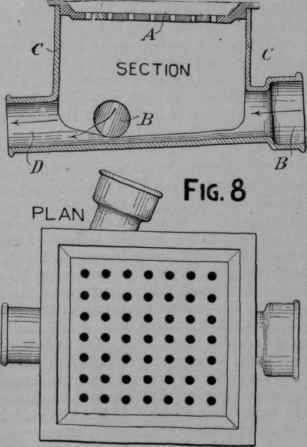
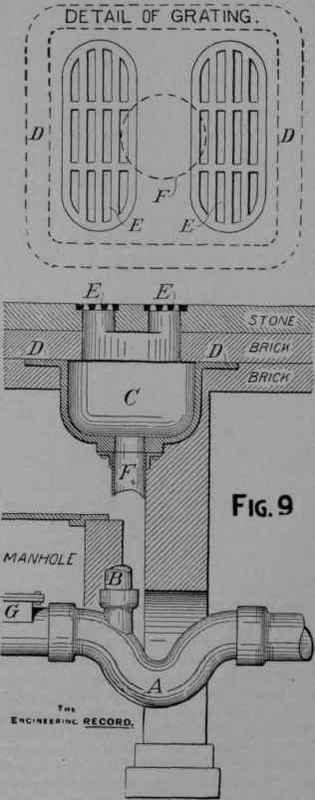
DRIP BOXES IN THE WALDORF HOTEL.
Continue to:


My Books

