


Arrangement Of A Group Of Closets
Description
This section is from the book "American Plumbing Practice", by The Engineering Record. Also available from Amazon: Plumbing: A working manual of American plumbing practice.
Arrangement Of A Group Of Closets
J. W. Barnett, City Engineer, Athens, Ga., writes:
"I send herewith a sketch (Fig. 1) of a plumbing job proposed to be done for the University of Georgia in this city and would like to know your idea as to the size of the main vent. There will be 11 water-closets set in the basement of a three-story building, flushed by one seven-gallon tank each. It is quite probable that five of them will be in use at the same moment. Is there danger of syphonage with a 2 inch main vent?"
[Assuming the simultaneous discharge of five closets to be the maximum tax put upon the pipes and that the individual seven-gallon tanks will empty in 10 seconds, the rate of discharge of the five tanks combined would be 23 cubic feet a minute. A 4-inch pipe laid with a fall of 1 in 25, or about one-half of an inch to 1 foot, will discharge about 30.cubic feet a minute with a velocity of about 6 feet a second when running full. We assume that the lateral soil branch will practically run full and that air must be supplied through the main vent at the rate of 23 cubic feet per second. The area of a 2 inch pipe is one-fourth of the area of a 4-inch pipe, and the velocity of air in.
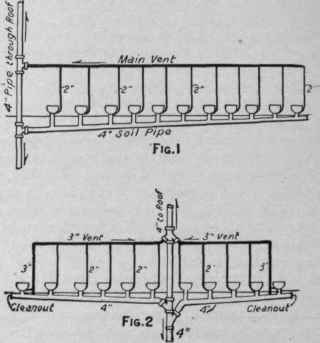
Another arrangement is shown in Fig. 2, using 4-inch soil branches and 4-inch soil extension to the roof if a straight run of pipe can be obtained. This is a preferable arrangement if practicable.]
Continue to:


My Books

