


Affinitas. Affinity. Part 5
Description
This section is from the book "The London Medical Dictionary", by Bartholomew Parr. Also available from Amazon: London Medical Dictionary.
Affinitas. Affinity. Part 5
Phosphorus
60. Volatile.Oil
Fixed Oil Fixed Alkali
Sulphur Phosphorus
61. Fixed.Oils
Lime
Potash
Soda
Magnesia
Ammonia
Oxide of Mercury Oilier Oxides Alumine Sulphur Phosphorus
62. Pyromrcous Acid
Potash
Soda
Barytes
Lime
Magnesia Ammonia Alumina Jargonia Oxides of Metals
63. Pyroligneous Acid
Lime
Barytes
Potash
Soda
Magnesia
Ammonia
Metallic Oxides
Alumina
64. Jargonia
Vegetable Acids Sulphuric Muriatic Nitric Acids
The affinities of oxygen, as ascertained by later observations, appear to be nearly in this order: Oxygen - Charcoal, titanium, manganese, zinc, iron, tin, uranium,molybdenum, tungstein, cobalt, antimony, hydrogen, phosphorus, sulphur, nickel, arsenic, nitrogen, chrome, bismuth, lead, copper, tellurium, platina, mercury, silver, nitrous gas, gold, muriatic acid.
Tables Of Double Elective Affinities, Ok Attractions
1. 'what occurs in Mixtures by Fusion.
1. | Tin, mixed with Silver, | Join with | Iron, mixed with ' Lead. |
2 | Copper, with Gold | Sulphur, with Lead. | |
3 | M.S. Gold, | Sulphur, with Regulus of antimony, |
II. What occurs in Mixtures of Watery Substances.
1 | Acids, mixed with Calcareous earths or Metallic substances, | Join with | Volatile alkali, mixed with Fixed air. | Frorn this may be experienced the nature of Double Elective Attraction when it takes place. Suppose the volatile alkali combined with any of the acids, and the fixed air with fixed alkali; these substances thus separately combined (No. 5.) will decompound each other; for the volatile alkali will unite with fixed air, and the acid with the fixed alkali. |
2. | Vitriolic or marine acid, with Alkalis or earths, | Mercury, silver, Lead, with Nitrous, or acetous acid. | ||
3. | Lead, Nitrous marine or Acetous acid, | Vitriolic acids, Alkalis, earths, or M. S. | ||
4. | Silver, Vitriolic, nitrous. or Acetous acid, | Marine acids, Alkaline salts, earths or M. S. | ||
5. | Volatile alkali, Acids, | Fixed air, and Fixed alkali | ||
6. | Nitrous, marine, and Acetous acids, Calcareous earths, | Volatile alkali, magnesia, earth of alum, Vitriolic acid. |
ill. What occurs in Distillation, on Sublimations, and re-quires Heat.
1. | Volatile alkali, mixed with Acids. | Join with | Fixed air, mixed with Calcareous earths. |
2. | Volatile alkali, with Vitriolic acid. | Nitrous, marine, or acetous acid, with fixed alkali. | |
3. | Volatile alkali, Nitrous marine or Vitriolic acids. | Acetous acid, Fixed alkali, or Absorbent earths. | |
4. | Regulus of antimony, Sulphur, | Marine acid, Quicksilver. |
See Dictionary of Chemistry, translated from the French; Black's Lectures; Chaptal, Fourcroy, and Thomson's Chemistry; Morveau 8 Papers in the Annates de Chimie; Kirwan; Phil, and Irish Trans.; besides those above quoted, may be consulted on this subject.
Affinity, compound, implies the union of different bodies in one homogeneous mass. Thus, alum, vitrio-lated tartar, a small proportion of alcohol and water, form a transparent fluid.
-------------compound, elective, we thus distinguish what is called double elective attraction, since, in many cases, there are more than four substances. If, for instance, nitric acid be added to the sulphat of ammonia, no decomposition takes place; but let nitrat of potash be added, and two new bodies are formed; that is, the potash attracts the sulphuric acid, while the nitric acid solicits the ammonia. This was familiarly explained by Dr. Black in the following manner:
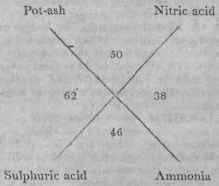
Suppose the two lines, two rulers, moving freely on the centre, if the affinity between the potash and sulphuric acid be equal to 62, that between nitric acid and ammonia equal to 3.8, the sum of these affinities will be superior to the affinities supposed to keep the sulphuric -acid and ammonia - the potash and nitric acid together, in the proportion of their sums, viz. 100 to 96. Bergman and Elliott have given different diagrams, which we need not copy. Berthollet has shewn that these representations are not chemically exact; but this would lead us into the intricacies of another science.
-------------intermediate, means the union of bodies by an intermede. The usual instance of water uniting with oil by the medium of mucilage, is incorrect; for this is not an-union, but an intimate mixture of particles unaltered. Azote will not unite with fixed alkalis, but when combined with other bodies in the form of nitric acid, the union is ready and perma nent.
Affinity, quiescent and dwellent. These terms are employed by Mr. Kirwan; the former to express the force exerted to preserve the old combination; the latter that which tends to destroy it. In the former example, the quiescent affinity between the ingredients of the sulphat of ammonia and the nitrat of potash, respectively, was equal only to 96; that of the other two bodies, respectively, equal to 100.
------------- reciprocal, forms a singular phenomenon in chemistry. A body consisting of two principles may be separated by another, which, with one of the principles of the first, forms a new compound; but the separated principle, after some time, will effect a separation of the new union.
Continue to:


My Books

