


Chapter 4. Proper Breathing
Description
This section is from the book "Reichian Therapy. The Technique, for Home Use", by Jack Willis. Also available as a hardcopy from Amazon.com.
Chapter 4. Proper Breathing
Individual Differences
How Breathing Occurs The Muscles Of Breathing
the diaphragm
the chest
Accessory Muscles Of Respiration Breathing Properly Into The Chest Paradoxical Breathing
Sounds
right sound: ah
wrong sounds
breath sound
The breathing is done in the working position (laying on your back, legs bent with the feet near the buttocks). Normal breathing is first belly and then chest in both inhale and exhale.
This is so important that I will repeat it: normal breathing is
first belly, then chest on both inhale and exhale.
If you have been instructed in yoga or Pilates or some other technique to breathe in any other way, drop that for this work.
All the breathing is done through the mouth. No nose breathing. The eyes are open at all times. Note in the top photograph in Figure 13 on page 66 that the mouth is fully open, not just a little bit, while the bottom photograph shows the (minor) error of not opening the mouth fully during the breathing.
The exhale is begun with an easy 'ah' sound without first closing the throat. I will return to this issue repeatedly.


Figure 13
Individual Differences
Some people hold their chest in a chronic inhale position. The chest is round and pulled up as though the person had already taken a deep breath. Other people hold their chest in a chronic exhale position. It is as though they had already pushed out all the air after an exhale. Examples are shown in Figure 14 on the next page. The photo on the left is an example of what is termed a barrel chest held in chronic inhale. The photo on the right is an example of the long thin chest held in chronic exhale.


Figure 14
Neither picture shows the extreme of the condition. The exemplars are ones available from my current patients.
Before you leap into right or wrong or justification for your chest shape; understand that (1) most people are in the middle and (2) there is no right or wrong in this. Whatever you are, that is what you are. There is no criticism and there is no praise. There is only fact.
Both the person on the left and the person on the right have restricted breathing which they are trying to correct. But someone in the middle can be just as restricted in his breathing as either of the two people in the photos.
As you read on, I will explain about chest movement. I will tell you how to measure it and how to correct any problems that you find.
That this issue is important, in fact central, to the work is plainly indicated by the fact that I have spent most all of Part One of this book just on just this issue of breathing.
Both the chronic inhale (on the left) and the chronic exhale (on the right) chest shape need special work. I will tell you how to work with chest shapes in Chapter six, but before you get to the working on chest shapes you need to learn the breathing exercises and get reasonably good at them.
First I will discuss the technical aspects of chest movement.
You really do need the information on chest movement. Next I will present the detailed information on proper breathing. Next, all the exercises and finally the special steps to take to free up the chronic inhale or chronic exhale chest.
How Breathing Occurs
Breathing Involves
- flattening the diaphragm
- expanding the chest
There are physically two ways to inhale. Together they form a complete proper breath.
Belly or abdominal breathing occurs when the diaphragm is tensed. When your diaphragm is tensed, your abdomen expands (balloons out). This is the first step in a full breath. This is more fully explained below.
Chest breathing occurs when the chest is expanded. In proper breathing this is accomplished by the muscles between the ribs. This is the second step in a full breath.
Some people breathe only with the diaphragm, some people breathe only with the chest. Proper breathing involves first belly then chest on the inhale and first belly then chest on the exhale.
Even though I will discuss it more fully below, I want to state from the beginning that chest breathing involves expansion of the chest, not raising of the chest. When the chest expands, it will seem to rise; but it is expansion that we want, not raising.
The Muscles Of Breathing
Belly Breathing, The Diaphragm
The Diaphragm
bell shaped
flattens in inhale: we don't breathe in, we flatten the diaphragm and that causes a vacuum which causes air to be pulled in
The diaphragm is a bell-shaped muscle. It attaches to the lower ribs in the front and then plunges down to the mid back region in the back. Figure 15 on page 70 shows the diaphragm in cross section when it is relaxed and when it is contracted.
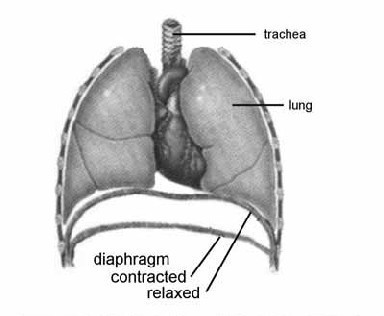
Figure 15
Note that since the diaphragm is bell shaped, when it contracts it flattens.
When the bell-shaped diaphragm flattens, that is contracts during an inhale, the air is sucked into the lungs.
The space below the diaphragm is the abdomen. That space is compacted by the flattening of the diaphragm and has to respond by ballooning out the belly. So when you breathe with the diaphragm your belly expands and your lungs expand. Please remember: air is sucked in by the flattening of the diaphragm. In fact you do not breathe in, you flatten the diaphragm and the air is sucked in to fill the space where the diaphragm was. This may seem like a small point, but actually if you incorporate this idea into your thinking about breathing, it changes the way you breathe.
As you do the work, try to think about breathing not as inhaling the air, but as expanding the abdomen and the chest. We naturally, but erroneously, think about inhaling as drawing the air in. That thought, in turn, tends to cause people to control their breathing by tension in their throat. That is kind of a natural thought. But if you keep in mind that all you are doing is expanding your belly and expanding your chest then you will learn more quickly to let go of artificial control.
Chest Breathing, The Ribs
The Chest
muscles between the ribs
expands (not rises) during inhale because of the placement of the ribs
As you can see in Figure 16 between all of your ribs there are two sets of muscles, the external intercostal muscles and the internal intercostal muscles. The suffix "costal" in intercostal is just another name for rib.

Figure 16
The external intercostal muscles are used during inhalation. They extend from about under the nipple line around back all the way to the spine.
The internal intercostal muscles are used during (forced) expiration. They run from your breast bone around the side and to about mid back.
Now think about your ribs for a moment. If you can't picture the rib cage, run your finger along your lower rib from your side, first coming forward to your breast bone and then backward toward your spine. The ribs are fixed in front at the breastbone and in back at the spine. Note that the ribs come down toward your feet as they come from the spine and then go back up to reach the breast bone.
When the external intercostal muscles contract during inhale the 2nd rib is pulled up toward the first rib, the 3rd toward the second and so on. Because of the shape of the ribs, as the ribs move upward, they move outward, thus expanding the chest. As your chest expands the air is sucked into your lungs. On the exhale the ribs return to their resting position and this pushes the air out.
I'll repeat all this once for emphasis because as you'll see in the next section, all this is important. You do not really inhale; you only create vacuums in your body and the air gets sucked in to fill the vacuum. One vacuum is created when you flatten (that is, contract) the diaphragm (and balloon out the belly) and the other vacuum is created when you expand the chest.
But there is another way that people (wrongly) breathe into the chest and we will look at that next.
Footnote 14. For the punctilious among my readers, yes I am aware that there are seven other muscles that effect chest breathing. Two is enough for our purposes here.
Continue to:


My Books

