


Chapter 2. Starting The Work - Daily Exercises. Part 3
Description
This section is from the book "Reichian Therapy. The Technique, for Home Use", by Jack Willis. Also available as a hardcopy from Amazon.com.
Chapter 2. Starting The Work - Daily Exercises. Part 3
The Eyes, Step 2
Now come closer to the mirror because you want to focus your whole attention on just your eyes.
WITH JUST YOUR EYES — IGNORE ALL THE REST OF YOUR FACE
Try to express, one by one, each of the following feelings or attitudes: anger, fear, happiness, sadness, disgust, longing, contentment, empathy, disinterest, love, and hate (you can add to this list). Note that the actual change in the eyes is very tiny and it does not matter whether you can make out any change. The goal of this exercise is to make the eyes alive.
You might know the often quoted phrase: the eyes are the window to the soul. They are. You can see in someone's eyes whether he is interested, uninterested, bored, pre-occupied, happy, fearful, angry and so much more. In general eyes can be alive or dead. People with expressive eyes are more attractive, more interesting. People with dead eyes tend to put us off, they appear as though the person were sleeping their way though life. Consciously or subconsciously we respond to the look in someone's eyes.
The goal of this daily exercise is to make your eyes alive.
To do this exercise properly you have to create the feeling in yourself and express it in your eyes. This is the kind of exercise that actors do in acting workshops that allows a great actor or actress to say so much with a close-up shot of his or her face or eyes.
This is a very powerful exercise over time. Don't be concerned if you can not seem to get anything at first.
Also don't overextend yourself (remember: don't stress yourself beyond endurance). If any given feeling is too hard on you, let it go for now. There is no rush. Come back to it days, weeks, or months later. It is better to skip something than to push yourself to perform and in the process go too far.
The issue here is the integrity of your effort, not the fact of your results. Like most things, practice makes perfect.
The Face
Move the face slowly from one state to another
From the eyes, we move to the face. While it seems simple, over time this exercise will pay big dividends.
The exercise is simply to contract and relax the muscles in your face. Note that there are, in most people, 22 muscles in the face. So there is a lot to move. You can wrinkle and relax the forehead muscle. You can squint or open widely your eyelids. You can wrinkle the nose (as if you are smelling a bad smell), you can even control the size of your nostrils (open and relax). In all there are 10,000 possible combinations of facial muscle patterns. That is not my number, it comes from Paul Ekman, the world's leading expert on emotion in the face.
If you get good you can raise one eyebrow and not the other. You can pull your eyebrows together (producing so-called frown lines). You can pull the inside of your eyebrows up or the outside of your eyebrows up or raise the whole eyebrow.
Of course you can smile and frown. You can tense your lips (purse) and you can extend your lips (pout). You can move your jaw back toward the ears (retract), out (extend), or to the left or right. You can open your mouth widely or clench your jaw.
There is one major requirement of this exercise and it will not do its job if you violate this requirement. The 'must do' rule is that all the movements must go slowly from one face to another. If, for example, you move your jaw all the way to the left and then bounce to all the way to the right, you are not doing the exercise correctly. It will not do its job.
The proper way is to, in slow motion, add new tension and then relax old tension. For example, with the jaw all the way to the left you now add squinting the left (or even the right) eye and then as you slowly move the jaw back to the center you add arching the left (or right) eyebrow.
This is only an example. The point is that you should try to make as many different faces as possible, adding new ones as you get good, but always moving slowly from one to the other.
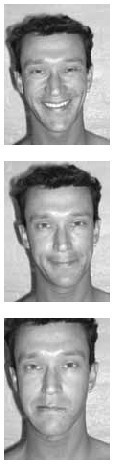


Figure 6

Figure 7
The Shoulders
1. pull shoulders together in the back
2. pull shoulders together in the front
3. shrug the shoulders
4. reach outward
From the face, we move to the shoulders. For the daily exercises this involves only four positions. In the second part of this book where I discuss the shoulders I give you a lot more shoulder exercises, but they are not for daily use.
Exercise 1
Standing up, pull your shoulder blades together in back as tightly as you can. Hold for about 20 seconds. Then relax. Think about it as though you are trying to touch your two shoulders blades together.

Figure 8
Exercise 2
Standing up, pull your shoulder blades together in front as tightly as you can. Hold for about 20 seconds. Then relax. This is a little harder than trying to touch your shoulder blades, but try.

Figure 9
Exercise 3
Standing up, shrug your shoulders and hold as tightly as possible. Do not let them relax. Hold for about 20 seconds. Then relax. This is easy to do, we all shrug our shoulders; but here you want to shrug them as high and as tight as you possibly can.
The bottom row of picture in figure 10 (next page) shows a limitation in the model's ability to shrug. Most or all of my readers will have read Reich. Reich used a single term: "armor" to describe all muscular attitudes. The use of a single term without amplification was unfortunate. It leads one to think of "armor" as only chronic tension. In fact, "armor" takes four forms: (1) chronic tension, (2) chronic flacidity, (3) rubbery muscle tone, and (4) the inability to appropriately use a muscle or muscle group. The photographs on the next page show an inability to use the trapezius to shrug the shoulders.


Figure 10
Exercise 4
Now extend your arms in front at 90 degrees to your body (that is, your hands are at shoulder level). Reach out as though you were asking for someone to help you or you were signaling that you wanted to hug someone.
Reach as far forward as you can. Strain to extend your hands further from your body. Hold for about 20 seconds.

Figure 11
Here again (as with the bottom photographs in figure 10) we see an example of how the body speaks about the character. Note that on the left the reach is also upward while on the right it is straight. Neither model was given any instructions except "now reach forward as though you wanted to reach to someone." The model on the left is like a child reaching to be picked up while the model on the right is reaching to embrace someone.
Now, here, I have to give you another caution.
Don't control your execution on any of these exercises. Don't pretend that someone is watching and judging how well you do an exercise. In pointing out the difference in these pictures I am only saying that the character is expressed in how we use our bodies. It is impossible to fake a character, it is there — in you — no matter what you do. If you try to do an exercise in a particular way all you will be doing is attempting to defend your character from change. You will not make this work more effective, you will defeat it.
Returning to my theme of the daily exercises for the shoulders, a more advanced form of this exercise — not recommended for students at the beginning of the daily therapy process — is to add words to the reaching out part of the exercise. With the hands straight, some examples are: "help me," "mommy," "daddy," "why." These are just examples. You should use whatever words seem to be right at the moment, even if they make no sense. You can also do this exercise with the hands bent back, as though you pushing something away. Then some words to use are: "stop," "no," "go away," and "I won't."
The Diaphragm
Continue to:


My Books

