


Summary Of Cases - The Therapy Of The Saline Waters
Description
This section is from the book "Part 5. Saline Therapy. Clinical Treatises On the Pathology and Therapy of Disorders of Metabolism and Nutrition", by Prof. Carl von Noorden. Also available from Amazon: Clinical Treatises On the Pathology and Therapy of Disorders of Metabolism and Nutrition, Part 5
Summary Of Cases - The Therapy Of The Saline Waters
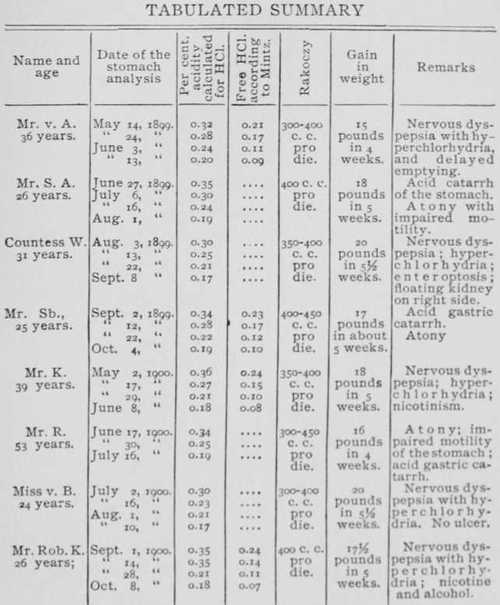
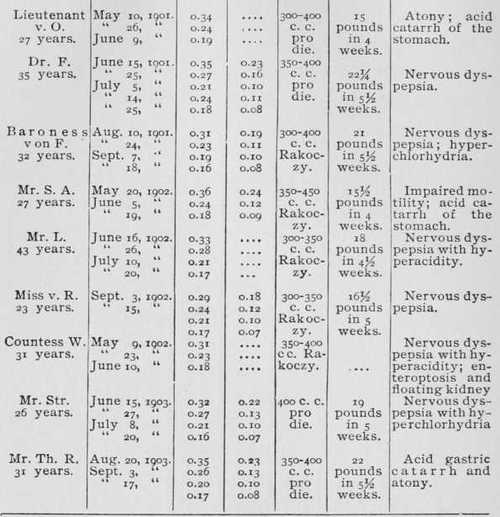
Whereas the above cases all showed good effects from the use of saline waters, there were, on the other hand, a number of cases in which the treatment was not successful. The latter, however, constitute the minority. It is impossible for the present to judge definitely which cases are suitable for treatment with saline mineral waters and which are not. While it is not, therefore, possible to say with absolute certainty that this, that, or the other case is a suitable one for this treatment, still certain predictions can be made, as follows :
Uniformly favorable results are almost invariably obtained in cases of hyperacidity occurring in nervous individuals; also in hyperacidity occurring in cases of acid catarrh of the stomach and atony of the stomach. Especially favorable and rapid results are obtained in those cases of dyspepsia that occur in persons who have overexerted themselves mentally. Whenever the patients were instructed to eat abundantly, and especially to eat large quantities of fat, in addition to taking the saline mineral waters, the therapeutic results were so good that they could be considered brilliant; for in all of these cases the gastric disturbances were cured, and, in addition, the patients gained in weight and in strength. The only cases in which the results were absolutely unfavorable were in young girls suffering from anaemia and chlorosis. In such patients we occasionally witnessed an increase of the gastric disturbances, increased formation of acid (an increase of the hyperacidity that originally existed before the treatment was begun), with loss of appetite, so that we ultimately decided to stop further therapeutic experiments with saline waters in such patients.
We, therefore, can chronicle the remarkable results that one and the same method of balneological treatment acts curatively in different diseased states of the stomach, and that at the same time this treatment may produce diametrically opposite results in regard to the chief symptom of all these diseased states, namely, the increased production of acid. This teaches us that the curative effect of the saline mineral waters cannot be gauged according to a simple formula. We are forced to abandon such routine statements as that sodium chloride increases or decreases the hydrochloric acid of the stomach, and we must be particularly careful not to measure our therapeutic indications according to such formulas. Otherwise, one incurs the danger of depriving the patients of a very useful treatment for the sake of living up to the postulates of such a formula. It is very possible that in a healthy subject the effect of saline mineral waters is exercised only in one direction, namely, towards decreasing the hydrochloric acid of the stomach. When the stomach is sick, however, this reaction cannot be considered to be so simple, for here apparently certain factors become operative that are altogether independent of the secretion of hydrochloric acid, and these unknown factors precisely produce the excellent therapeutic result that is obtained both in cases of subacidity and of hyperacidity.
We do not by any means claim that the use of the saline mineral waters alone can be made responsible for the good therapeutic results obtained in the class of cases described above. We need hardly mention that in all of the patients very exact and carefully determined dietetic measures were employed, together with the saline waters, and that the regimen was dif ferent in each case, and was adapted to the requirements of each individual patient. Without such dietetic prescriptions it would have been altogether impossible to obtain good results in many of the cases. On the other hand, the good results would not have been obtained if the ordinary dietetic scheme had been followed that is adopted as a routine measure in many of the watering places, and that is characterized chiefly by the exclusion from the diet of certain articles of food. For instance, if we had followed the scheme that is so popular in many watering places, of excluding all fat from the diet of these patients (see below) instead of permitting them to eat from 150 to 200 grams of butter every day, our emaciated patients, with nervous dyspepsia and hyperacidity, might possibly have been relieved of their stomach symptoms, but they would certainly have lost much strength and weight. We do not think that von Sohlern is justified in stating, as he does in a small monograph that has recently appeared, that the favorable results claimed from the use of saline mineral waters in the treatment of hyperacidity are due exclusively to the dietetic and hygienic regulations employed simultaneously in these cases, and not at all to any specific effect of the saline waters. One might just as well make the same statement in regard to cases of chronic catarrh of the stomach due to alcoholic excesses; and in this condition no one will certainly deny that the use of saline mineral waters has been a very successful treatment for a great many years. This point was made by Dapper in a paper that he read before the International Medical Congress in Carlsbad; and, nevertheless, no one will gainsay that even in alcoholic gastritis the use of saline mineral waters alone would certainly never lead to the goal if all other measures that are commonly used in the treatment of stomach disease were neglected. In all of these cures the prescription of the saline water is only one link in the long chain of rules and regulations that are given to the patient, but the water is a very strong link in this chain, and one that is of paramount importance.
Continue to:


My Books

