


II. On The Effect Of Saline Mineral Waters. Part 3
Description
This section is from the book "Part 5. Saline Therapy. Clinical Treatises On the Pathology and Therapy of Disorders of Metabolism and Nutrition", by Prof. Carl von Noorden. Also available from Amazon: Clinical Treatises On the Pathology and Therapy of Disorders of Metabolism and Nutrition, Part 5
II. On The Effect Of Saline Mineral Waters. Part 3
We can now report the important experiments that were performed on patients. One such investigation has already been reported, namely, the experiments carried out by von Noorden on the patient suffering from habitual constipation. To a certain extent, Dapper's investigation on himself also belongs to this category, inasmuch as a certain therapeutic aim was sought after during the time the investigation was carried on, namely, a reduction of fat.
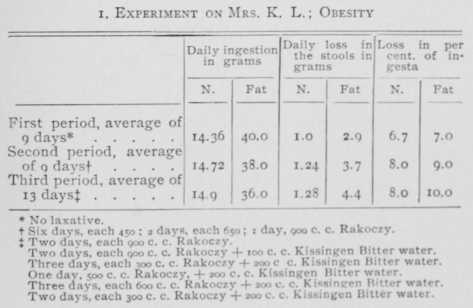
1. Experiment on Mrs K. L.; Obesity
In the foregoing and following experiments we have given a few observations on the utilization of the food in cases undergoing the reduction cure, all of the patients taking Kissingen water during the period of observation.
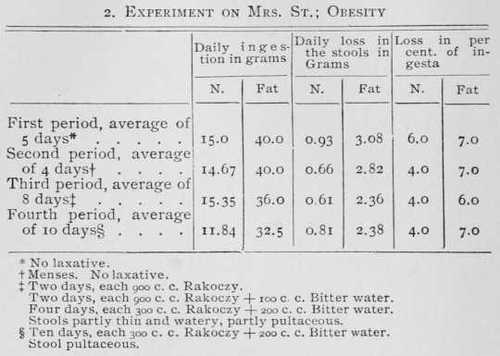
2. Experiment On Mrs. St.; Obesity
The following experiment is of great importance, because it concerns an invalid who had serious digestive disorders. The patient was suffering from gastrectasis, and an advanced degree of hypersecretion and hyperacidity, together with obstinate constipation. The patient was much emaciated. She was fed on milk, zwieback, butter, and scraped meat. The amount of food was calculated to increase the weight of the patient. In view of the condition of the stomach and the tendency of this patient to constipation, Kissingen Rakoczy mixed with equal parts of Bitter water was given.
Ingestion each day in grams | Output each day in faeces | Remarks | ||||
N. | Fat | Carbohy drate | N. | Fat | ||
1st period 7 days | 14.8 | 100 | 150 | 0.53 | 3.24 | No Laxative. Stool solid. |
2d period 5 days | 15.14 | 100 | 150 | 0.49 | 2.91 | Daily, 200 c. c. Rakoczy and 100 c. c. Bitter water. Stool pultaceous. |
One hundred grams of fat are a considerable quantity to give a patient suffering from gastric trouble and general poor health. Only a few years ago one would hardly have dared to give so much fat to a sufferer from gastric disease. Von Noorden was the first to show that such large quantities of fat may not only be permissible in stomach trouble, but that they are often actually indicated. How anxiously one endeavored formerly to withhold fat of any kind from patients suffering from stomach trouble, and how one dreaded above all to give large quantities of fat together with strong saline mineral waters! In this particular case the combination of fat and saline mineral water produced most excellent results. The subjective sensations of the patient improved considerably; the action of the bowels was regulated, so that defecation proceeded promptly; the body weight increased. In the course of the first seven days of the cure (without mineral water) the patient's weight increased from 41 kilos to 41.5 kilos; on the following five days (with mineral water) to 42.8 kilos, and then in the course of the next week, while the same treatment was continued (but no further analyses of the faeces were undertaken), the weight increased another 0.7 kilo.
Another investigation concerns a patient with gastric catarrh following alcoholic excesses. The man was also suffering from incipient phthisis, causing slight febrile movements during the course of the investigations. We have already had something to say about this particular case (Bunt) above. We called attention to the fact that we succeeded in increasing the production of hydrochloric acid by the administration of Kissingen Rakoczy. During the course of the investigation this patient daily ate the following articles of diet (carefully analyzed): 100 grams of chopped meats; 95 grams of eggs, 1 liter of milk, 200 grams of white bread, 200 grams of potatoes, 120 grams of butter, 60 grams of sesame oil, 600 c. c. of meat broths, 100 grams of raw apple, 1 bottle of artificial carbonated water, and 60 c. c. of brandy. The total values of the daily food were as follows: 13 grams of N., 250 grams of carbohydrates, 175 grams of fat.
Fat in faeces in each day | Fat in faeces in per cent. of intake | Remarks. | |
Fore-period, average of 4 days | 13.0 | 7.5 | Stool once a day. |
Drinking period, average of 3 days | 12.0 | 7.0 | Daily 600 c.c. of Rakoczy. Twice daily a thin stool. |
During the course of the experiment the patient gained 0.8 kilo.
The investigations just reported constitute the only therapeutic experiments performed on sufferers afflicted with serious gastric disease, in which metabolic experiments on the influence of mineral waters were undertaken. We found that in none of the cases were even the slightest digestive disorders produced. We have a large number of cases on record in which Kissingen water and large quantities of fat were given in stomach patients, without any report of metabolic studies. In some cases we even went much further with the administration of fat, and gave as much as 250 grams a day, or even more, with the very best results. In fact, we feel justified in making the statement that it was much easier to give large quantities of fats without objection on the part of the patient, and without detriment to the patient afflicted with stomach trouble, if some saline mineral water was administered at the same time than without the saline water. There is nothing to show that fat and saline waters are incompatible, and any teachings to this effect must be regarded as fairy tales that have gained popular credence in certain watering places. The belief in this antagonism is a dangerous one, because many patients on the strength of this popular prejudice are deprived of the fat, which is necessary to improve their general nutrition.
To the above investigations we add a brief communication on the digestion of fats, as observed in two sufferers from gout. No complete investigation of the assimilation of the fat was performed in these cases; the quantity of fat that was consumed on three consecutive days was simply determined, and the faeces passed during this time were analyzed for fat. During the course of this investigation (as well as on the ten days preceding), the patients both drank 600 c. c. of Homburg Elizabeth water in the morning on an empty stomach, and 200 c. c. more of the same water in the afternoon at five o'clock.
The first patient had suffered a number of gouty attacks, and had been so frightened by the varying and contradictory dietetic regulations that had been imposed upon him by his numerous medical advisers that he hardly dared to eat a square meal. He had lost about forty pounds in weight during the course of one year, so that at the time he came under our observation he weighed only 102 pounds. In addition, he was very much constipated, and suffered from distention of the bowels with gas. He was told to eat a diet containing very much fat and an abundance of other articles. On the three days during which he was under observation he ate between 180 and 200 grains of fat a day, and the faeces during this time contained 5.1 grams of fat each day. One can say, therefore, that the assimilation of fat was faultless. His digestive disturbances improved considerably during the course of the treatment. He gained 5.1 kilos in three weeks, and his general strength improved enormously. If this patient had been treated according to the customary scheme that calls for the exclusion of fat, he presumably would have left the watering place in a worse condition than when he came there.
Continue to:


My Books

