


Measurement Of Work Performed During Walking
Description
This section is from the book "Human Vitality And Efficiency Under Prolonged Restricted Diet", by Francis G.BENEDICT, Walter R. Miles, Paul Roth, And H. Monmouth Smith. Also available from Amazon: Human Vitality and Efficiency Under Prolonged Restricted Diet.
Measurement Of Work Performed During Walking
In the experiments in which the subject walked upon the treadmill, the distance walked and the rate of walking were recorded, also the number of steps taken. The body-weight and other characteristics of the men were likewise taken into account. In this research it was found impracticable to complicate the apparatus by adding the device employed by Dr. Carl Tigerstedt1 to indicate the up-and-down motion of the body while walking.
It must be remembered that in these experiments the subject was walking in an inclosed chamber and was thus inaccessible to the operators during the experimental period. Although the small circular window gave the man an opportunity to look out, it did not provide sufficient light to allow the operators to make observations of conditions within the chamber, and all recording devices therefore had to be outside the chamber proper. Furthermore, the chamber had to be air-tight, which required extra precaution in its construction and limited in a large measure the manner by which these recording devices could be attached.
The treadmill used was designed by Mr. E. H. Metcalf, formerly of the Nutrition Laboratory staff, and has been described in detail elsewhere.2 It has proved most satisfactory and can be adjusted to practically any degree of speed. It has been the experience of subjects walking upon this treadmill that it represents very closely free walking upon a smooth sidewalk. To eliminate the element of novelty, the subjects were given 5-minute periods of walking beginning Nov. 10, every time they came to Boston, so that when the final quantitative test was made, the men would be thoroughly familiar with the apparatus and its technique.
The treadmill, with connections and accessories, is shown in figure 14 in its location in the chamber. Briefly, the treadmill consists of a leather belt 58 cm. wide passing around two wooden pulleys 41 cm. in diameter. The belt is 435 cm. long and the portion on which the subject walks is supported by steel tube rollers with ball bearings.
1 Reported by Benedict and Murschhauser, Carnegie Inst. Wash. Pub. No. 231, 1915, p. 39. 2 Benedict and Murschhauser, Carnegie Inst. Wash. Pub. No. 231, 1915, p. 34.
The mill was driven by a 220-volt, D. C, 1/2 H. P. motor (D) placed in front of the rear pulley, to which it was connected by a chain drive and reducing gears. The line to the motor entered the chamber between the base and skirt by being bent U-shape to conform to the trough of the base. Two variable resistances were inserted in the line at the observer's table for regulating the speed of the mill.
In order to have the experiments with the different subjects as comparable as possible, it was necessary to have the speed at which the subject was walking under constant observation and control. In previous experimenting a measure of the speed of the treadmill was obtained by means of a mechanical counter which recorded the revolutions of the front pulley of the treadmill. As the treadmill in this research was inclosed in a chamber, it became necessary by an electrical device to transmit these revolutions to a counter which could be under constant observation. This was done by attaching to the periphery of the front pulley a brass segment which made a wipe contact with a laminated brass finger fastened to the frame of the mill. With each revolution of the pulley an electric contact was made which actuated a counter placed on the observer's table and known in the telephone trade as a "p. b. x. message register." (See fig. 15.) As a precaution two such contacts and counters were installed and connected by a double-throw switch. In practice, however, no difficulty was experienced and only one counter was used.
To test the speed of the mill the time required for 10 revolutions of the pulley as recorded by the counter was noted with a stop watch, and by reference to a previously prepared chart the speed was immediately known. After the proper rate was established, which rarely occupied over a minute, further observations were taken every 2 minutes, and any adjustment that seemed necessary was easily and quickly made by the adjustable resistance. As a rule very little adjusting had to be done after the first 2 minutes and the speed was very constant. With uniformity of speed there was naturally uniformity in the distance traveled during the periods, but there was always the possibility that on account of poor contact the counter might fail to register or that an occasional chatter of the contact might cause an extra number to be recorded.
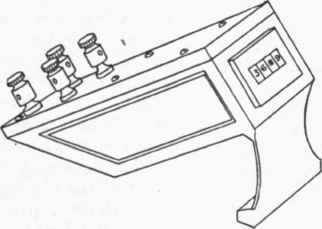
Fig. 15. - Electrical counter.
The message register is shown mounted in a specially designed support which places it conveniently for reading.
To guard against this possibility, advantage was taken of the construction of the message registers which allowed the connection of a second circuit. This second circuit was carried to a signal magnet and a Blix-Sandstrom kymograph. With each operation of the message register this separate circuit was also completed through the signal magnet. As the kymograph was uniform in its movement, any skip or extra count in the message register would at once be apparent in the spacing of the signal magnet tracings on the kymograph. The records show no such irregularities and the numbers read off the message registers are believed to be accurate for the revolutions of the pulley. The counter was read at the beginning and end of a period. From these records and from the circumference of the pulley and the length of the experimental period, computations could be made of the total distance traveled and the rate per minute.
Factors which have to be considered when comparing the metabolism of different individuals during horizontal walking include the weight moved and the distance traveled in unit time.
It has been shown1 that the energy expended during horizontal walking when calculated on a basis of kilogram weight and meter distance increases very slightly with the rate of walking up to a point of approximately 80 to 85 meters per minute. This point has been termed the "speed of maximum efficiency." At this point there appears to be a break in the curve and any increase in speed is done at a relatively greater cost in energy expended. Brezina and Kolmer2 have shown that within this optimum range of speed the metabolism per kilogram and meter distance is independent of the weight carried up to a load of 20 kg.
Continue to:


My Books

